


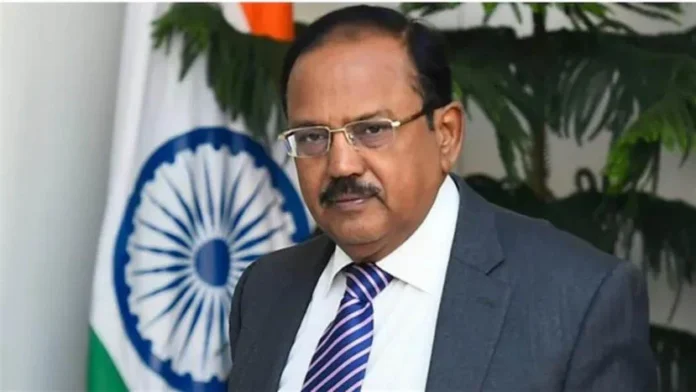
When NSA Ajit Doval invoked “zero tolerance” for terrorism at the 16th BRICS National Security Advisers’ Meeting in New Delhi, the phrase landed with the cadence of doctrine rather than diplomacy. India has been using that formulation for decades—in UN forums, FATF consultations, bilateral summits and bilateral engagements concerning Pakistan.
The question worth asking, therefore, is not whether India’s counter-terrorism position has changed. It has not. The question is whether the New Delhi summit has changed the institutional environment in which that position can be made to matter.

The answer is: possibly, and, for the first time in a long while, plausibly.
The Platform Problem India Has Always Had
India’s counter-terrorism frustrations are structural, not merely rhetorical. For three decades, New Delhi has argued, with considerable justification, that the international community applies double standards to terrorist organisations. Such groups are often characterised as liberation movements or strategic assets when geopolitical convenience demands it, but when Western interests are directly threatened, they are suddenly reclassified as terrorist networks.
The problem, therefore, extends far beyond language or diplomatic formulation.
The Financial Action Task Force (FATF), for all its rigour regarding technical compliance, has been slow to hold state sponsors of terrorism to the same standards that it applies to their proxies. Similarly, the United Nations Security Council’s 1267 sanctions regime remains vulnerable to veto politics that have, at times, protected designated entities when permanent members have had strategic reasons to do so.

BRICS does not solve these problems. However, it does create something structurally different: a forum in which India holds agenda-setting influence over security discussions that simultaneously include China, Russia, Iran, Saudi Arabia and the United Arab Emirates.
No Western-led forum possesses this composition.

The G20 does not conduct operational counter-terrorism discussions. The Quad has no formal mandate for counter-terrorism cooperation. The Shanghai Cooperation Organisation (SCO) has often appeared constrained by a China-Russia strategic axis that has historically subordinated counter-terrorism cooperation to broader geopolitical considerations.
BRICS, with India in the chair, provides New Delhi with a relatively rare opportunity to shape counter-terrorism norms for a coalition that spans, across its eleven members, some of the world’s most consequential terrorist transit corridors, financing networks and radicalisation ecosystems.
Whether India can actually capitalise on this opportunity is, however, a different question altogether.
The New Delhi summit raised substantial doubts even as it clarified certain strategic possibilities.
Terrorism 5.0 and the Doctrine Gap
The summit’s most substantive contribution was its collective acknowledgement that terrorism has undergone a generational transformation.
The threat landscape discussed in New Delhi—AI-enabled radicalisation, deepfake propaganda, cryptocurrency financing, dark web operational planning and drone-based attack vectors—is qualitatively different from the threat India confronted in Kashmir during the 1990s or in Mumbai in 2008.
Security establishments across BRICS acknowledged, at least rhetorically, that physical border management and the kinetic disruption of training camps remain necessary, but are no longer sufficient responses.
Terrorism 5.0 and the Doctrine Gap
The summit’s most substantive contribution was its collective acknowledgement that terrorism has undergone a generational transformation.
The threat landscape discussed in New Delhi—AI-enabled radicalisation, deepfake propaganda, cryptocurrency financing, dark web operational planning and drone-based attack vectors—is qualitatively different from the threat India confronted in Kashmir during the 1990s or in Mumbai in 2008.
Security establishments across BRICS acknowledged, at least rhetorically, that physical border management and the kinetic disruption of training camps remain necessary, but are no longer sufficient responses.
The summit was not a breakthrough; it was an opening
For India specifically, this framing carries both opportunity and obligation.
The opportunity is institutional. By leading discussions on what might be termed “Terrorism 5.0” within BRICS, India can advocate the creation of a shared cyber-terrorism task force, a joint terrorist-financing monitoring mechanism linking financial intelligence units across member states, and eventually a BRICS counter-terrorism fusion centre with real-time watchlist integration.
These objectives are architecturally achievable.
The Financial Action Task Force’s work on cryptocurrency tracing and trade-based terrorist financing already provides methodological frameworks. India’s own Financial Intelligence Unit (FIU) possesses the technical capability to anchor such cooperation.
India’s Institutional Readiness
The obligation, however, is considerably more demanding.
If India intends to lead a credible BRICS counter-terrorism architecture, it must demonstrate a level of domestic institutional readiness that matches its multilateral ambitions.
India’s counter-terrorism ecosystem—spanning the National Investigation Agency (NIA), Intelligence Bureau (IB), Research and Analysis Wing (RAW), NATGRID and state police forces—continues to exhibit structural fragmentation. This limits the effectiveness of real-time intelligence fusion, even within India’s own federal framework.
Advocating cross-border intelligence integration among eleven countries with competing strategic interests becomes considerably more persuasive if India can first demonstrate that it has addressed the integration challenge within its own domestic architecture.
The challenge is therefore not merely diplomatic. It is also institutional.
India’s ability to shape a future BRICS counter-terrorism architecture will depend not only upon its strategic vision, but also upon the degree to which it can demonstrate the operational effectiveness of its own counter-terrorism ecosystem.
Architecture Versus Ambition
This distinction between ambition and institutional capability is critical.
Building a multilateral counter-terrorism architecture requires more than political declarations or summit communiqués. It requires interoperable institutions, trusted information-sharing mechanisms, agreed technical standards and sustained agency-to-agency cooperation.
The New Delhi summit demonstrated that BRICS members increasingly recognise the evolving nature of contemporary terrorism.
Terrorism 5.0 demands new responses to AI-enabled radicalisation, cryptocurrency financing and cyber-enabled extremism
Whether that recognition can be translated into operational architecture remains the central question.
The Definitional Battleground
The summit’s most uncomfortable moment was also its most analytically revealing.
Iran’s representative used the plenary session to demand that BRICS condemn what Tehran characterised as “state terrorism” by the United States and Israel, while simultaneously accusing the United Arab Emirates, a fellow BRICS member, of complicity in military strikes against Iranian infrastructure. The UAE delegation rejected both the characterisation and the allegations. India, chairing the session, made no public intervention.
This episode is not a diplomatic footnote. It is the central challenge of BRICS counter-terrorism cooperation made visible.
The organisation now includes member states that actively disagree about what terrorism is, who practises it and which actors deserve international sanction.
China has historically blocked the UN designation of Pakistan-based terrorist entities. Russia has protected Syrian-linked networks when its strategic interests have required it. Iran’s presence within BRICS makes any near-term consensus on state sponsorship of terrorism structurally unachievable, at least in the immediate future.
India’s zero-tolerance doctrine, which rejects any distinction between “good” and “bad” militants and has for decades advocated accountability for state sponsors of terrorism, remains in direct tension with the political preferences of several BRICS members.
Ajit Doval can articulate the principle with authority. Converting that principle into an operational BRICS consensus is an entirely different challenge.
From Rhetoric to Architecture
The realistic near-term scope of BRICS counter-terrorism cooperation is therefore narrower than the summit’s rhetoric may have suggested.
India’s challenge is not articulating zero tolerance, but translating it into operational architecture
Shared frameworks for AI-enabled extremist content detection, coordinated monitoring of cryptocurrency channels used by non-state actors, joint cyber incident response protocols and capacity-building initiatives for member states with weaker forensic infrastructure remain achievable precisely because they do not require member states to agree on who the terrorists are. They require agreement only on how the tools used by terrorists should be identified, monitored and disrupted.
What India Should Do with This Moment
India’s strategic interest lies in institutionalising the BRICS counter-terrorism agenda before the chairmanship rotates.
Three priorities deserve particular attention.
First, India should advocate the formalisation of the BRICS Joint Working Groups on Counter-Terrorism into more permanent, professionally staffed mechanisms with clearly defined information-sharing protocols. Such structures should evolve beyond review bodies and develop into operational nodes capable of functioning in real-world scenarios.
The distinction is important.
Review bodies produce communiqués.
Operational nodes produce arrests, financial freezes and network disruptions.
Second, India should anchor a BRICS Terrorist Financing Intelligence Network around its existing Financial Intelligence Unit infrastructure, inviting member states to integrate around a common technical architecture for cryptocurrency tracing and hawala monitoring.
This approach is less politically sensitive than intelligence fusion involving human networks and directly addresses one of the most significant operational gaps in contemporary counter-terrorism: the movement of funds across jurisdictions that individually lack the technical capacity to track them.
Rhetorical consensus produces communiqués; operational cooperation disrupts terrorist networks
Third, and perhaps most importantly, India should resist the temptation to regard the summit’s zero-tolerance language as a diplomatic victory in itself.
Rhetorical consensus at the National Security Adviser level has been achieved repeatedly across multiple international forums over the past two decades.
What has remained elusive is operational follow-through: the quiet, technical and agency-to-agency cooperation that actually disrupts terrorist networks.
An Opening, Not a Breakthrough
The New Delhi summit created conditions in which such cooperation appears more institutionally plausible than before.
Whether India’s security establishment can convert those conditions into durable institutional architecture is the real test of whether this summit will ultimately matter.
The 16th BRICS NSA Meeting was not a breakthrough. It was an opening. The difference between the two will depend entirely on what India builds through it.

The writer is an expert on geopolitics, national security, and counter-terrorism; and he regularly contributes his subject thought-leadership and academic commentary with several publications in newspapers, journals, and periodicals. He works with investigative agencies, regulatory bodies, financial institutions and enterprises, providing strategic and regulatory advisory. The views expressed are personal and do not necessarily carry the views of Raksha Anirveda





