


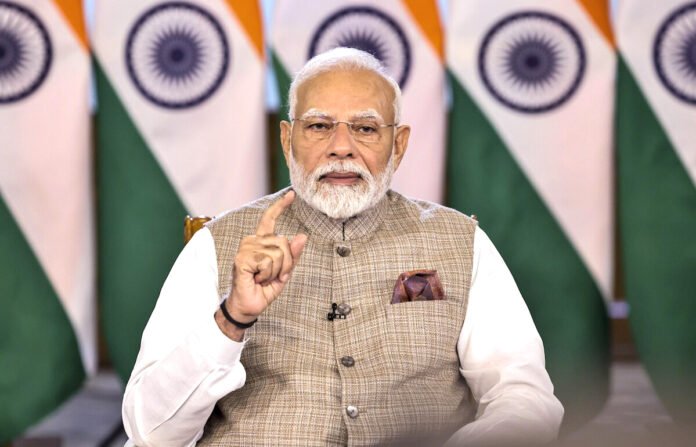
The national security landscape of India between 2014 and 2026 under Prime Minister Narendra Modi represents a fundamental shift from strategic restraint to assertive deterrence. Marketed under the rubric of Surakshit Bharat (Secure India), this 12-year tenure has repositioned India’s defence posture by linking national security directly to economic sovereignty and domestic manufacturing. This period was defined by sharp geopolitical pivots, structural military reforms, and acute crises — most notably the management of covert and overt cross-border threats, colloquially referenced in strategic circles alongside operational counter-measures like Operation Sindoor —alongside an unprecedented drive for defence self-reliance (Aatmanirbharta).
A critical commentary on these 12 years reveals a complex balancing act: while India successfully modernised its arsenal and expanded domestic defence production, it simultaneously faced persistent structural bottlenecks, theatre-level vulnerabilities, and the challenge of managing a dual-front threat from China and Pakistan.

The Doctrine of Assertive Deterrence
The foundational pillars of the Surakshit Bharat framework were built on the rejection of strategic ambiguity. Before 2014, India’s response to cross-border terrorism was largely diplomatic and defensive. The Modi administration altered this paradigm by establishing a new baseline for kinetic retaliation, demonstrated by the 2016 surgical strikes and the 2019 Balakot airstrikes. This doctrine aimed to penalise adversaries for proxy warfare by shifting the costs directly onto them.
In sub-conventional and covert domains, the administration demonstrated an increased appetite for risk. Operations aimed at neutralising deep-seated espionage, cyber warfare networks, and cross-border infiltration — frequently intersecting with high-stakes intelligence manoeuvres like Operation Sindoor — illustrated a paradigm where defence was no longer restricted to the borders. Instead, proactive intelligence-led operations became central to domestic stability.
Before 2014, India’s response to cross-border terrorism was diplomatic and defensive. The Modi administration altered this paradigm by establishing a new baseline for kinetic retaliation, demonstrated by the 2016 surgical strikes and the 2019 Balakot airstrikes. This doctrine aimed to penalise adversaries for proxy warfare by shifting the costs directly onto them
However, this assertive posture altered India’s risk matrix. While it successfully boosted domestic morale and established a domestic narrative of an iron-clad state, it also locked India into a cycle of heightened vigilance, demanding continuous high-intensity resource allocation along the Line of Control (LoC) and the Line of Actual Control (LAC).
The Push for Aatmanirbharta and Defence Production
The most tangible shift in India’s defence architecture over these 12 years has been the aggressive push for domestic defence production. Historically, one of the world’s largest importers of military hardware, India made efforts to reduce this dependency systematically. The Ministry of Defence introduced consecutive Positive Indigenisation Lists, banning the import of hundreds of military items, ranging from simple ammunition to complex missile systems and light combat helicopters.

By 2025–2026, the dividends of these policies manifested in record-breaking domestic defence production figures and a historic surge in defence exports, which crossed the ₹21,000 crore mark. The corporatisation of the archaic Ordnance Factory Board (OFB) into seven distinct public sector undertakings (DPSUs) unlocked manufacturing efficiencies that had stagnated for decades.
Furthermore, the private sector — led by domestic industrial giants and an emerging ecosystem of defence startups funded through initiatives like iDEX (Innovations for Defence Excellence) — became a core driver of innovation. India’s defence industrial base successfully scaled up the production of the Tejas Light Combat Aircraft (LCA), advanced towed artillery gun systems (ATAGS), and an array of indigenous drones and loitering munitions.

Critically, however, this transition revealed a structural friction point: the gap between policy intent and technological maturity. While the production numbers are impressive, a significant portion of ‘indigenous’ platforms still relies heavily on imported sub-systems, such as foreign-sourced engines, advanced sensors, and semiconductor chips. True self-reliance remains constrained by India’s foundational deficits in core industrial R&D.
India’s defence production numbers are impressive, but a significant portion of ‘indigenous’ platforms still relies heavily on imported sub-systems, such as engines, advanced sensors, and semiconductor chips. True self-reliance remains constrained by India’s foundational deficits in core industrial R&D
Expansion of the Strategic and Conventional Arsenal
To sustain a credible two-front deterrence, the administration oversaw a major expansion of India’s conventional and strategic arsenal. The crown jewel of this modernisation has been the consolidation of India’s nuclear triad. The commissioning of indigenous nuclear-powered ballistic missile submarines (SSBNs) like the INS Arihant and INS Arighat, alongside the successful testing of the Agni-V missile with Multiple Independently Targetable Re-entry Vehicle (MIRV) technology, firmly established India’s second-strike capability.
On the conventional front, the induction of 4.5-generation Rafale fighter jets provided the Indian Air Force with immediate tactical superiority in beyond-visual-range combat. Concurrently, the Indian Navy aggressively pursued its blue-water ambitions, commissioning the indigenous aircraft carrier INS Vikrant and expanding its stealth destroyer and submarine fleets to counter Chinese maritime expansionism in the Indian Ocean Region (IOR).
Yet, the critical critique of this arsenal expansion lies in its uneven distribution. The heavy capital expenditure required for strategic naval and air platforms frequently starved the army’s infantry modernisation plans. The slow procurement of basic equipment, such as modern assault rifles, body armour, and secure communication networks for the standard soldier, highlighted a persistent imbalance between high-tech deterrence and basic operational readiness.
The 12 years of Surakshit Bharat will be remembered for driving the most sweeping structural reforms in the history of the Indian Armed Forces. The creation of the post of Chief of Defence Staff (CDS) in late 2019 resolved a decades-old civil-military logjam, providing single-point military advice to the political executive
Structural Reforms and Theatrisation
The 12 years of Surakshit Bharat will also be remembered for driving the most sweeping structural reforms in the history of the Indian Armed Forces. The creation of the post of Chief of Defence Staff (CDS) in late 2019 resolved a decades-old civil-military logjam, providing single-point military advice to the political executive. This structural evolution was designed to dismantle the operational silos of the Army, Navy, and Air Force, paving the way for integrated theatre commands.
In tandem with structural integration, the government introduced the Agnipath scheme for human resource rationalisation. Designed to reduce the ballooning defence pension budget — which threatened to consume resources vital for capital modernisation — the scheme shifted recruitment to short-term, four-year tenures for soldiers (Agniveers).
While fiscally pragmatic, the Agnipath scheme drew sharp criticism from military veterans and strategic analysts. Critics argued that short-term tenures could compromise the operational cohesion, regimental ethos, and technical proficiency required to operate complex modern weaponry. Similarly, the transition to integrated theatre commands faced bureaucratic resistance and conceptual disagreements among the services regarding the control of air assets, delaying its full operationalisation.
A critical assessment of the Surakshit Bharat era must account for the geopolitical realities. The 2020 Galwan Valley clash and the subsequent protracted standoff along the LAC shattered the long-standing diplomatic equilibrium with China. This forced a massive reorientation of Indian military assets from the western border with Pakistan to the northern border with China
The Looming Himalayan Challenge
Any critical assessment of the Surakshit Bharat era must account for the geopolitical reality along the northern border. The 2020 Galwan Valley clash and the subsequent protracted standoff along the LAC in Eastern Ladakh shattered the long-standing diplomatic equilibrium with China. This forced a massive, permanent reorientation of Indian military assets from the western border with Pakistan to the northern border with China.
The administration responded with an unprecedented infrastructure blitz, constructing all-weather tunnels, strategic roads, and high-altitude advanced landing grounds along the LAC. While this significantly narrowed the logistical gap with China’s People’s Liberation Army (PLA), it also underscored an uncomfortable reality: despite 12 years of modernisation, India remains locked in an asymmetric attritional standoff with a technologically superior adversary. China’s rapid advances in cyber warfare, counter-space capabilities, and artificial intelligence present an evolving technological challenge that India’s defence ecosystem is still scrambling to match.
Conclusion
The 12-year arc of Surakshit Bharat under Prime Minister Modi has successfully redefined India’s national security parameters. It transformed India from a passive recipient of geopolitical shocks into a proactive actor willing to project power, reform its military hierarchy, and aggressively build a domestic defence industry. The achievements in indigenisation, missile technology, and strategic deterrence are historic milestones.
However, the critical vulnerabilities of this period cannot be overlooked. The armed forces remain caught between the financial imperatives of a developing economy and the astronomical costs of modern warfare. The structural anxieties surrounding the Agnipath scheme, the slow pace of full theatrisation, and the technological dependencies inherent in local manufacturing remain unresolved challenges. Ultimately, these 12 years have built a sturdier, more self-reliant foundation for India’s defence, but the transition from a regionally secure nation to a globally dominant, fully indigenised military power remains an unfinished project.

–The writer is Assistant Professor, ICFAI School of Liberal Arts, ICFAI University, Jaipur. The views expressed are of the writer and do not necessarily reflect the views of Raksha Anirveda





