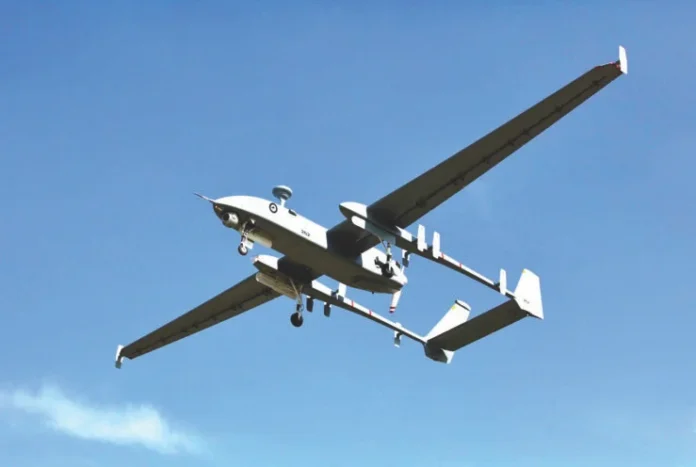
New Delhi: With the continuing standoff along the Sino-Indian border for almost five months, India has decided in favour of the weaponised MQ-9B Sky Guardian drone from the US and to upgrade its existing Israeli Heron fleet with satellite communication capability in an attempt to enhance its range as well as surveillance capabilities.

The face-off between the Indian Army and People’s Liberation Army (PLA) has spurred the Indian private sector and the Defence Research and Development Organisation (DRDO) to start manufacturing short-range tactical drones as well as anti-drone systems to boost border defences.
The three services have come to a conclusion that India should opt for a weaponised drone rather than the 22 reconnaissance and surveillance Sea Guardian drones approved in 2017 by the US administration for supply to India, according to highly placed sources.
The MQ-9B, manufactured by General Atomics, has a 40-hour endurance with a maximum altitude of 40,000 feet and payload or weapon carrying capacity of over 2.5 tonne, including air-to-surface missiles and laser-guided bombs. “We are in negotiations with the Trump administration, which is willing to provide India with the latest armed drone technology. In this, it is the prohibitive cost of the system that is a hurdle, not the Trump administration,” said an official.
Besides, India has asked Israel to upgrade its existing Heron medium-altitude, long-endurance surveillance drone by upgrading its communication links. Presently, due to lack of a satellite link in the Heron, two such unmanned aerial drones have to be flown in tandem with a time gap so that information is relayed back to base through the second drone in case of long-range surveillance.

The upgrade involves fitting the Heron drone with a satellite package so that the unmanned aerial vehicle (UAV) links with the satellite above and information is sent on a real-time basis. The upgrade will allow the Heron to conduct long-range surveillance without the fear of losing contact with the base or go into no contact zone. The Heron upgrade programme was approved by the defence ministry last month.
The drone revolution in the Indian military has come after it was felt that India had no answer to Chinese armed drone and surveillance drone capabilities, with the PLA deploying the unmanned devices in significant capacities in the Ladakh theatre apart from sensors and surveillance cameras that provide advance warning on moves by the adversary.