


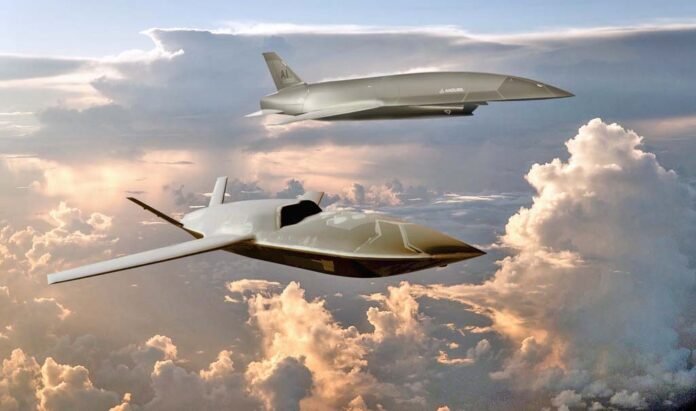
The aircraft are part of the Collaborative Combat Aircraft (CCA) programme, which is intended to pair semi-autonomous jets with crewed fighters. The Air Force awarded both companies engineering, manufacturing and production contracts for the programme’s first increment on June 17, 2026 – four months ahead of schedule. The awards cover the first three production lots, though officials have not disclosed how many aircraft each company will build or the contracts’ value.
General Atomics’ aircraft, the FQ-42A, is based on its YFQ-42A prototype; Anduril’s FQ-44A Fury follows its YFQ-44A. The designation’s “F” identifies a fighter, while “Q” marks it as uncrewed. Both prototypes have moved from ground and flight testing toward production, but the aircraft will continue to be evaluated as the service develops the programme.

Rather than choose a single supplier, the Air Force selected both firms. The approach gives the service two aircraft designs and keeps competition between manufacturers as it works toward the target of at least 150 aircraft by the end of the decade. In the longer term, the Air Force has discussed a fleet of roughly 1,000 CCAs to complement aircraft such as the F-35, F-22 and future F-47.
The service envisions CCAs flying alongside crewed jets to extend their reach and add capacity in contested airspace. Depending on their equipment and software, the aircraft could support strike missions, reconnaissance, electronic warfare or jamming. The first increment is expected to have a combat radius of at least 700 nautical miles. These are programme goals, not evidence that the aircraft have already demonstrated every planned operational capability.
The Air Force is separating the aircraft from the autonomy software that will help operate them. It selected Anduril, Shield AI and Collins Aerospace to compete in the next phase of the mission-software effort, with a primary provider expected to be chosen in 2027. The service says this “software sold separately” strategy is intended to let it update software independently of the airframes and preserve competition among providers.
Cost and production pace remain central challenges. The Air Force has said it wants each CCA to cost less than about $30 million-roughly one-third the cost of an F-35-while producing aircraft quickly enough to build a larger force. Officials have said the programme is meeting or exceeding that cost goal, but have not released contract prices or quantities by production lot.

Funding could affect how quickly the plans translate into aircraft. In September, Air Force acquisition executive Brig Gen Timothy Helfrich said production required a new budget. A temporary funding measure extended appropriations at 2026 levels through December, while the fiscal 2027 budget remained unresolved. Under that continuing resolution, new programmes such as CCA production could face limits. Anduril said it had bought parts and prepared production assets in advance; General Atomics said it was self-funding some early aircraft to maintain momentum.
The June awards mark a major step from prototypes to manufacturing, but they do not mean the aircraft are already operational. The service must still fund the programme, complete testing and refine how pilots will work with uncrewed aircraft. Its plan combines a growing fleet of lower-cost aircraft with human oversight and adaptable software. Whether the programme can deliver that scale on schedule will depend not only on the manufacturers, but also on budget decisions and the Air Force’s ability to turn the new aircraft into a deployable capability.







