


Against the spiritual landscape of Varanasi, where the eternal flow of the Ganges meets centuries of Indian heritage, the skies of Kashi transformed into a high-octane theatre of modern military might. The three-day mega event, ‘Wings over Ganges’, concluded on October 25, 2026, marking a spectacular commemoration of the Indian Air Force’s 94th anniversary.
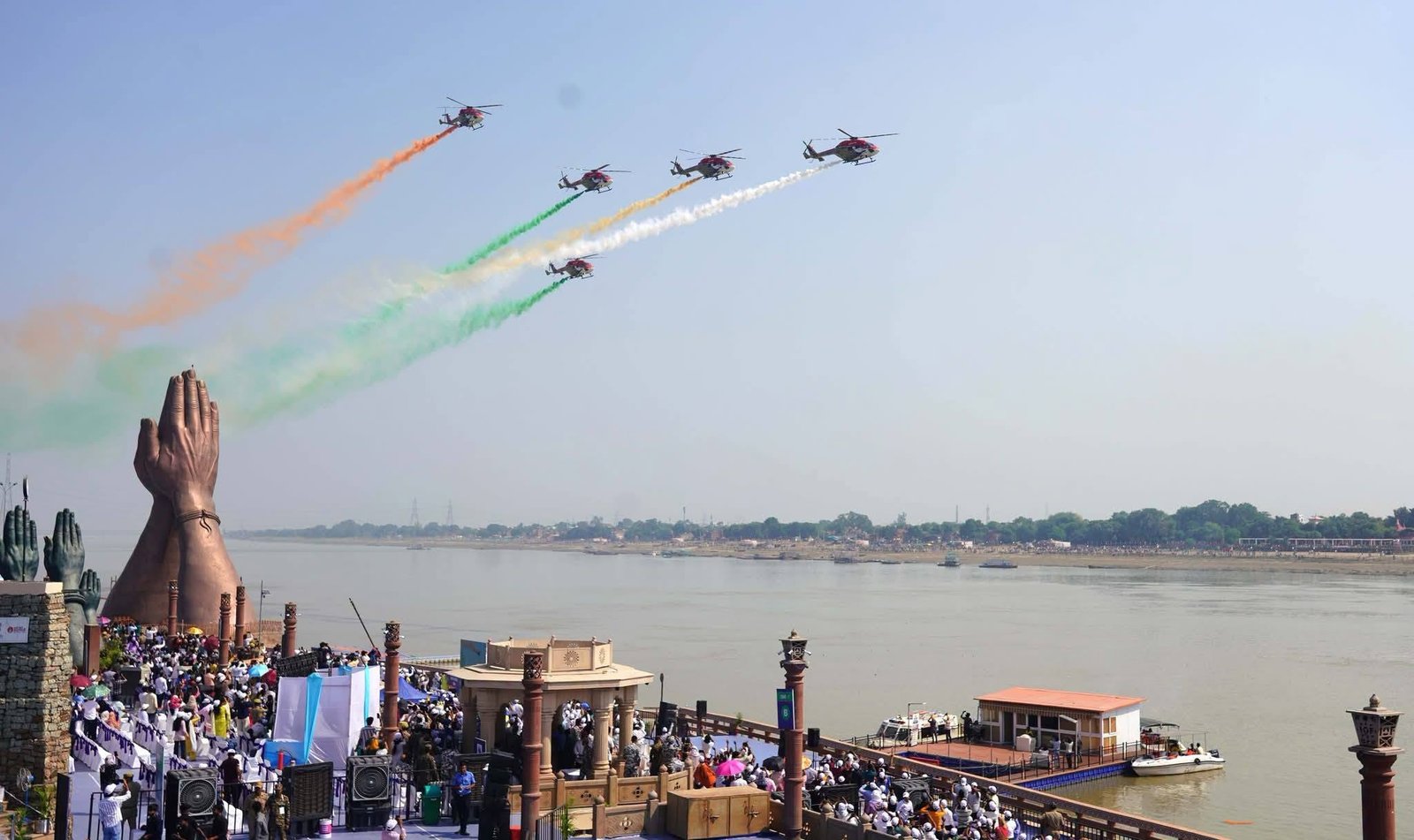
Watching from Namo Ghat, Prime Minister Narendra Modi — joined by Defence Minister Rajnath Singh and Uttar Pradesh Chief Minister Yogi Adityanath — soaked in a masterclass of precision flying. The backdrop was deeply symbolic: the roar of high-performance fighter jets cutting through the peaceful morning air of the Prime Minister’s parliamentary constituency, bridging ancient civilisational roots with cutting-edge defence technology.

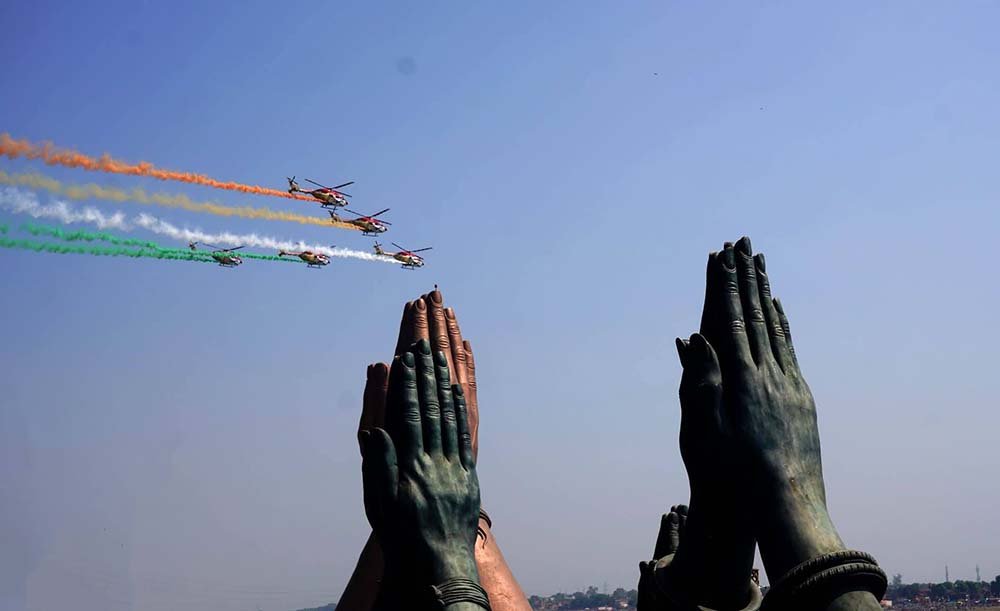
The legendary Surya Kiran aerobatic team and the Sarang helicopter display team pushed their airframes to the absolute limit, executing mirror-images and cross-overs that drew thunderous applause
The Highlights: A Masterclass in Aerial Choreography
The air show was a carefully choreographed demonstration of speed, agility, and technical competence. For over an hour, the IAF’s premier display teams enthralled hundreds of thousands of spectators lined along the sacred riverbanks.
- The Kashi Formation: The emotional high point featured three Kiran aircraft flying in a tight ‘V’ formation, blanketing the sky in the vibrant saffron, white, and green of the national Tricolour.
- The Omkar Formation: Heavy-lift Mi-17 helicopters gracefully traversed the river corridor, carrying the national flag aloft in a nod to the city’s profound spiritual identity.
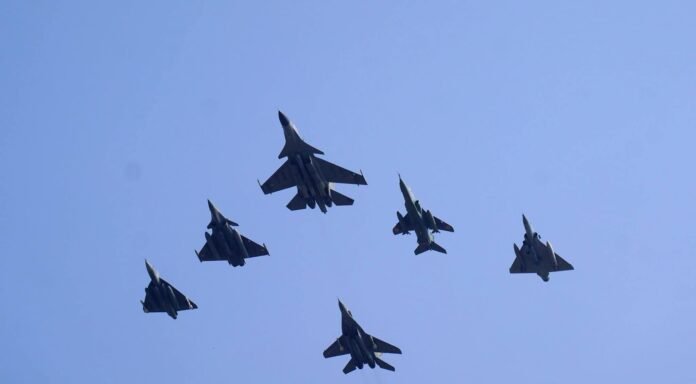
- The Kinetic Roar: The frontline fighter fleet — comprising the multi-role Rafale, the swing-role Mirage 2000, the agile MiG-29, the veteran Jaguar, and the air superiority Sukhoi-30 MKI — executed dizzying vertical Charlies and loops directly over the water.
- Indigenous Pride: The home-grown LCA Tejas and the Light Combat Helicopter (LCH) Prachand demonstrated their unique manoeuvrability, proving India’s growing domestic aerospace design footprint.
- Aerobatic Excellence: The legendary Surya Kiran aerobatic team and the Sarang helicopter display team pushed their airframes to the absolute limit, executing mirror-images and cross-overs that drew thunderous applause.
When pressed by reporters to isolate which specific formation or aircraft delivered the finest performance over the Ganges, the Air Chief responded with classic paternal wit: “All of them. You try asking a father, which of your children is the best?”
The IAF Chief’s Ground Reality: Fatherly Pride and Tactical Wit
While the pilots stole the show in the air, Chief of the Air Staff, Air Chief Marshal Amar Preet Singh, dominated the discourse on the ground. When pressed by reporters to isolate which specific formation or aircraft delivered the finest performance over the Ganges, the Air Chief responded with classic paternal wit: “All of them. You try asking a father, which of your children is the best?”
Beneath this lighthearted, media-friendly response lay a profound statement of leadership. By refusing to elevate the imported Rafale over the indigenous Tejas, or the fighter fleet over the utility transport helicopters, the IAF Chief sent a strong signal of institutional cohesion. His words highlighted that modern air campaigns are not won by isolated silver-bullet platforms, but by the seamless interaction of an entire integrated aerial ecosystem.
Structural Analysis: Showcasing Strengths and Weaknesses
THE VARANASI AVIATION AUDIT: A DOUBLE-EDGED SWORD

| Operational Strengths | Flawless precision flying under complex riverine conditions
Growing showcase of indigenous platforms (Tejas, Prachand)  Exceptional maintenance & high operational availability |
| Structural Weaknesses | Critical squadron depletion (down to ~31 vs authorized 42)
Heavy reliance on legacy trainer airframes (Kiran series) Fragmented logistics chains due to diverse global imports |
The Varanasi display was a brilliant exhibition of the IAF’s undeniable strengths. Executing high-speed manoeuvres in the dense, low-altitude air over a major river corridor requires exceptional pilot skill and superb maintenance support. The flawless integration of diverse assets — ranging from Russian-origin Sukhois to French Rafales and British legacy Jaguars — showcased the force’s mastery over complex, heterogeneous fleet logistics. Furthermore, the prominent roles played by the LCA Tejas and the LCH Prachand underscored that India’s push for Aatmanirbharta (self-reliance) is steadily yielding combat-ready results.
Operating five fighter jet types creates challenges in logistics, component stocking, and specialised engineering training. This diversity shows a deeper crisis: the steady depletion of the IAF’s fighter squadrons, which currently hover around 31 against a sanctioned requirement of 42
However, a critical defence analysis reveals systemic weaknesses that the public spectacle could not entirely hide. The ‘Kashi Formation’, while visually stunning, relied on the ageing Kiran aircraft — a platform that has long outlived its intended operational cycle and highlights India’s chronic delays in scaling up intermediate jet trainer replacements. More pressingly, the diverse line-up of fighter jets serves as a reminder of the IAF’s fragmented supply chain. Operating five distinct fighter types simultaneously creates massive challenges in logistics, component stocking, and specialised engineering training. This diversity is a symptom of a deeper crisis: the steady depletion of the IAF’s fighter squadrons, which currently hover around 31 against a sanctioned requirement of 42 to counter a two-front threat.
The Crux: Theatre Commands and the Flexibility of Air Power
The true significance of the Air Chief’s remarks emerged during his major public briefing on the sidelines of the event, where he directly addressed India’s most ambitious defence reforms since Independence: the creation of Integrated Theatre Commands.
Air Chief Marshal AP Singh offered a clear, uncompromised view on this transformation. He firmly said the IAF does not view theatrisation as an exercise to “permanently divide fighter assets geographically.” The Air Chief argued against blindly copying foreign structures, urging instead for a customised model tailored specifically to India’s unique borders and security challenges.
The IAF does not view the creation of Integrated Theatre Commands as an exercise to “permanently divide fighter assets geographically,” the Air Chief said, arguing against blindly copying foreign structures
The Air Chief’s argument hinges on the core nature of air power: speed, reach, and extreme flexibility. In a vast country facing threats on multiple fronts, permanently assigning scarce fighter squadrons to fixed geographical commands (such as a separate Northern or Western Theatre) would tie down crucial assets and limit the military’s options. Instead, the Air Chief advocated for a philosophy of “centralised control where necessary, and decentralised execution where appropriate.”
To support his point, he cited the success of Operation Sindoor, a recent joint operation carried out under a unified structure set up by the Chief of Defence Staff and the three service chiefs. During that operation, the centralised control and rapid redirection of critical aerial assets across sectors proved decisive. Future conflicts, the Air Chief warned, will be highly integrated and multi-domain by design. While the IAF remains fully committed to jointness and integration, the process must be done in clear phases so that India’s frontline operational readiness is never compromised in the rush to reorganise.
Ultimately, the Varanasi air show was far more than a public relations triumph or a weekend festival along the Ganges. It served as a clear message to the political leadership watching from the ghats: the Indian Air Force possesses the skill and precision to protect the nation’s skies, but its ultimate power lies in its ability to adapt and strike quickly. True jointness will not be achieved by splitting squadrons up on a map, but by building a unified, uniquely Indian defence structure that allows the inherent flexibility of air power to be deployed wherever the nation needs it most.

–The writer is Assistant Professor, ICFAI School of Liberal Arts, ICFAI University, Jaipur. The views expressed are of the writer and do not necessarily reflect the views of Raksha Anirveda





