


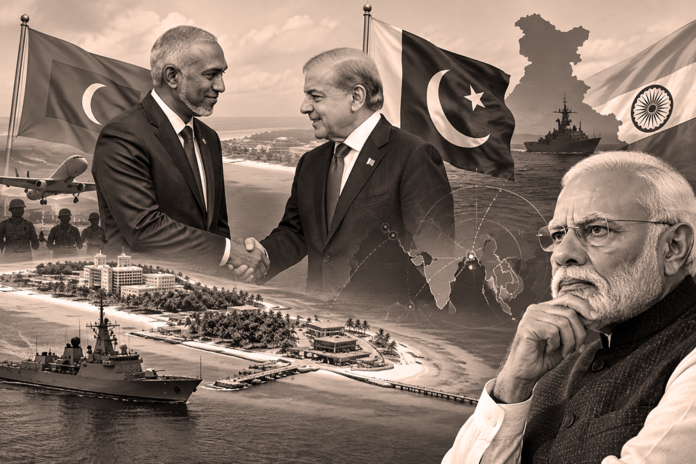
Last week, Mohamed Muizzu visited Pakistan, first by a Maldivian President in 11 years. During the visit he signed 20 agreements spanning defence, maritime security, cybersecurity, AI and intelligence sharing, triggering concern in New Delhi.
While the Maldivian President termed signing of these agreements as an opportunity to establish a new era of cooperation, his office confirmed that defence and security, training and capacity-building were among the priorities discussed between the two countries.

Muizzu’s Anti-India Inclinations
This signals deepening of engagement between Maldives and Pakistan. But what has shocked New Delhi is Islamist-leaning Muizzu’s re-launch of anti-India strategy. Lying just 70 nautical miles away from India’s western coast, Male in January 2024 allowed a Chinese research vessel, Xiang Yang Hong 03 to enter the Maldivian waters.
Earlier, the Muizzu government signed defence agreements and infrastructure deals and Free Trade Agreement (FTA) with China. Despite such moves, India prioritised diplomatic engagement with Maldives. In June 2024, Muizzu was invited to attend the swearing-in of the Narendra Modi government for the third term.
Maldives signed 20 agreements with Pakistan covering defence, maritime security, cybersecurity, AI and intelligence sharing during the first presidential visit in 11 years
Four months later, he made his first state visit to India and presided over signing of currency swap agreement between the Reserve Bank of India and the Maldives Monetary Authority of US$400 million and US$357 million In early 2024, India also offered a loan of over US$29 million to Maldives.
In the same year, India agreed to roll over a US$ 50 million loan to Maldives after the Muizzu government made a special request to secure budgetary support from New Delhi. Then this year on August 27, India backed US$506.58 million line of credit to Maldives became effective.

In addition, India has extended financial assistance to the Maldives through investments in government securities. It subscribed to two long-term Treasury bonds worth US$250 million and US$100 million, respectively. Muizzu, who won the presidential election in Maldives on “India out” plank and demanded the complete removal of Indian military technical personnel from the island nation, secured such loans, swap deals and investments from New Delhi by tweaking his anti-India stances.
Muizzu’s Game in Indian Ocean
However, his aversion for India and his strong Islamic orientation did not disappear entirely. This came to the fore when he visited Pakistan. To the chagrin of New Delhi, the Maldivian President entered into a pact with Pakistan on intelligence sharing and closer defence cooperation – hinting clearly that Male with the help of Islamabad is seeking to draw anti-India plans in the Indian Ocean with aim to complicate the former’s security interest in the region.

Pakistan’s growing ties with Male amplify existing concerns over China’s naval presence and dual-use developments at Pakistan’s Gwadar Port
India is already concerned about China’s assistance to Pakistan in its naval modernisation by providing frigates, submarines, aircraft and unmanned assets. China has also assisted Pakistan in the development of Gwadar Port. Strategically located in the Arabian Sea, Gwadar Port provides China and Pakistan a potential vantage point for monitoring maritime traffic in the Indian Ocean.
Against this background, experts see Maldives-Pakistan defence cooperation as a source of concern for India, as there is a possibility that it would facilitate greater Pakistani access to the strategically located island nation. Since Maldives is located near key sea lanes in the Indian Ocean, closer security engagement with Pakistan could complicate India’s maritime surveillance and regional security calculations, especially if it involves intelligence exchanges regarding Indian naval movements.
In fact, for New Delhi concern emanates not merely from the expansion of bilateral relations between Maldives and Pakistan, but the possibility that such cooperation could gradually acquire a broader strategic and military dimension. If Islamabad uses its growing engagement with Male to expand its maritime intelligence network or establish a greater security presence in the central Indian Ocean, India could face additional challenges in protecting its maritime approaches and monitoring developments across the region.
Such concerns become more significant when viewed alongside China’s strategic partnership with Pakistan and its involvement in the development of Gwadar Port, which has dual-use significance for commercial and military activities.
Muizzu’s joint push with Pakistan to revive SAARC directly challenges India’s firm stance against diplomatic engagement while cross-border terrorism persists
Attempt to Belittle India
Nonetheless, beyond defence, what has triggered unease in India is Maldives going Bangladesh way in pitching for the revival of the SAARC. During the joint press conference with Pakistan Prime Minister Shehbaz Sharif, Muizzu said his country “firmly believes in the value of SAARC, and in the tremendous potential for our region to address shared challenges through collective action.”
The Maldivian President said this even after knowing the reason why since 2016, the regional gathering of seven countries could not take place.
When three months ago he told a gathering at a Maldivian Independence Day that differences ought to be settled by way of dialogue and the SAARC members must “return to the negotiating table in the interest of regional peace and cooperation,” New Delhi had categorically maintained that “everyone in South Asia is aware of which country and what activities are responsible for stymieing SAARC.”
To safeguard its maritime interests, New Delhi must pair diplomatic engagement with stronger regional defence partnerships to counter Male’s shift
New Delhi’s stand is that so long as Pakistan does not put an end to cross-border terrorism, it will not encourage revival of SAARC. After Pakistan-backed terrorists had carried out an attack on an Indian Army brigade headquarters in Uri in Jammu and Kashmir on September 18, 2016, India boycotted the 19th SAARC summit in Islamabad scheduled on November 9-10, 2016. Following this, Afghanistan, Bhutan, Bangladesh and Nepal also expressed their inability to attend the SAARC summit in Pakistan.
Since the ground situation remains the same with Pakistan continuing to back terrorism against India, New Delhi has refused to join any call for the restoration of the summit-level gathering of SAARC. India’s position is that the responsibility for SAARC’s revival lies with Pakistan and that member states must recognise that, unless Islamabad takes credible steps to curb terrorism, neither regional peace nor the revival of SAARC will be possible. Consequently, India is likely to continue its boycott of SAARC summit meetings.
To conclude, While Maldives is free to diversify its partnerships, any defence or intelligence cooperation that strengthens Pakistan’s presence in the Indian Ocean could undermine India’s maritime security. New Delhi must therefore balance diplomatic engagement and economic assistance with stronger maritime partnerships to safeguard its regional interests. SAARC’s revival and regional stability will remain elusive unless Pakistan takes credible steps to end cross-border terrorism.

The writer is a senior journalist with wide experience in covering international affairs. The views expressed are of the writer and do not necessarily reflect the views of Raksha Anirveda





