


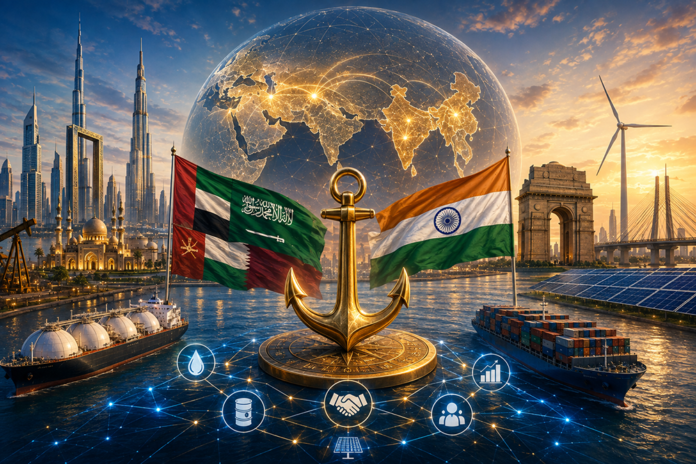
On August 15, 2026, as India celebrates the 80th Independence Day, it is important to assess its prominent presence on the global stage. Today, India and Indians are playing a vital role in all fields at the international arena, creating global recognition for Indian talent, skills and perseverance. India in 2026 has the largest demography, is the largest democracy, possesses significant military power and is one of the major economies in the world. It is fast modernising and expanding its infrastructure and making leaps in adopting technology in all fields. While domestic reforms and developments are a major component of India’s growth story, the expansion of external relations and foreign policy has also played a major role. India’s engagement with the world has grown exponentially, with multi-alignment continuing to guide Indian behaviour. While New Delhi has engaged a wide arena of global regions in recent years, its increasing partnerships in the Middle East have been notable.
For India, the Middle East is not a distant theatre—it is the extended neighbourhood where its economic and security interests converge
The Middle East, comprising the crucial Persian Gulf and Eastern Mediterranean regions, has emerged as one of the most important regions in Indian foreign policy in the twenty-first century. Many critical Indian interests are linked to the region, including energy security, maritime and coastal security, and the free and unimpeded access to international shipping routes in the Arabian Sea, the Red Sea and the Persian Gulf. Besides, the presence of nearly 10 million Indian expatriates in the Gulf region and the $35–40 billion in remittances they send back home annually is a significant factor in the India-Middle East partnership. Additionally, India’s growing trade, business and investment activities with the Gulf region make it one of the most important regions in India’s extended neighbourhood. Cooperation in counterterrorism, combating radicalism, and fighting organised crime and terror financing has emerged as a crucial component in Indo-Gulf relations.

Given the critical importance of the Middle East in India’s international relations, New Delhi has over the years invested significantly in cultivating political and diplomatic relations with major regional countries. India’s engagements with the region reflect the broad contours of Indian foreign policy, with multi-alignment being the guiding principle and India emphasising and abiding by the norm of non-intervention and respect for state sovereignty. As a result of this foreign policy approach, backed by strong domestic performance in economic, military and political spheres and the growing international recognition of India’s rise, the Middle Eastern countries too have shown extraordinary inclination to cultivate relations with India and strengthen partnerships in multiple fields.
The UAE has emerged as one of India’s closest partners, with multi-faceted ties spanning trade, investment, defence, and minilateral initiatives like I2U2 and IMEC
India’s relations with most regional countries have strengthened in recent years. The United Arab Emirates (UAE) has emerged as a close partner with multi-faceted growth in ties, and the two have become partners in many minilateral initiatives such as I2U2 (a grouping of India, Israel, the UAE, and the United States) and connectivity projects such as the India-Middle East-Europe Economic Corridor (IMEC). Moreover, the UAE today is a leading economic partner of India, with trade, business and investment ties growing by leaps and bounds. India and the UAE have also worked to improve defence and security relations. Israel is another regional country that has emerged as one of the closest partners of India. Political and diplomatic relations, trade and economic ties, and scientific and technological cooperation have added to bilateral relations based on traditionally strong defence and security cooperation.
Additionally, India has very strong bilateral relations with other regional countries, especially the members of the Gulf Cooperation Council (GCC). Saudi Arabia, given its regional importance, has emerged as one of the most important countries in India’s Middle East engagements. Indo-Saudi relations have grown in multiple domains, including people-to-people ties, cultural contacts, energy trade, and business and investment cooperation, creating the basis for significant engagements in defence and security as well as in new and emerging areas. India’s relations with other GCC countries, including Oman, Bahrain, Kuwait and Qatar, have also strengthened, based on robust trade and business ties, energy cooperation, people-to-people ties, and consistent political and diplomatic contacts. Efforts have also gone into improving defence and security cooperation with significant results.
India’s ties with Iran have been affected by extraneous factors, while relations with Türkiye remain strained due to Ankara’s alignment with Pakistan
India’s relations with Iran and Türkiye do face some challenges. With Iran, relations have been affected by extraneous factors, but New Delhi continues to engage with Tehran through established diplomatic and political channels. On the other hand, relations with Türkiye have been affected by India viewing the Türkiye-Pakistan axis as working to undermine India’s interests and security and stability. Notwithstanding, India has widened its horizons in the Middle East to expand relations with Egypt, Jordan, Iraq, Syria, Algeria and Morocco, with a focus on improving trade, business and investment cooperation, energy security, and partnerships in defence and security. Cultural linkages, diplomatic contacts and political ties have helped India expand its relations in the wider Middle East beyond the traditional focus on the Persian Gulf region.

Given the importance of the region, India has adopted a more regional approach, gradually moving away from bilateralism as the abiding principle. Despite this expanding regional approach, India has refrained from getting involved in regional conflicts, tensions, rivalries and geopolitical competition. The wars in the Gaza Strip and Iran, and internal turmoil in Yemen, though they have affected some of India’s interests and ambitions, have seen India adopt an approach of using diplomacy only to safeguard specific interests and not risking its broader engagements and interests that could be affected by the widening regional crisis. This multi-aligned and risk-averse Indian approach has served Indian interests well, and New Delhi is likely to continue pursuing this policy in the foreseeable future.
Despite expanding its regional engagement, New Delhi has consistently refrained from getting entangled in conflicts, rivalries, and geopolitical competitions
A case in point is the ongoing war in Iran, triggered by the US-Israeli attacks on the Persian Gulf country in February 2026. The attacks led to a war between the US-Israel and Iran and caused the blockade of the Strait of Hormuz. It resulted in serious hardships for international shipping passing through the strait, causing concerns over energy security, oil and gas prices, and the safety and security of seafarers. India too was significantly affected. India engaged with all sides to safeguard its interests and urged restraint and de-escalation but refrained from getting involved in trying to mediate or resolve the situation, as that could have proved counterproductive for Indian interests in the region. Nonetheless, the Indian approach has given rise to domestic and international debates on India’s choices, especially as Pakistan was involved in mediating and helped in signing the ceasefire agreement in June, though it soon unravelled.

However, going forward, India would do well to continue working on enhancing its comprehensive power by investing in hard power capabilities and soft power appeal. This will go a long way in expanding India’s global footprint and strengthening partnerships in the Middle East. In the eight decades since independence, India has expanded its external relations significantly, and the Middle East has emerged as a vital region in India’s global engagements. As India’s global aspirations and ambitions rise further, backed by domestic growth and development, India can further rise as a major global power and continue to expand its partnerships in the Middle East. With a concentrated approach, there are no limits to India’s arrival as a power on the global stage.
The author is an Associate Professor of Middle East Studies at Jawaharlal Nehru University, New Delhi. The views expressed are personal and do not necessarily reflect the views of Raksha Anirveda





