


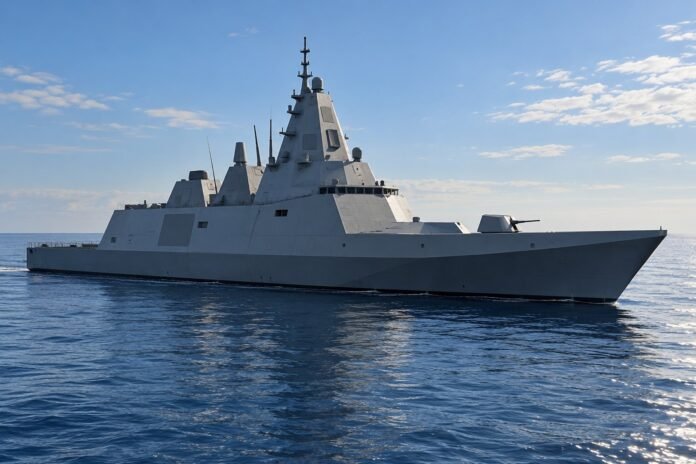
New Delhi. India’s Defence Acquisition Council (DAC) has given in-principle approval to Project 18A, a programme to develop next-generation stealth guided-missile destroyers for the Indian Navy, according to reports. The decision advances a long-planned design effort, but it is not a construction contract: bidding, final specifications and procurement approvals remain ahead.
The proposed ships are expected to be larger and more heavily armed than the Navy’s current Visakhapatnam-class destroyers. A report put their displacement at more than 10,000 tonnes, compared with about 7,400 tonnes for the existing class, and estimated the programme could cost upwards of ₹75,000 crore. Those figures remain reported estimates, not confirmed final specifications or an approved project cost.

The Navy’s Warship Design Bureau is expected to lead the design. Competitive bidding for construction is anticipated, though shipyards have not yet been selected. The reported delivery window – 5 to 10 years after a contract is signed-underlines how far the project remains from producing operational ships.
The plan is part of the government’s response to growing maritime threats, with the vessels being placed as future frontline combatants. So far, details about the final weapons fit, sensor suite, propulsion system or ship count have not been made public.
The programme would build on a domestic warship effort already visible in the Navy’s frontline fleet. In October 2023, the Defence Ministry said Mazagon Dock Shipbuilders had delivered INS Imphal, a Project 15B guided-missile destroyer built with indigenous steel. The ministry highlighted its BrahMos missiles, Barak-8 air-defence missiles and anti-submarine sensors and weapons, an illustration of the multiple roles current Indian destroyers are designed to perform.
A next-generation ship could expand those capabilities, but size alone does not guarantee combat effectiveness. Its value will depend on how well weapons, radars, communications, electronic warfare, aviation and anti-submarine systems work together-and on the Navy’s ability to maintain the vessels and train crews over decades. The project’s eventual industrial footprint will likewise depend on the final design, procurement choices and the capacity of Indian shipyards and suppliers.

The strategic context is broader than any single vessel. India’s long coastline and reliance on maritime trade make the security of sea routes a national concern. Analysts have pointed to a busier Indian Ocean, China’s expanding naval activity and the risks posed by submarines, long-range missiles and attacks on shipping. These factors help explain the Navy’s interest in ships able to defend a task force, track threats and operate at distance, though the specific operational requirements for Project 18A have not been publicly detailed.
The destroyer proposal also fits into a wider fleet-modernisation push. The Navy has commissioned new domestically built combatants in recent years, while other programmes seek to increase the number of ships under construction and improve local industrial capacity. A 2023 Defence Ministry account of INS Imphal’s delivery underscored the progress of Indian shipbuilding, while also showing the complexity involved in integrating weapons and sensors into a modern warship.

For now, Project 18A is a policy and design milestone, not an imminent addition to the fleet. Its cost, scale, schedule and configuration will become clearer through subsequent procurement stages. The challenge will be to turn ambition into ships that can be built on time, equipped reliably and supported throughout their service lives.







