


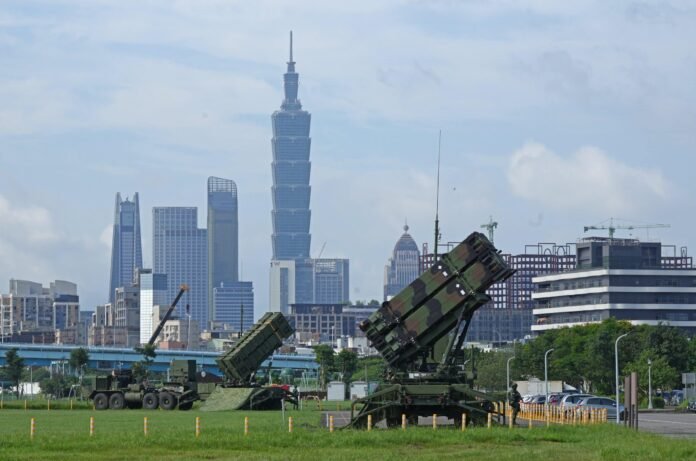
Tel Aviv: The covert defence relations between Taiwan and Israel have reached an advanced stage, accompanied by efforts to hide them.
Israeli sources said that the Taiwanese have analysed the way Israel used its multi-layered air defence system during the recent war with Iran and came to the conclusion that it should be the basis for its T- Dome programme.

Taiwan is not directly buying off-the-shelf Iron Dome batteries from Israel. Instead, Taiwan is developing its own indigenous multi-layered missile shield. According to an Israeli source, the T-Dome is heavily inspired by Israeli defence architecture and reportedly utilises quiet technical cooperation, specialised radar concepts, and component inspiration from Israeli systems.
Taiwanese President Lai Ching-te explicitly modelled the T-Dome framework after Israel’s Iron Dome and multi-layered defence tech. Taiwan allocated a massive multi-year defence budget of roughly $40 billion (spanning 2026 to 2033) to fund this comprehensive air-defence modernisation. The system aims to integrate high-speed networking, advanced sensors, and interceptors to counter potential incoming drones, missiles, and fighter jets.
Intelligence reports indicate that rather than a formal, public procurement of complete Israeli-made batteries, Taiwan has pursued technical exchanges and specialised components (such as radar and tracking tech similar to Israeli models).
A formal, open military trade between Israel and Taiwan remains severely restricted due to Israel’s deep diplomatic and economic ties with the People’s Republic of China, forcing any tactical cooperation to remain discreet or indirect.

Taiwan’s defence procurement operates under severe structural constraints that limit its ability to source weapons from non-US suppliers. The US restrictions on technology transfers, aimed at maintaining regional stability and not provoking China, restrict Taiwan’s access to advanced defence technologies.
China’s diplomatic and economic coercion further discourages other states from engaging in arms sales or defence-related technology transfers to Taiwan. These external pressures have historically impeded Taiwan’s ability to independently shape its military posture.

Israel’s military relations with Taiwan were aborted by the mid-1990s, though attempts have been made to resume defence links since Taiwan faces one of the world’s most difficult air defence problems due to its proximity to China and the PLA’s massive investments in systems that threaten Taiwanese aircraft both in the air and on the ground.
China now can destroy all of Taiwan’s aircraft at their bases in a major conflict. Taiwan’s current air defence investments centre on US-supplied systems, including F-16s, Patriot batteries, and indigenously produced Tien Kung III SAMs.
Taiwan’s evolving defence strategy emphasises asymmetric capabilities, distributed mobile weapons, and cost-efficient procurement. The recommended approach prioritises domestic production for asymmetric systems, co-production for complex platforms, and reliance on US imports for high-tech assets.
Taiwan’s defence industry struggles to produce and procure sufficient weaponry due to historical, international, and domestic constraints.

-The writer is an Israel-based freelance journalist. The views expressed are of the writer and do not necessarily reflect the views of Raksha Anirveda





