


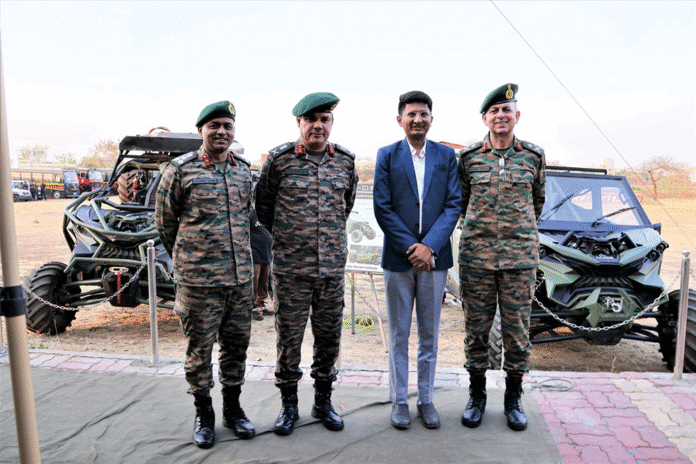
There is a question that has stayed with me since the day I first visited a forward military post in the Indian Himalayas. Why does one of the world’s largest and most operationally experienced armies depend on imported vehicles for all terrain light tactical and logistics mobility?
Eighty percent (80%) of Earth’s landmass is inaccessible to conventional vehicles. For India, this is not a statistic. It is an operational reality. From the glaciers of Ladakh to the deserts of Rajasthan, from the riverine terrain of the Northeast to the high passes of Uttarakhand, the Indian soldier operates in conditions that would disable most machines on the planet. And for decades, the vehicles carrying them into these environments were designed in the United States and Canada. Platforms built for American ranches and Canadian trails, were adapted, not designed, for the Indian theatre. From Scandinavian Arctic operations to Middle Eastern desert patrols, from Australian outback missions to South American border security, militaries across the globe have relied on these imported platforms, underscoring both the scale of global demand and the absence of indigenous alternatives.

That question became the founding impulse behind A-THON All-Terrain Private Limited.
Beginning with a Blank Sheet
We started in 2022 in Bengaluru with nothing but a conviction: India has the engineering talent, the manufacturing capability, and the strategic necessity to build its own all terrain mobility platforms from the ground up. Not assemble. Not manufacture under licence. Not rebadge a foreign design. Author.
A-THON was never meant to be an automobile company that happens to sell to the military. It was conceived as a defence technology company that thinks in terrain. Our Discovery Engine is meant for mobility beyond roads, where only humans and quadrupeds can tread. Every platform we build starts with a single question: what does the Indian soldier need in the field that does not exist today?
A-THON was never meant to be an automobile company that happens to sell to the military. It was conceived as a defence technology company that thinks in terms of terrain. Our Discovery Engine is meant for mobility beyond roads, where only humans and quadrupeds can tread. Every platform we build starts with a single question: what does the Indian soldier need in the field that does not exist today?
The vision for this architecture came from Irfann Sheriff, A-THON’s Chief Visionary and Architect. While I was obsessed with what the vehicle should do on the ground, Irfann was thinking five years ahead about what the entire mobility ecosystem should look like. The product roadmap, the institutional partnerships, the alignment with national defence policy, the technology integration philosophy, all of that carries his imprint. Irfann builds the future they drive into.

The ASHVA Series
The result is the ASHVA series, India’s first indigenous family of all-terrain vehicles designed specifically for military and extreme terrain applications.
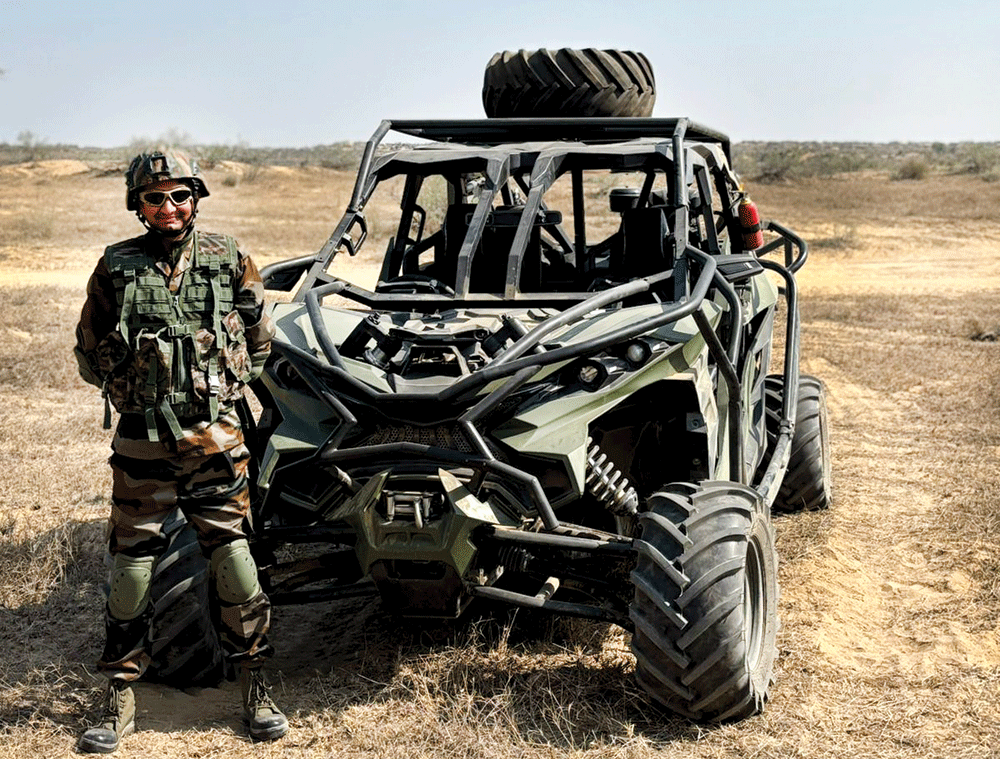
The ASHVA 4×4 2S is a two seater 4WD platform with tethered drone integration for persistent surveillance and targeting, capable of 72 hour independent operations. Recovery winch, radio set, battery pack, foldable ladder, integrated cargo. Armoured customisation available with LMG, MMG, and ATGM mount capability.

The ASHVA 4×4 4S is a four seater configured for rapid deployment of troops and mission critical equipment into forward areas where conventional vehicles simply cannot go.
The ASHVA 4×4 5S is a five seater with integrated fixed wing VTOL drone. Drone carrying, drone charging via three redundant power systems: engine power take off, silent generator, and battery pack. Closed cabin, five fully equipped operators, 72 hour independent operations.
And then there is the ASHVA 6×6 2S. The world’s only 6×6 all-terrain side by side vehicle. Six-wheel drive, two primary seats, two auxiliary seats, gun mounts on top. This platform goes where nothing else can. It is not a variant. It is a category virtually absent from the global landscape until A-THON engineered it.
Beyond ASHVA, A-THON’s product line includes ATATS (All-Terrain Artillery Tug System), a specialised platform for towing and deploying artillery including 105mm light field guns across terrain where conventional tug vehicles cannot operate, and RAKSHAK, an armoured patrol vehicle for border security and internal security applications.
Every one of these platforms is indigenously designed, developed, and manufactured. Indian IP. Indian engineering. IDDM category.
20,000 Feet and the Soldiers Who Live There
Before any of our platforms saw a military exercise, they had to survive something harder: four months of continuous trials across the most demanding terrain India can offer.
We started in Ladakh. Pangong Tso at 14,270 feet, the lake that sits on the Line of Actual Control. Then Marsimik La, the fourth highest motorable pass in the world at 18,314 feet, where atmospheric pressure drops to roughly half of sea level. Then Chusul Heights, above 20,000 feet.
We moved to Uttarakhand. Raiwala, Joshimath, Malari, Sumna, Lapthal, Atisen, Rimkhim, and Sidhitop at 16,500 feet. Every location was a different test. River beds, mountain switchbacks, snow, slush, rock. In Jammu, we added military grade terrain validation at Aanganpatri and Tri Star at over 12,000 feet. At Agra, the Technical Evaluation Centre put the platforms through formal assessment. TEC approvals were completed.
We spent four months in conditions that tested every limit of human endurance. Minus 25 degrees. Oxygen at half of sea level. Passes where you cannot walk ten steps without gasping. The ASHVA ran through all of it without complaint. The machine was ready long before we were. That experience gave us something no test bench ever could: an understanding of what the Indian soldier endures daily, and a conviction that they deserve equipment built to match their courage.
At Babina Fire Range, we conducted something no other company has: assisted autonomous defence trials with the ASHVA 6×6. The platform was demonstrated to the Vice Chief of the Indian Army and Army Design Bureau. This was not just remote controlled operation but a testament of assisted autonomous navigation technology developed through our partnership with ARTPARK at the Indian Institute of Science, Bengaluru.
Kharga Shakti: When India Chose Indian
In February 2026, the Indian Army’s Western Command conducted Exercise Kharga Shakti at the Mahajan Field Firing Ranges in Rajasthan. This was the Kharga Corps’ biennial strike corps exercise, and the first major combat drill since Operation Sindoor. It was reviewed by Lt Gen Manoj Kumar Katiyar, GOC in C Western Command. Drones at every echelon. Precision fires. Networked command and control. Bhairav battalions. Ashni Platoons. Lessons from modern warfare put to the test.
Four A-THON vehicles were there. Four different ASHVA configurations, customised to Western Command’s operational requirements for drone carrier integration.
A-THON was the only IDDM vehicle platform in the exercise.
The ASHVA 6×6 2S is the world’s only 6×6 all-terrain side by side vehicle. Six-wheel drive, two primary seats, two auxiliary seats, gun mounts on top. This platform goes where nothing else can. It is not a variant. It is a category virtually absent from the global landscape until A-THON engineered it
Times of India posted the images. DD News broadcast the vehicles nationally. The Indian Army’s Western Command shared them from their official channels. Millions saw the ASHVA tearing across the Rajasthan desert with a drone on its roof. They saw it before they knew its name.
Its name is ASHVA. The company is A-THON. The city is Bengaluru. The country is India.
The Ecosystem that Makes it Possible
A-THON did not build ASHVA in isolation. Our rise from a 2022 startup to deployment in a Western Command exercise is the product of India’s defence innovation ecosystem working exactly as it was designed to.
The first pillar is ARTPARK at IISc, Bengaluru, the AI and Robotics Technology Park promoted by the Indian Institute of Science, seed funded by the Department of Science and Technology under NM-ICPS and the Government of Karnataka. A-THON is an industry partner at ARTPARK, and the collaboration extends to assisted autonomous technology integration for our platforms. The autonomous 6×6 has been demonstrated to HD Kumaraswamy, Minister of Heavy Industries, and to DST officials at the ARTPARK facility.
The second pillar is IIT Ropar’s Defence Research Innovation Foundation (DRIF), a Section 8 company bridging the Armed Forces, Defence Industry, and Academia. Our MoU with DRIF is central to the development of ATATS and broader defence R&D collaboration.
The third pillar is the Army Design Bureau (ADB). A-THON works directly with ADB to address problem statements defined by the end user, the Indian Army. We are also designing and developing robotic mobility platforms for the Army under the ADB compendium jointly with ARTPARK and DRIF. The ASHVA series was not designed and then pitched. It was developed in response to specific capability gaps identified by the Army itself.
This three pillar model, IISc for autonomous technology, IIT Ropar for defence R&D, and ADB for end user requirements, is how India’s defence innovation architecture was meant to function. A-THON is proof that it works.
Every ASHVA deployed with the Indian Armed Forces conserves foreign exchange, strengthens indigenous intellectual property, and extends India’s vision of Make in India and Innovate in India into the most demanding operational environments on Earth. The policy and the product have converged
DAP 2026: The Policy Catches Up
On February 10, 2026, the Ministry of Defence released the draft Defence Acquisition Procedure 2026. The single most consequential change: the elimination of the ‘Buy (Indian)’ procurement category entirely. Under DAP 2020, this category allowed Indian vendors to supply equipment with at least 60% indigenous content, even when the design and core intellectual property belonged to a foreign OEM. DAP 2026 closes that door. The only preferred procurement path is now ‘Buy (Indian IDDM)’, where equipment must be indigenously designed, developed, and manufactured. The Ministry has framed this as a shift from ‘Made in India’ to ‘Owned by India.’
A-THON was already there.
Every ASHVA deployed with the Indian Armed Forces conserves foreign exchange, strengthens indigenous intellectual property, and extends India’s vision of Make in India and Innovate in India into the most demanding operational environments on Earth. The policy and the product have converged.
For defence startups and MSMEs that have invested in genuine indigenous R&D, DAP 2026 is the framework they have been waiting for. It rewards those who took the harder path, the path of designing from scratch rather than assembling under licence. A-THON took that path from day one. Not because the policy told us to. Because the Indian soldier deserved it.
ATATS will address the Indian Army’s modernising artillery regiments. RAKSHAK will serve border security and internal security applications. The autonomous variants, developed through our ARTPARK partnership, will address the future of unmanned ground operations. The international market, where demand for proven, cost effective, and politically unencumbered tactical mobility platforms is growing, is on our horizon
What Comes Next
The ASHVA series has been proven at every altitude, across every terrain, in the Indian Army’s own exercises and trials. But this is not the destination. It is the starting point. ATATS will address the Indian Army’s modernising artillery regiments. RAKSHAK will serve border security and internal security applications. The autonomous variants, developed through our ARTPARK partnership, will address the future of unmanned ground operations. The international market, where demand for proven, cost effective, and politically unencumbered tactical mobility platforms is growing, is on our horizon.
Recently, A-THON participated at AeroDef India 2026 and the Defence Mobility Manufacturing Expo at Yashobhoomi, New Delhi, from April 8-10, 2026. The overwhelming response to its showstopper platforms were encouraging.
We do not follow a category. We are creating one.

The writer is the Founder of A-THON All Terrain Private Limited, an IDDM category defence technology company headquartered in Bengaluru, Karnataka. A-THON is an industry partner at ARTPARK, IISc Bengaluru, with defence R&D collaboration through DRIF, IIT Ropar. The company’s ASHVA series was the only IDDM vehicle platform deployed in Exercise Kharga Shakti 2026. The views expressed are personal and do not necessarily reflect the views of Raksha Anirveda





