


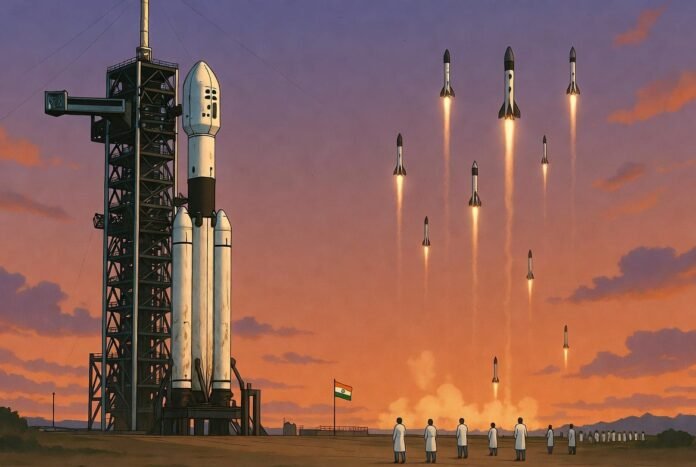
There is a particular kind of institutional courage in an organisation choosing to stop doing the thing that made it famous. That is effectively what is unfolding at the Indian Space Research Organisation (ISRO) right now.
Over the past few weeks, IN-SPACe Chairman Pawan Goenka has said, in plain terms, that ISRO will eventually stop manufacturing launch vehicles altogether. The Small Satellite Launch Vehicle has already been handed over to Hindustan Aeronautics Limited after a competitive bid, and the far bigger workhorses, the PSLV and the LVM3 are next in line for transfer to private industry.

Having watched this sector for years, I think this is the right call, though not risk-free. It deserves an honest accounting rather than either cheerleading or alarm.
Why This Makes Sense
ISRO was built to do something almost no other institution in India could in the 1970s and 1980s: design, build, test and fly rockets from a standing start, with limited industrial capacity to draw on. That meant vertical integration. ISRO ran its own fabrication lines, assembly and quality checks, largely because nobody else could.
That world no longer exists. India now has a mature aerospace and precision manufacturing base, private companies capable of producing rocket structures, avionics, and propulsion components to exacting tolerances, and a policy architecture specifically designed to attract them.
India’s space agency can achieve more by focusing on frontier research than on routine production
Continuing to have ISRO’s scientists supervise routine, repetitive work on building the twentieth or fortieth PSLV is not the best use of some of the country’s scarcest technical talent. Every hour a senior propulsion engineer spends on production oversight is an hour not spent on the next-generation reusable launch vehicle, on deep-space instrumentation, or on the Gaganyaan human spaceflight programme.

The economic logic also holds up. The government is targeting a space economy of around 44 billion dollars by 2033, up from roughly 8 billion dollars today. That kind of growth requires launch frequency that a single state-run agency, however capable, cannot deliver on its own.
Private players bring capital, manufacturing scale and the commercial incentive to cut costs and turnaround times, things that are harder to demand of a public agency built for exploration rather than throughput.

There is precedent elsewhere as well. NASA’s shift from owning and operating the Space Shuttle to buying seats and cargo capacity from SpaceX and others, freed it to focus on Artemis and deep space science.
Transferring the SSLV, PSLV and LVM3 to companies could bring greater capital, scale and launch frequency
ISRO’s move follows a similar logic, even though the Indian private space sector is still much younger than its American counterpart.
Where the Caution is Warranted
That said, this transition is not without genuine risk, and it would be dishonest to pretend otherwise. Former ISRO chief G Madhavan Nair has publicly questioned whether Indian industry is truly ready to take on full production of vehicles as complex as the LVM3, which relies on cryogenic engines that took ISRO decades to master.
Handing over technology on paper is not the same as transferring tacit knowledge, the years of failure analysis and small adjustments that make a rocket reliable. That kind of institutional memory is hard to transfer through a bidding document.
There is also a sequencing question. The SSLV transfer to HAL is a useful pilot, but it is a much smaller and simpler vehicle than the PSLV or LVM3.
Moving too quickly from that pilot to the country’s most powerful and most relied-upon launchers, without sufficient operational learning in between, could create real production and reliability gaps at a time when India is trying to build a reputation for launch dependability in a competitive global market.
Rocket-making expertise involves tacit knowledge that cannot be transferred through paperwork alone
Then there is the workforce question. Thousands of skilled technicians and engineers at ISRO centres have built their careers around production work. Any credible transition plan needs to address where they will go, whether into the new private manufacturing base, into ISRO’s expanded research mandate, or elsewhere, and not treat this simply as a headcount problem to be solved by attrition.
A Transition Worth Getting Right
None of this is an argument against the policy. It is an argument for pacing it properly. ISRO’s shift from routine manufacturing to focus on frontier research, deep-space missions and next-generation technology is a natural and overdue evolution for an agency that has outgrown its original operating model. The direction is sound.
What will determine whether this becomes a genuine success story or a cautionary tale is execution: how carefully technology and knowledge are transferred, how honestly industry readiness is assessed rather than assumed and how much oversight IN-SPACe retains even as it lets go of day-to-day control.
Ambition and caution are not opposites here. India’s space programme has always managed to hold both at once, and this transition will need exactly the same balance to succeed.

The writer, a PVSM, AVSM, VSM has had an illustrious career spanning nearly four decades. A distinguished Armoured Corps officer, he has served in various prestigious staff and command appointments including Commander Independent Armoured Brigade, ADG PP, GOC Armoured Division and GOC Strike 1. The officer retired as DG Mechanised Forces in December 2017 during which he was the architect to initiate process for reintroduction of Light Tank and Chairman on the study on C5ISR for Indian Army. Subsequently he was Consultant MoD/OFB from 2018 to 2020. He is also a reputed defence analyst, a motivational speaker and prolific writer on matters of military, defence technology and national security. The views expressed are personal and do not necessarily carry the views of Raksha Anirveda





