


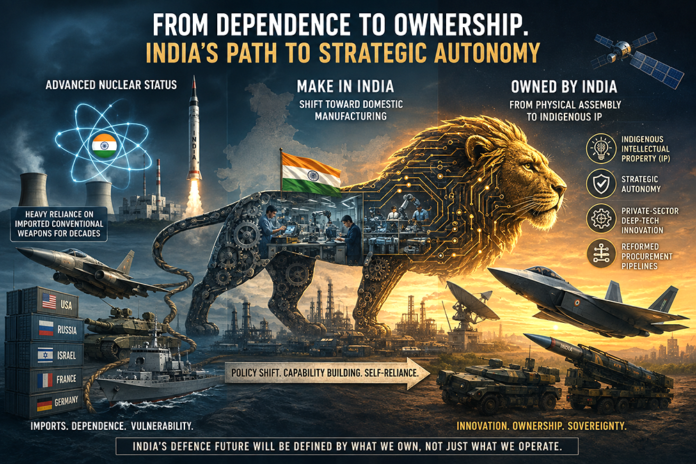
For decades, India’s strategic posture was defined by a critical paradox: a nation capable of deploying advanced nuclear assets while remaining one of the world’s largest importers of conventional military hardware.
The inauguration of the flagship Make in India initiative marked a dramatic policy shift toward reversing this dependency, aiming to convert the domestic industrial base from passive consumers to active producers. Over the past decade, this drive has accelerated through consecutive iterations of the Defense Acquisition Procedure (DAP).

Yet, as global geopolitics becomes increasingly volatile, a subtle but fundamental vulnerability has emerged in India’s defence industrial architecture.
Manufacturing military hardware within domestic borders is no longer sufficient to guarantee strategic autonomy. The true test of national sovereignty lies not in where a weapon system is assembled, but in who owns the underlying Intellectual Property (IP).
Moving from ‘Make in India’ to ‘Owned by India’ represents a profound structural evolution – transitioning from contract manufacturing under foreign licence to native technological sovereignty.
Achieving this transition requires confronting deeply entrenched bottlenecks within India’s defence-industrial ecosystem, modernising R&D integration and radically rethinking how the military apparatus engages with private sector deep-tech startups.

Manufacturing foreign designs domestically builds shop-floor skills but creates an “Assembly Trap”, leaving India dependent on foreign OEMs for critical software, source codes, upgrades and life-cycle support
The Assembly Trap: Why Manufacturing is Not Ownership
The fundamental flaw in traditional defence indigenisation lies in confusing physical assembly with technological self-reliance. Historically, under ‘Buy and Make’ categories, foreign Original Equipment Manufacturers (OEMs) transferred build-to-print technology to domestic entities, primarily Defence Public Sector Undertakings (DPSUs).
While this provided local employment and developed basic shop-floor expertise, it routinely failed to transfer critical design knowledge. The core IP – the source code for avionics, metallurgical formulas for hot-end turbine blades, algorithmic frameworks for active electronically scanned array (AESA) radars and complex sensor fusion software – remained securely locked inside foreign vaults.

This model created an ‘Assembly Trap’. Without IP control, India remains perpetually dependent on foreign suppliers for life-cycle support, system upgrades, mid-life modernisations and critical spare parts during operational crises.
When an imported fighter jet or submarine requires integration with indigenous weaponry, foreign OEMs demand exorbitant integration fees or deny access to flight control software altogether citing proprietary rights.
True operational sovereignty requires the freedom to modify, scale, export and reconfigure military assets without external permission – capabilities that can only be unlocked when IP resides within domestic jurisdiction.
Despite prioritisation under DAP 2020, rigid qualitative requirements, obsolete acquisition cycles and state-ownership IP disputes continue to disincentivise private-sector defence R&D investment
Bridging the Procurement Divide: DAP and the IP Paradox
To address this structural vulnerability, recent frameworks such as the Defence Acquisition Procedure 2020 elevated the Buy (Indian-Indigenously Designed, Developed and Manufactured), or Buy (Indian-IDDM), category to the highest priority in procurement hierarchies.
The policy mandates that equipment must not only contain high levels of local content, but must also be built upon an indigenously owned design. On paper, this prioritises domestic IP; in practice, structural bottlenecks within the procurement pipeline impede progress.
The central friction point is the stark misalignment between military procurement cycles and the pace of technological development. Traditional acquisition pipelines rely on rigid Qualitative Requirements (QRs) drafted years before a contract is awarded.
By the time a platform moves from staff requirements to field trials, the embedded microprocessors, sensors and software architecture are often obsolete.
Furthermore, legacy procurement protocols prioritise capital-heavy infrastructure and past performance over agility, systematically favouring established state-run enterprises that historically struggled with rapid innovation cycles over dynamic private-sector firms.
Initiatives like iDEX and ADITI have catalysed agile startup innovation in autonomous systems and electronic warfare while allowing developers to retain primary IP rights
Without long-term R&D funding guarantees, private defence firms face severe capital risks when investing internal funds into high-risk research. When the government does fund co-development under platforms like the Make-I (Government-funded) scheme, contentious debates over IP ownership frequently stall progress.
Bureaucratic frameworks have historically treated software, schematics and design innovations as state property in exchange for funding, stripping private developers of the commercial incentives needed to scale their innovations or export non-sensitive variants globally.
The Disruptive Power of Deep-Tech and iDEX
Where traditional acquisition has stumbled, non-traditional policy initiatives have opened new avenues. The establishment of Innovations for Defence Excellence (iDEX), executed under the Defence Innovation Organisation (DIO), represents a major shift in how the Indian Ministry of Defence engages with commercial tech ecosystems.
Startups struggle to transition successful prototypes into large-scale production due to legacy procurement barriers, capital deficits and slow trial scaling
By lowering barriers to entry for startups, micro, small and medium enterprises (MSMEs), and individual innovators through mechanisms like the Defence India Startup Challenge (DISC) and the ADITI scheme, iDEX has injected real agility into the defence technological base.
Startups working in swarm robotics, autonomous underwater vehicles (AUVs), AI-driven electronic warfare suites and satellite-based secure communications are proving that cutting-edge defence solutions do not always require decades of development or massive capital outlays.
Through fast-track seed funding, mentorship and direct access to military trial grounds, deep-tech firms are bridging the gap between field operational needs and manufacturing readiness.
Crucially, iDEX allows startups to retain the primary Intellectual Property generated during their challenges, granting the armed forces rights of use. This model preserves commercial viability while securing military access.
De-linking IP state-ownership from co-funded projects grants armed forces perpetual usage rights while incentivising private industry to scale dual-use, exportable technologies
However, a major structural hurdle remains: the ‘Valley of Death’. Startups excel at moving a concept from TRL 3 (Technology Readiness Level: proof of concept) to TRL 6 (prototype demonstration).
Yet, converting a successful iDEX prototype into a multi-year, large-scale production contract – TRL 9 – remains bogged down by legacy procurement steps, capital constraints and institutional resistance to scaling startup solutions.
Architecting the Path to “Owned by India”
To transition smoothly from local manufacturing to indigenous IP ownership, the Ministry of Defence must first overhaul traditional procurement clauses by de-linking IP ownership from state funding.
Allowing private innovators to retain full underlying intellectual property rights – even in government co-funded projects – incentivises commercial R&D while granting the Indian Armed Forces royalty-free, perpetual usage and modification licenses.
Parallelly, the defence acquisition pipeline requires institutionalised fast-track scale-up pathways. Creating an automatic transition route from successful iDEX and ADITI trials directly into low-rate initial production contracts bypasses redundant, multi-year field evaluation trials, accelerating the deployment of verified software and electronic sub-systems to front-line units.
Realising true autonomy requires fast-tracking trial transitions, establishing specialised venture capital funds and setting dynamic specifications in real-time military-innovator hubs
Beyond streamlining acquisitions, deepening civil-military technical collaboration is essential for realistic technology development. Expanding embedded military-innovator hubs – modeled on the success of the Army Design Bureau – across all service branches allows service commanders and developers to refine Qualitative Requirements dynamically based on existing technological capabilities rather than idealised, unattainable specifications.
Finally, overcoming the operational “Valley of Death” requires catalysing strategic venture capital through a dedicated, government-backed Defence Innovation Venture Fund. This financial bridge provides critical growth capital to deep-tech startups attempting to scale high-risk prototypes into industrial-volume manufacturing.
Transitioning from ‘Make in India’ to ‘Owned by India’ is an urgent national security imperative, as future conflicts will be won by the speed of technological iteration rather than the mere volume of locally assembled foreign hardware.
Escaping the assembly trap requires aligning procurement policy with agile R&D, incentivising private-sector capital, and institutionalising startup innovation to protect domestic intellectual property.
Ultimately, true strategic autonomy will not be measured by the tonnage of defence equipment forged on Indian soil, but by the lines of code, system designs and patents conceived, owned and defended by Indian minds.

The writer is a policy analyst, author and researcher with research experience in South Asian geopolitics, India's foreign policy and the Indo-Pacific. The views expressed are personal and do not necessarily reflect the views of Raksha Anirveda





