


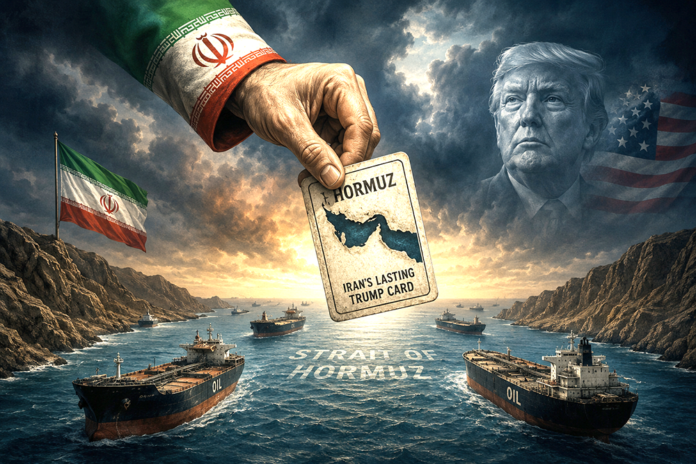
The most consequential weapon Iran has gained from the war may not be a nuclear weapon. It is geography. The Strait of Hormuz gives Tehran a strategic leverage that is disproportionate to its economic weight.
Roughly a fifth of the world’s oil and LNG passes through this narrow waterway. The ability to disrupt this artery gives Iran considerable influence over global energy markets and, by extension, over the United States and its allies.

The critical question, however, is not whether Iran can weaponise Hormuz, but how long it can sustain that leverage. The answer will vary by commodity and by country. The six Gulf Cooperation Council countries are already working to reduce their dependence on the strait.
Before the war, around 15 million barrels of oil a day passed through Hormuz. Saudi Arabia’s East-West pipeline had a capacity of only about one million barrels a day. Since the war, Riyadh has increased this capacity to seven million barrels a day, of which about five million barrels are available for export and the remainder for coastal refineries.
The UAE, meanwhile, has increased the flow through its Habshan-Fujairah pipeline from about one million barrels a day to 1.8 million. Iraq has also activated its pipeline route to Turkey, while new pipelines are being planned or built across the region. Baghdad is looking at routes towards Jordan, Syria and Turkey.
Roughly 20% of the world’s oil and LNG transits through the narrow Strait of Hormuz. Disruption directly threatens global energy stability, affording Tehran coercive leverage over international powers and allies
By 2030, another five million barrels a day could potentially bypass Hormuz. The Gulf states also have an important advantage over countries such as India when building such infrastructure: acquiring land for pipelines is considerably easier.

These developments will gradually reduce Iran’s ability to influence global oil prices by threatening the strait.
But oil is only part of the equation. Qatar faces a much more acute vulnerability, as its LNG exports are almost entirely dependent on Hormuz. There is currently no LNG pipeline under construction that can provide a comparable alternative.

Gulf refineries are similarly dependent on the strait, both for supplies and access to external markets. Even Saudi oil exports routed through Yanbu must pass through the Bab el-Mandeb to reach Asia, exposing them to the continuing risk of attacks by the Houthis.
Gulf states are racing to reduce reliance on the strait. Saudi Arabia expanded its East-West pipeline to seven million barrels daily, while the UAE and Iraq are activating alternative export pipelines toward the Red Sea, Mediterranean and Turkey
This creates an important distinction between Iran’s immediate leverage and its long-term strategic position. Alternative oil pipelines can reduce the economic value of Hormuz for Tehran, but they cannot eliminate the strait’s strategic importance.
Iran will remain the gatekeeper of one of the world’s most important maritime chokepoints. Its ability to weaponise that position may decline, but its ability to influence the calculations of the Gulf states will endure.
There is also a possibility that Tehran will seek to monetise this leverage rather than permanently close the strait.
Reports that Iran is collecting about $2 million per vessel transiting Hormuz, if sustained, point towards such a model. At pre-war traffic levels, with traffic subsequently falling to about 70% of those levels, such charges could theoretically generate tens of billions of dollars annually.
Rather than closing the waterway, Iran may shift toward monetisation. Levying toll charges on transiting ships could yield tens of billions annually, enticing Gulf neighbours toward economic accommodation rather than endless military confrontation
The UAE’s renewed trade and diplomatic engagement with Iran, and indications that the two sides have discussed transit arrangements, suggest that some Gulf states may eventually prefer accommodation to prolonged confrontation.
Iran’s reported legislative effort to keep transit charges just below the cost of the next-best alternative route, whether through Bab el-Mandeb or around the Cape of Good Hope, would be a particularly rational strategy.
It would allow Tehran to extract revenue while giving commercial shipping an incentive to continue using Hormuz. The difficulty is enforcement.
If some tankers refuse to pay, Iran would need to demonstrate that non-payment carries consequences. Any attempt to compel compliance through attacks, however, would raise the risk of a wider regional conflict and make the strait even less attractive to international shipping.
That is why Iran’s grip on Hormuz could outlast the war itself, even if its economic leverage gradually diminishes.
Saudi Arabia and the UAE are expanding pipelines to bypass the strait; Iraq is seeking to divert more of its oil northwards; and US and Saudi investors have planned a major refinery outside Hormuz.
Bypass routes offer partial relief, but pipeline capacity is constrained and costly to build. Furthermore, overland infrastructure remains vulnerable to sabotage, leaving Gulf states with the unresolved question of how to secure these new transit lines
Yet, infrastructure has limits. Pipelines take years to build, their capacity cannot be expanded indefinitely, and alternative routes remain vulnerable.
Most importantly, who will protect these new pipelines from Iranian attacks?
This is where the strategic dilemma becomes more complicated. The Gulf states can reduce their dependence on Hormuz, but they cannot remove Iran from the geography.
Qatar, in particular, will remain highly exposed unless a credible alternative for its LNG exports emerges. The Gulf states may therefore eventually face an uncomfortable choice between prolonged vulnerability and some form of accommodation with Tehran.
Iran has indicated that it wants to manage the strait jointly with Oman. Such an arrangement, if it emerges, could provide the basis for a broader regional understanding in which Gulf states pay transit fees while retaining access to the waterway.
While Tehran’s absolute economic leverage may wane as bypass routes mature, its geographical command of the strait is permanent. The region must ultimately navigate between perpetual conflict and a structured framework for managed access
For Tehran, this would transform Hormuz from a wartime weapon into a durable source of strategic and economic influence.
Iran may therefore win the immediate battle for Hormuz while gradually losing some of its economic leverage over it. The Gulf states are unlikely to accept permanent dependence on a chokepoint controlled by a potential adversary and will continue investing in alternatives.
But geography changes much more slowly than politics. For India, which depends heavily on Gulf energy and remains deeply connected to these maritime routes, the lesson is clear: the strategic significance of Hormuz will survive any single war. Iran’s leverage may weaken, but its position as gatekeeper will remain.
The real contest will be over whether the region can turn that enduring geographical reality into a framework for managed access rather than perpetual confrontation.

The writer commanded 15 Punjab in Lebanon under United Nations Flag, commanded 27 Sector as DIG in Churachandpur and was Brigadier Operational Logistics in HQ Western Command. He is currently an analyst on geopolitics, international and defence affairs. The views expressed are personal and do not necessarily carry the views of Raksha Anirveda





