



Seventy-nine years ago, India declared that it would govern itself — that its fate, its resources, and its voice would belong to no foreign power. That declaration was made with words, courage, and the collective will of a billion people not yet born. On this Independence Day 2026, India makes another declaration — quieter, more technical, but no less historic: that its digital data, too, shall be sovereign.
India has, in fact, become one of a handful of nations in the world with field-validated, military-grade quantum communication capability.

This is not merely a claim — it is field-proven, grounded in the laws of quantum physics.
Background
India’s quest for quantum technologies has shifted from aspiration to strategic imperative. In an era of cyber warfare and technology-led power projection, quantum computing and communication will increasingly shape security and innovation.
Michele Mosca’s well-known risk framework captures the urgency: if the shelf life of encrypted data, added to the time needed to migrate to quantum-safe systems, exceeds the time before a cryptographically relevant quantum computer arrives, action must begin now. This is the logic behind ‘harvest now, decrypt later’ attacks, in which sensitive, encrypted data is collected today for future decryption. For India, where sensitive defence, strategic, financial, and critical-infrastructure data may remain valuable for decades, this is not a distant theoretical risk — it is a strategic deadline that demands action today.
The National Quantum Mission (NQM), approved for the 2023–31 period with an outlay of Rs 6,003.65 crore, is built around four pillars: computing, communication, sensing and metrology, and materials. It brings academic institutions, national laboratories, defence organisations, startups, and industry into a single ecosystem
A National Mission Takes Shape
India’s answer is the National Quantum Mission (NQM), approved for the 2023–31 period with an outlay of ₹6,003.65 crore. Built around four pillars — computing, communication, sensing and metrology, and materials — it brings academic institutions, national laboratories, defence organisations, startups, and industry into a single ecosystem, where hardware, software, photonics, and applications are meant to mature together.

Its targets include quantum computers in the 50–1,000-qubit range, satellite-based secure links over 2,000 km, inter-city quantum key distribution (QKD) over optical fibres, multi-node quantum networks with synchronised repeaters, high-precision sensors and atomic clocks, and advanced quantum materials. The message underpinning these targets is clear: India aims to develop these capabilities indigenously, rather than remain dependent on imported technologies.
Quantum-Secure Communication: The Urgent Front
Of the four pillars, quantum-secure communication offers one of the most immediate pathways to practical deployment. Classical encryption carries a long-term vulnerability: a sufficiently powerful quantum computer could eventually break widely used public-key cryptographic systems. For defence and critical infrastructure, where secrets may need to remain protected for decades, that vulnerability cannot be deferred. This is the gap Quantum Key Distribution (QKD) is designed to address.

The core mission of Taqbit Labs is to prepare Indian enterprises, government institutions, and defence establishments for the post-quantum security era by protecting critical communications against both today’s cyber threats and the emerging threat of quantum-capable adversaries
QKD is not a rip-and-replace proposition. It can run alongside existing infrastructure and be layered with post-quantum cryptography (PQC) and quantum random-number generation (QRNG) as part of a defence-in-depth strategy. It is less a futuristic novelty than an insurance policy bought before the disaster, not after—a deployable national-resilience capability for information whose confidentiality must survive the arrival of quantum computing.
Taqbit Labs: Building the Quantum Communication Backbone
Every national mission needs industries capable of translating laboratory breakthroughs into deployed, full-stack solutions spanning both hardware and software. In quantum-secure communication, Taqbit Labs has emerged as one of India’s concrete responses to this need. Founded in 2018 by quantum physicists, the company’s core mission is to prepare Indian enterprises, government institutions, and defence establishments for the post-quantum security era by protecting critical communications against both today’s cyber threats and the emerging threat of quantum-capable adversaries.
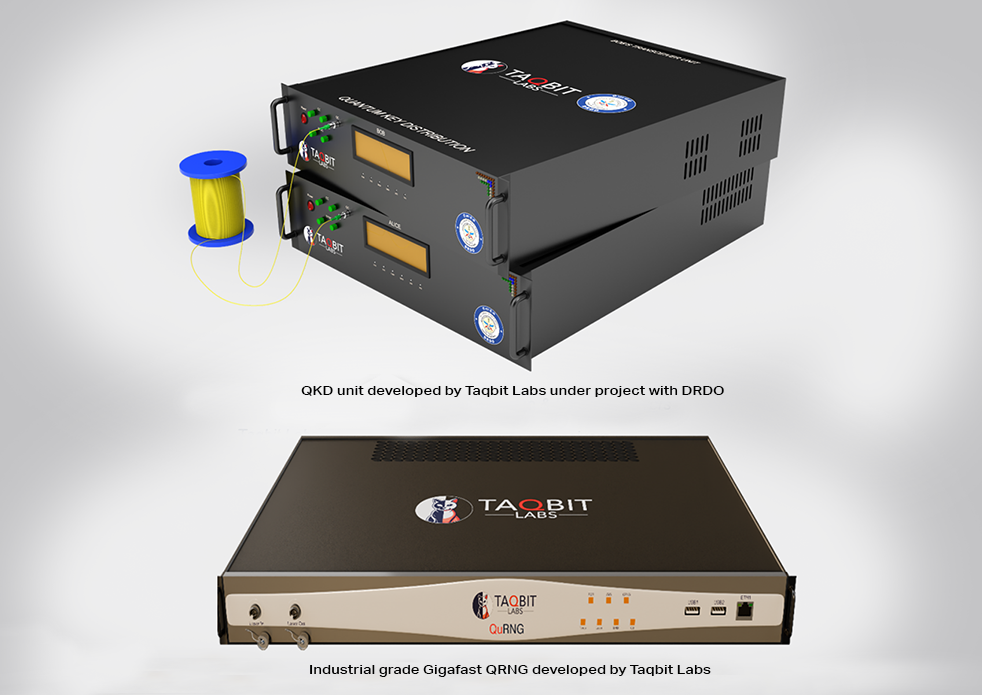
Taqbit’s partnership with DRDO began in 2020, when Taqbit won a contract to develop customised QKD systems for military communications networks. Over five years, the collaboration progressed from proof-of-concept demonstrations to a deployable system through successive trials, engineering development, and integration under real-world field conditions
The founding premise was straightforward but urgent: conventional public-key cryptographic systems, including RSA and elliptic-curve cryptography, face a fundamental threat from sufficiently powerful quantum computers. Taqbit was built to address that challenge before it becomes a crisis, rather than after.
DRDO–Taqbit Partnership: From Lab to Field Deployment
Taqbit’s partnership with the Defence Research and Development Organisation (DRDO) began in 2020, when Taqbit won a contract to develop customised QKD systems for military communications networks. Over five years, the collaboration progressed from proof-of-concept demonstrations to a deployable system through successive trials, engineering development, and integration under real-world field conditions.
A Landmark Achievement — July 14, 2026
On July 14, 2026, DRDO formally announced the successful completion of military field trials of a scalable, interoperable fibre-based QKD system developed in partnership with Taqbit Labs.
The significance of this milestone cannot be overstated:
- Field-validated performance: The system was tested under genuine field conditions, including temperature fluctuations and fibre-related signal degradation.
- Scalable network architecture: The architecture is designed to scale into multi-hop quantum networks—meaning it is not merely a point-to-point demonstration, but a potential building block for a broader national military quantum communication infrastructure.
- Strategic positioning: The successful field trials strengthen India’s position among the small number of nations with proven, field-validated military quantum communication capabilities.
In the information age, independence means the freedom to communicate securely — with the ability to detect attempts at eavesdropping and without the vulnerability that comes from depending on another nation’s technology to protect your most sensitive information
The Road Ahead
India’s 2,000-kilometre target now looks like a floor, not a ceiling. The next phase could connect defence installations, financial networks, and critical infrastructure through a quantum-secure mesh. Satellite-based QKD — the frontier pioneered by our neighbouring nations — is the next major milestone, potentially extending quantum-secure communication to naval vessels, remote forward bases, and satellite ground stations.
Additionally, India’s space-startup ecosystem is developing the sovereign launch capabilities needed to pursue that objective on its own terms. On July 18, 2026 — just four weeks before this Independence Day — Skyroot Aerospace’s Vikram-1 became the first privately developed Indian rocket to reach orbit from Sriharikota, making India only the third country after China and the United States to achieve this milestone through a domestic private company. A nation that can develop its own quantum payloads and launch them on its own rockets needs no one else’s permission to build quantum communication infrastructure in space.
The challenge is not just technical. It is strategic. India must build a domestic supply chain for photonic components and integrate QKD with post-quantum cryptography into a layered security architecture. The adversary is not standing still. Neither is India.
A Message for Independence Day
Independence in 1947 meant freedom from colonial rule. In the information age, independence also means the freedom to communicate securely — with the ability to detect attempts at eavesdropping and without the vulnerability that comes from depending on another nation’s technology to protect your most sensitive information. India has progressed from the conception of the NQM to field-validated quantum-secure communication systems, with a new generation of quantum scientists and engineers building what comes next.
Jai Hind.

The writer is the Founder and CEO of Taqbit Labs. He is working at the frontier of quantum-secure communications for India’s defence and critical infrastructure. The views expressed are of the writer and do not necessarily reflect the views of Raksha Anirveda





