


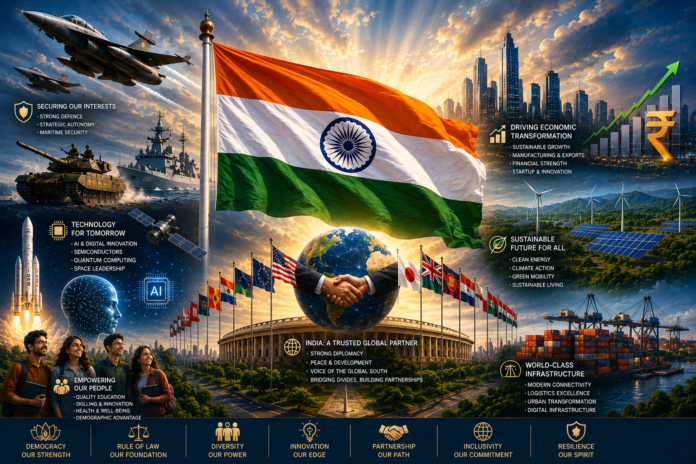
For decades, India was described as a nation of immense potential, a country on the cusp of greatness, yet perpetually categorised as an ‘emerging power’. That narrative is rapidly becoming outdated. The decade ahead will witness India’s crescendo transition into a decisive global power, shaping economic growth, technological innovation, and geopolitical stability.
The global order has been undergoing its most significant transformation since the end of the Cold War. Supply chains are being reconfigured, technological leadership is being fiercely contested, and nations are reassessing strategic alliances amid increasing geopolitical uncertainty. In this environment, India is uniquely positioned, not as a passive participant but as a country capable of influencing the direction of global progress.

The foundation of this transition rests on three interconnected pillars: economy, technology, and diplomacy.
The Economic Engine of Global Growth
India’s economic trajectory is now dominated less by domestic factors and more by strategic growth for the global economy.
With one of the world’s youngest workforces, sustained infrastructure investment, expanding manufacturing capabilities, and an increasingly digital economy, India is creating a growth model that balances consumption with production. Government initiatives such as Make in India, Digital India, the Production Linked Incentive (PLI) schemes, India Semiconductor Mission (ISM), Gati Shakti, and the National Logistics Policy are collectively transforming India’s competitiveness.
More importantly, global businesses are no longer viewing India merely as an alternative manufacturing destination. They increasingly see India as a long-term hub for innovation and operations. The shift from ‘China Plus One’ to ‘India First’ strategies across multiple industries reflects growing confidence in India’s economic resilience.

India is creating a growth model that balances consumption with production. Initiatives such as Make in India, Digital India, the Production Linked Incentive (PLI) schemes, India Semiconductor Mission (ISM), Gati Shakti, and the National Logistics Policy are collectively transforming India’s competitiveness
Strategic sectors including defence manufacturing, chip-initiative programmes, aerospace, electronics, renewable energy, and digital infrastructure are witnessing unprecedented investment. These industries are not only strengthening India’s industrial base but are also reducing strategic dependencies that have historically constrained national capabilities.
Economic strength today is measured not only by GDP but by resilience, innovation, and strategic autonomy. India is steadily strengthening all three.

Technology as the New Strategic Advantage
Technology has become the defining currency of geopolitical influence.
Artificial Intelligence, autonomous systems, cybersecurity, quantum computing, space technologies, drones, and advanced surveillance solutions are fundamentally reshaping economies and national security architectures. Nations leading in these technologies will increasingly shape global standards, supply chains, and strategic alliances.
India possesses a significant advantage in this race.
The country combines world-class software capabilities with rapidly expanding hardware manufacturing, supported by one of the largest pools of engineering talent globally. More importantly, India is demonstrating the ability to innovate at scale.
The success of India’s Digital Public Infrastructure, including Aadhaar, UPI, DigiLocker, and ONDC, has already attracted global attention as a scalable governance model. These platforms showcase India’s ability to solve complex national challenges through technology while creating globally replicable frameworks.
Global businesses are no longer viewing India merely as an alternative manufacturing destination. They increasingly see India as a long-term hub for innovation and operations. The shift from ‘China Plus One’ to ‘India First’ strategies across multiple industries reflects growing confidence in India’s economic resilience
The next decade will demand similar leadership across emerging technologies.
AI will drive intelligent decision-making across various industries. Drone technologies will redefine agriculture, logistics, infrastructure monitoring, disaster response, and defence operations. Advanced surveillance powered by computer vision and predictive analytics will become critical to securing urban infrastructure, transportation networks, and critical assets.
The convergence of AI, drones, IoT, and edge computing will create entirely new industries that extend beyond automation; they will enable intelligent ecosystems capable of real-time decision-making.
India’s growing startup ecosystem, combined with increasing public-private collaboration and strategic investments, positions the country to become a global innovation hub rather than merely a technology consumer. The objective should now be to attain technology leadership.
Defence Innovation: A Pillar of Strategic Sovereignty
No nation can claim global leadership without securing its strategic interests.
India’s defence modernisation over the past decade reflects a decisive shift from import dependence towards indigenous capability development. The emphasis on Aatmanirbhar Bharat in defence has accelerated innovation across unmanned systems, AI-enabled surveillance, secure communications, advanced electronics, and next-generation defence technologies.
India’s growing startup ecosystem, combined with increasing public-private collaboration and strategic investments, positions the country to become a global innovation hub rather than merely a technology consumer. The objective should now be to attain technology leadership
The future battlefield will be increasingly autonomous, data-driven, and intelligence-led.
Unmanned aerial systems are evolving beyond reconnaissance into logistics, precision operations, border management, and critical infrastructure protection. AI-powered surveillance platforms are enabling predictive threat detection rather than reactive monitoring. Integrated command-and-control ecosystems are transforming decision-making across defence and homeland security.
India’s defence modernisation over the past decade reflects a decisive shift from import dependence towards indigenous capability development. The emphasis on Aatmanirbhar Bharat in defence has accelerated innovation across unmanned systems, AI-enabled surveillance, secure communications, advanced electronics, and next-generation defence technologies
Equally important is the emergence of India’s private sector as a strategic partner in defence innovation. Homegrown companies are increasingly contributing advanced technologies that meet global standards while supporting national security objectives.
This expanding defence ecosystem has implications beyond military preparedness. It strengthens manufacturing, creates high-value employment, accelerates research, and enhances India’s position as a trusted global defence technology partner.
Strategic capability today extends far beyond conventional military strength; it includes technological superiority, resilient infrastructure, and the ability to innovate faster than evolving threats.
Diplomacy in a Multipolar World
Economic and technological strength acquires global significance only when supported by strategic diplomacy.
The emerging international order is no longer in a unipolar position. It is increasingly multipolar, requiring nations to balance partnerships across diverse geopolitical interests.
India has demonstrated remarkable diplomatic agility in navigating this complex landscape.
Whether through leadership within the G20, strengthening the Quad, expanding engagement with the Global South, deepening partnerships in the Indo-Pacific, or maintaining strategic autonomy across competing global powers, India has consistently pursued a pragmatic foreign policy rooted in national interest.
Whether through leadership within the G20, strengthening the Quad, expanding engagement with the Global South, deepening partnerships in the Indo-Pacific, or maintaining strategic autonomy across competing global powers, India has consistently pursued a pragmatic foreign policy rooted in national interest
India’s diplomacy is increasingly characterised by credibility rather than alignment.
The country’s growing influence stems from its ability to serve as a bridge between developed and developing economies, between East and West, and between technological advancement and inclusive development.
This balanced approach enhances India’s role as a trusted partner in addressing global challenges ranging from climate resilience and energy security to digital governance and emerging technologies.
As geopolitical competition intensifies, India’s diplomatic maturity will become an equally important strategic asset.
India’s transition into a global power is not guaranteed by demographics alone. It will depend on sustained investments in innovation, education, infrastructure, manufacturing, research, and institutional capacity.
The coming decade presents a rare strategic opportunity.
If India successfully integrates economic growth with technological leadership and strategic diplomacy, it will help define the future global order.
This transformation also carries a broader responsibility.
As one of the world’s largest democracies, India has the opportunity to demonstrate that inclusive growth, technological advancement, and national security can evolve together. The country can offer an alternative development model that combines innovation with accessibility, strategic autonomy with global cooperation, and economic ambition with societal progress.
The world is no longer asking whether India will rise. The more important question is how India will lead.
The answer will be written over the next decade through the decisions we make today, the technologies we build, the partnerships we strengthen, and the vision we collectively pursue.
For India, the transition from an emerging power to a real global power has already begun. The challenge now is to sustain momentum and convert opportunity into enduring global leadership.

The writer is Global CEO and Managing Director of Magellanic Cloud Limited. An accomplished entrepreneur and business leader, he has played a pivotal role in expanding the organisation’s presence across multiple markets while driving innovation-led solutions. The views expressed are personal and do not necessarily carry the views of Raksha Anirveda





