


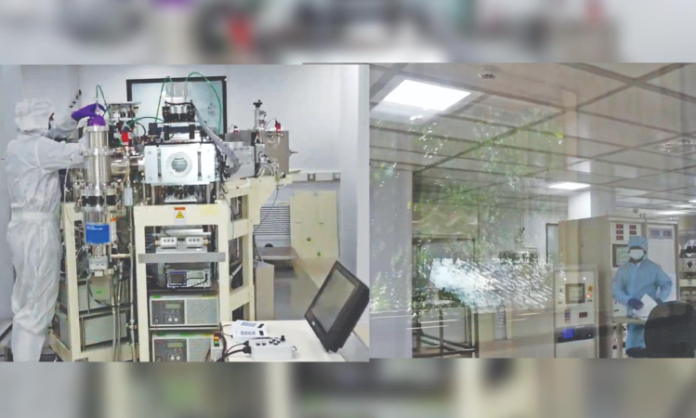
Chennai: IIT-Madras has inaugurated a new AMOLED Research Centre (ARC) aimed at advancing the development of next-generation display technologies. This facility is part of India’s initiative to enhance its capabilities in display manufacturing, particularly for Active Matrix Organic Light Emitting Diode (AMOLED) displays used in smartphones, tablets, and wearables.
The ARC is funded by the Ministry of Electronics and Information Technology (MeitY), the Defence Research and Development Organisation (DRDO), and Tata Sons, highlighting a collaborative effort to boost India’s technological infrastructure.

Located within the Department of Electrical Engineering at IIT-Madras, the ARC boasts state-of-the-art cleanrooms with ‘class 100’ and ‘class 1000’ ratings. It is equipped with advanced fabrication tools and an innovative pixel patterning system developed by IIT-Madras researchers. The centre will not only focus on AMOLED displays but also engage in research related to OLED TVs, OLED lighting, and organic photovoltaic devices. This aligns with the broader goal of establishing a self-reliant semiconductor industry in India.
The primary objective of the ARC is to develop novel manufacturing techniques that can lead to more efficient production processes. One notable approach being explored is the “economies-of-speed” concept, which aims to optimise fabrication times while utilising smaller mother-glass sizes. This could enable the establishment of modular micro-factories for display production, making it more scalable and cost-effective.
The global AMOLED display market is currently valued at approximately $15 billion and is anticipated to grow significantly. The innovations from ARC are expected to position India as a competitive player in this expanding market, catering to both domestic and international demands for high-quality display technologies.
The establishment of the AMOLED Research Centre at IIT-Madras represents a significant step towards enhancing India’s capabilities in advanced display technology, fostering innovation, and supporting the country’s ambitions in the global electronics market.


Raksha Anirveda's editorial desk team brings in the collective experience of creative professionals - a fine mix of senior copy editors, writers, proofreaders and designers. Working as a team, they continuously create, manage, and curate content to sustain the magazine's profile and reputation in line with market trends and achieve magazine's goal.





