


The Indian Army’s drone fleet has grown from a few hundred to more than 50,000 in two years, with plans to double that number within the next two to three years. This marks a significant shift in how India prepares to fight. But numbers alone can mask a critical weakness. How much of this fleet can India build, sustain and control on its own?
Estimates suggest that 50 to 60 per cent of drone components are imported, while the claim that every permanent magnet used in Indian drones is imported remains unverified. The irony is hard to miss: India is expanding its drone fleet at speed, yet, much of the industrial foundation that keeps them flying may still lie beyond its control.

Sovereignty Is Not Self-Sufficiency
The test of sovereignty begins where assembly ends. An Indian company may build the airframe, integrate the payload and deliver the finished drone, yet remain dependent on a foreign supplier for its motor, flight controller or software updates.
Domestic firms largely assemble imported modules, leaving crucial components like brushless motors, lithium cells and sensors exposed to foreign supply disruptions
The drone may be Indian by manufacture but vulnerable by design. In a crisis, the decisive question is not where it was assembled. It is whether India can manufacture it, maintain it, secure its data and sustain its operation without permission from an external supplier.
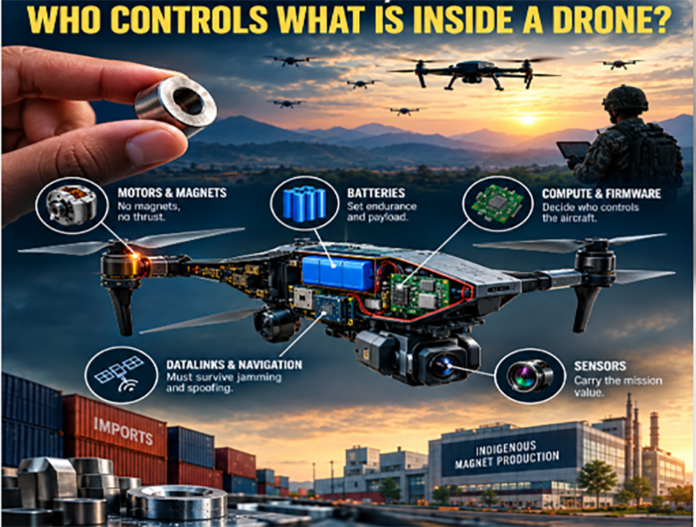
Inside a typical military multi-rotor, five things decide control over the drone, i.e.;
- Motors and magnets. Brushless motors run on sintered neodymium-iron-boron magnets. Without them, there is no thrust.
- Batteries. Lithium cells set endurance and payload, and supply is concentrated with a few Asian producers.
- Compute and firmware. The processor, autopilot software and update path determine who actually controls the drone.
- Datalinks and navigation. Radios and satellite navigation receivers must withstand jamming and spoofing.
- Sensors. Electro-optical and infrared payloads carry most of the mission value.
The airframe is the visible part of the drone, but it is rarely the source of its greatest strategic vulnerability. A motor failure grounds the drone. A battery shortage reduces endurance and constrains the fleet.

A compromised flight controller or insecure update mechanism raises a more serious question: who can influence the drone after it enters service? A vulnerable datalink can expose it to disruption, while dependence on satellite navigation can become a liability under jamming or spoofing.
Foreign flight controllers, datalinks and unverified firmware update channels create severe espionage and jamming vulnerabilities inside “Indian-made” drones
These risks are different and require different remedies. They should not be hidden behind a single indigenous-content percentage.

The Cost Has Already Been Paid Once
In February 2025, press reports citing defence sources said three contracts for 400 logistics drones, worth over ₹ 230 crore, were cancelled because of Chinese components. The contracts covered 200 mid-altitude, 100 heavyweight and 100 lightweight drones, bought under emergency procurement in 2023 from a single Chennai-based company. I found no official statement, so treat the details as reported, not confirmed.
The lesson is about verification, not about a single vendor. The drones were ordered, built and nearly delivered before anyone established what was inside them. A foreign radio module or a foreign firmware update channel is not only a supply risk. It is a data risk, and it can sit inside a drone with an Indian name on the side.
Incentives That Were Too Small
The policy record shows steady intent and modest funding. India banned imports of finished drones in 2022 but left components open. The 2021 production-linked incentive offered 20 per cent of value addition, within a ₹ 120 crore envelope over three years.
The reported cancellation of ₹230 crore worth of army drone contracts over Chinese parts highlights the urgent need for pre-delivery component verification
The government disbursed about ₹ 30 crore in 2022-23. Turnover of the shortlisted companies rose from ₹ 88 crore to about ₹ 319 crore between FY21 and FY22, which is real growth, but the kind of assembly of imported modules can deliver.
Turnover is a useful measure of industrial activity, but it does not establish the depth of domestic capability. The relevant questions are how much of the value is created within India, which critical components are manufactured here, who owns the underlying intellectual property, and whether production can continue if imports stop.
A company assembling imported modules may be commercially successful without building the capability that the armed forces need in a prolonged conflict. Incentives should, therefore, reward verified manufacturing depth, not just finished-drone output or declared localisation.
In my view, closing the door on whole drones while leaving it open for parts produced by assemblers not manufacturers, is a judgemental call and not a measured result. Thus, the successor scheme remains unsettled.
Media reports in July 2025 described a ₹ 2,000 crore programme aiming for 40 per cent localisation of key components by FY28. In August 2026, the civil aviation minister said a new incentive scheme was being prepared, and its structure and timing had not been disclosed. I could not confirm that any scheme has been notified.
Past production incentives rewarded assembly turnover over deep manufacturing, while the new ₹7,280 crore rare-earth magnet scheme won’t yield output until at least 2028
The Magnet Scheme Aims at the Right Chokepoint, And Arrives Late
On November 26, 2025, the Union Cabinet approved a ₹ 7,280 crore scheme for sintered rare earth magnets. It targets 6,000 tonnes per year, with ₹ 6,450 crore in sales-linked incentives and ₹ 750 crore in capital subsidy over seven years, including a two-year build phase.
The notification highlights the gap: India mines and refines rare earth oxides through a state-owned company but lacks industrial-scale capacity to turn oxides into metal, alloy and finished magnets. Bids for the same were invited in March 2026.
Two cautions follow. First, on the scheme’s own timetable, I would not expect meaningful domestic output before 2028, and probably later. That is my inference, not an official forecast. The fleet is growing much faster than that, so for the next two or three years, India will fly on imported magnets, whatever it decides today.
Second, drones are likely to be a small buyer by tonnage compared with electric vehicles and wind turbines. Without a defence offtake commitment, early domestic magnets may go to whoever orders the most.
India must enforce tiered localisation deadlines, stockpile critical magnets and mandate defence offtake clauses so domestic raw materials reach military motor makers
Four Moves
- Publish a tiered component list with dates. Tier one: magnets, cells, flight controllers and secure datalinks. Tier two: cameras, gimbals and power electronics. Tier three: commodity parts where imports are acceptable.
Procurement rules then follow the list, and each tier has its own localisation deadline. A single “indigenous content” percentage can be met while the parts that prevent a drone from flying remain foreign.
- Bridge the gap openly. Maintain a strategic reserve of motors and magnets, sized to cover a stated number of months of military production and diversify import sources. This costs money, but it costs less than a grounded fleet.
- Tie the magnet scheme to drone demand. Attach a defence offtake clause to magnet awards and have motor makers qualify domestic grades early, so the first tonnes have a buyer. Deliberately fund winding and magnet-to-motor integration. A magnet plant without a motor maker beside it is half a supply chain.
- Certify trust, not origin. Create a national certification covering firmware audits, update-channel control and supply-chain traceability. A foreign-designed part built under audited conditions can be acceptable. A domestic part with unexamined foreign firmware is not. This turns sovereignty into something a procurement officer can verify.
This framework needs a single point of accountability. The Ministry of Defence should designate a lead authority to maintain the critical-component register, set localisation milestones with the services and verify compliance before awarding a contract.
Certification must continue after induction through periodic firmware audits, controlled software updates and checks on changes in component suppliers. Vendors should disclose the origin of critical modules and demonstrate that they can support the platform if the original supplier withdraws.
Moving beyond broad indigenous-content percentages, the Defence Ministry should audit firmware, secure update paths and pool tri-service demand to build a resilient ecosystem
Sensitive source code and design data can be examined under secure, need-to-know arrangements without requiring unrestricted disclosure to every buyer. The objective is to establish trust that can be tested, not paperwork that can be submitted.
Two supporting steps matter as much. Pool demand across the services into common component standards, because no supplier builds a magnet or cell line for orders of a few hundred units. Further, expand testing capacity, since qualifying a new motor or datalink takes months of vibration, thermal and jamming trials and a good domestic part can lose a year waiting in a queue.
Overall, the measure of a sovereign drone ecosystem is not the number of drones delivered. It is how long the fleet can remain operational when a critical supplier withdraws, how quickly production can be restored, and whether India retains control over the software, data and updates on which the mission depends.
Progress should be tested against disruption scenarios, not declared through localisation percentages alone. India does not need to manufacture every component within its borders. It does need to know which dependencies can stop a mission, which can be replaced, and which must be brought under assured national control.

The writer, a PVSM, AVSM, VSM has had an illustrious career spanning nearly four decades. A distinguished Armoured Corps officer, he has served in various prestigious staff and command appointments including Commander Independent Armoured Brigade, ADG PP, GOC Armoured Division and GOC Strike 1. The officer retired as DG Mechanised Forces in December 2017 during which he was the architect to initiate process for reintroduction of Light Tank and Chairman on the study on C5ISR for Indian Army. Subsequently he was Consultant MoD/OFB from 2018 to 2020. He is also a reputed defence analyst, a motivational speaker and prolific writer on matters of military, defence technology and national security. The views expressed are personal and do not necessarily carry the views of Raksha Anirveda






