


India’s vision of the Indo-Pacific has evolved over the past decade from a primarily Indian Ocean-centred maritime doctrine into a comprehensive and multidimensional geopolitical strategy. Today, India’s Indo-Pacific approach has attracted significant attention among policymakers and strategic analysts worldwide, reflecting the country’s growing role in shaping the future of this vast maritime region.
India’s geography, demographic strength, economic potential, and civilisational heritage place it in a category of its own. The Indo-Pacific that India seeks to help shape is neither an American lake nor a Chinese sphere of influence, nor a theatre of permanent confrontation. Instead, New Delhi envisages an open, inclusive, multipolar and rules-based maritime order, where sovereignty is respected and no nation is coerced into submission.

Within Indian strategic thinking, the Indo-Pacific now represents a continuous maritime space extending from Africa’s eastern coastline to the western Pacific. India values partnerships with middle powers because it has little interest in a bipolar order dominated exclusively by Washington and Beijing.
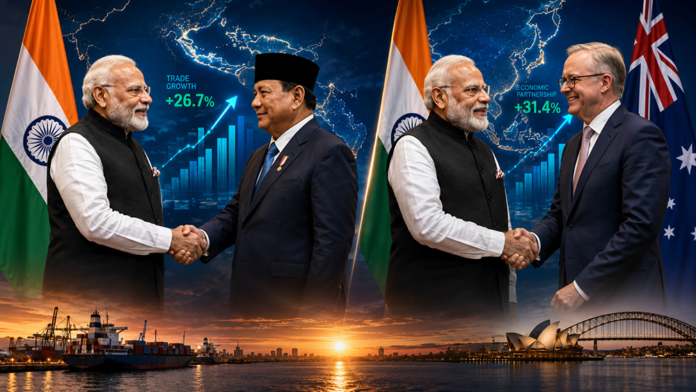
Against this strategic backdrop, Prime Minister Narendra Modi’s recent visits to Indonesia, Australia, and New Zealand assume significance far beyond routine diplomacy.
Collectively, the three visits illustrate India’s expanding strategic horizon across the Indo-Pacific and its determination to strengthen partnerships with countries that influence the region’s evolving maritime balance.
The Emerging Arc of Trust
A new strategic arc, with India increasingly positioned at its centre, is gradually taking shape across the Indo-Pacific.

Prime Minister Modi’s three-nation tour reflected New Delhi’s continuing effort to deepen partnerships across the eastern Indo-Pacific with countries that will play an increasingly important role in India’s maritime future.
The agenda extended well beyond traditional diplomacy, encompassing trade, critical minerals, defence, maritime security, education, technology, innovation, and diaspora engagement.

More fundamentally, the tour reflected India’s MAHASAGAR (Mutual and Holistic Advancement for Security and Growth Across Regions) vision, which expands the earlier SAGAR (Security and Growth for All in the Region) doctrine from the Indian Ocean to the wider Indo-Pacific.
Indonesia, Australia, and New Zealand occupy strategically important positions across this expanded maritime geography. Together, they sit astride vital sea lanes, resilient supply chains, and strategic partnerships through which India’s economic, technological, and security interests increasingly intersect with those of the Pacific.
The significance of the three-nation tour becomes even clearer when each visit is examined within this broader strategic framework.
Indonesia: Gateway to the Indo-Pacific
Indonesia occupies a pivotal position in India’s eastern Indo-Pacific strategy. Situated at the confluence of the Indian and Pacific Oceans, Indonesia straddles the Malacca, Sunda, and Lombok Straits — three of the world’s most strategically important maritime chokepoints.
For India, whose trade, energy supplies, and maritime commerce depend heavily on these sea lanes, Indonesia is far more than an important ASEAN partner. It is one of the principal maritime gateways linking the Indian Ocean with the Pacific.
Indonesia’s importance has grown further because of its position in global critical mineral supply chains, particularly nickel, a resource central to battery manufacturing and electric mobility.
The Indo-Pacific that India seeks to help shape is neither an American lake nor a Chinese sphere of influence, nor a theatre of permanent confrontation. Instead, New Delhi envisages an open, inclusive, multipolar and rules-based maritime order
As India seeks to build resilient supply chains and accelerate its clean-energy transition, cooperation with Indonesia in the critical minerals sector has acquired increasing strategic significance.
During Prime Minister Modi’s visit, India and Indonesia signed 14 agreements covering critical minerals, maritime security, defence cooperation, and trade.
According to the joint statement issued after the summit, both leaders reaffirmed their commitment to further strengthening defence and maritime cooperation, building upon the Defence Cooperation Agreement of 2018.
They also emphasised that economic and trade cooperation remains one of the principal pillars of the expanding India-Indonesia strategic partnership and pledged to unlock new opportunities for investment, connectivity, and industrial collaboration.
Among the agreements concluded during the visit were Memoranda of Understanding (MoUs) covering agriculture, steel, and critical mineral supply chains.
Perhaps the most strategically significant outcome, however, was the contract between BrahMos Aerospace and Indonesia’s Ministry of Defence for the supply of BRAHMOS supersonic cruise missiles to the Indonesian armed forces.
Beyond its commercial value, the agreement marks an important milestone in India’s emergence as a credible defence exporter and a trusted security partner in the Indo-Pacific.
Australia: India’s Strategic Anchor in the Southern Indo-Pacific
Australia has emerged as one of India’s most consequential strategic partners in the Indo-Pacific. Over the past decade, bilateral relations have undergone a remarkable transformation. Once constrained by differences over nuclear policy, the partnership today encompasses defence, maritime security, logistics cooperation, critical minerals, education, clean energy, advanced technology, and trade.
Australia occupies a central place in India’s eastern Indo-Pacific strategy. As a key member of the Quad, Canberra has become an important security partner in promoting a free Indo-Pacific.
The Quad itself has evolved considerably. Initially perceived primarily as a strategic balancing arrangement, it has progressively expanded its agenda to include maritime domain awareness, resilient supply chains, emerging technologies, health security, critical infrastructure, and disaster resilience.
Against this backdrop, Prime Minister Modi’s visit to Australia assumed considerable strategic significance.
During bilateral discussions with Australian Prime Minister Anthony Albanese, the two leaders reviewed cooperation across a wide spectrum of areas, including trade, defence, clean energy, education, critical minerals, supply-chain resilience, technology and diaspora engagement.
Both sides also reaffirmed their commitment to concluding a Comprehensive Economic Cooperation Agreement (CECA) at the earliest opportunity, recognising its potential to significantly expand bilateral trade and investment.
One of the most important outcomes of the visit was the adoption of a new Joint Declaration on Defence and Security Cooperation, substantially upgrading the existing strategic framework.
The two countries agreed to enhance interoperability between their armed forces, expand bilateral and multilateral military exercises, establish an Annual Defence Ministers’ Dialogue, and deepen cooperation in cybersecurity, maritime security, defence industry collaboration, and emerging technologies.
Another significant initiative was the unveiling of the India-Australia Maritime Security Collaboration Roadmap, aimed at strengthening information-sharing, maritime domain awareness, and operational coordination across the Indo-Pacific.
Australia’s decision to permit uranium exports for India’s civilian nuclear programme represents another milestone in bilateral relations. By removing one of the last remaining legacy issues in the relationship, the decision strengthens India’s long-term clean-energy ambitions while reinforcing mutual strategic trust.
The two countries also agreed to broaden cooperation in critical minerals, recognising their growing importance in ensuring resilient supply chains for advanced manufacturing, renewable energy, and emerging technologies.
Collectively, these initiatives underscore the transformation of the India-Australia relationship into one of the principal pillars of New Delhi’s Indo-Pacific strategy.
New Zealand: Extending India’s Pacific Reach
Although considerably smaller in size, New Zealand occupies an important place in India’s broader Indo-Pacific engagement by extending New Delhi’s diplomatic and strategic reach deeper into the Pacific.
Prime Minister Modi’s visit — the first by an Indian Prime Minister in four decades — built upon the momentum generated by recent high-level exchanges, including President Droupadi Murmu’s 2024 visit and Prime Minister Christopher Luxon’s 2025 visit to India.
Both countries share a strong interest in preserving a stable maritime order, secure sea lanes, and an open Indo-Pacific, providing a solid foundation for expanding bilateral cooperation.
Indonesia strengthens India’s engagement with Southeast Asia and the eastern Indian Ocean. Australia reinforces India’s strategic weight in the southern Indo-Pacific. New Zealand extends India’s diplomatic and maritime reach into the South Pacific
Among the major outcomes of the visit was a renewed commitment to maximise the benefits arising from the recently concluded India-New Zealand Free Trade Agreement (FTA).
The two sides also announced new collaborative initiatives in dairy, kiwifruit cultivation, agricultural technology, and high-performance sports, reflecting the increasingly diversified nature of bilateral relations.
The visit featured the well-attended “Kia Ora Modi” diaspora event at Spark Arena in Auckland, where both Prime Ministers highlighted the growing contribution of the Indian diaspora in strengthening people-to-people ties.
More significantly, the two leaders formally elevated bilateral relations to a Strategic Partnership and endorsed a Roadmap to 2030, aimed at doubling bilateral trade while expanding cooperation across multiple sectors.
Key agreements announced during the visit included enhanced maritime cooperation in the Indo-Pacific and mutual logistics support between the Indian Navy and the New Zealand Defence Force, further strengthening defence cooperation between the two countries.
Although New Zealand’s military capabilities are modest compared with those of larger Indo-Pacific partners, its strategic location and longstanding commitment to a rules-based maritime order make it an increasingly valuable partner in India’s wider Indo-Pacific vision.
Building a Network of Trusted Partners
Indonesia strengthens India’s engagement with Southeast Asia and the eastern Indian Ocean. Australia reinforces India’s strategic weight in the southern Indo-Pacific. New Zealand extends India’s diplomatic and maritime reach into the South Pacific.
Across Indonesia, Australia, and New Zealand, India expanded cooperation in an exceptionally broad range of sectors, including trade, defence, maritime security, critical minerals, technology, innovation, clean energy, education, and people-to-people exchanges.
India shares with all three countries a common interest in preserving regional stability, freedom of navigation, resilient supply chains, and a predictable maritime order.
Supply-chain diversification, energy security, access to critical minerals, and cooperation in emerging technologies have become central pillars of India’s Indo-Pacific strategy as it seeks to preserve strategic autonomy amid intensifying geopolitical competition.
Equally significant is the contribution of the vibrant Indian diaspora, whose growing presence across all three countries serves as a bridge for trade, investment, education, technology, innovation, and cultural engagement.
Prime Minister Modi’s three-nation tour was less about three bilateral relationships than about reinforcing India’s emergence as a leading maritime partner across the Indo-Pacific.
he three visits reflected New Delhi’s determination to strengthen the southern arc of the Indo-Pacific through its Act East Policy, and its MAHASAGAR vision.
Together, they illustrate New Delhi’s effort to construct a network of trusted maritime partnerships spanning the wider Indo-Pacific, enabling it to work with like-minded countries while retaining the flexibility that has long characterised India’s foreign policy.

The author retired as a Senior Technical Officer at the Central Salt and Marine Chemicals Research Institute, Bhavnagar (Gujarat), and currently contributes articles to research journals and magazines. The views expressed are personal and do not necessarily carry the views of Raksha Anirveda.





