


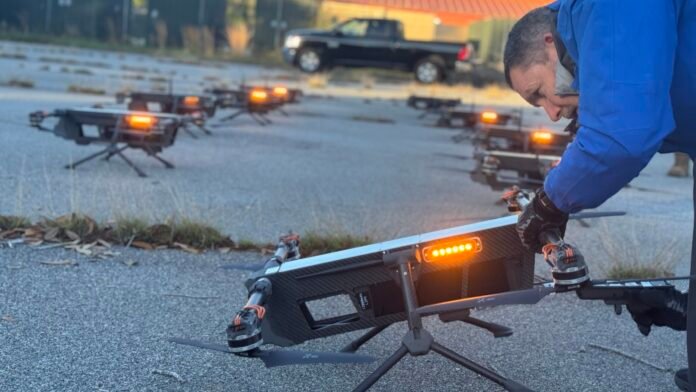
Washington: The Pentagon’s embassy in Silicon Valley, the Defence Innovation Unit (DIU), is offering up to $100 million in prizes for companies to prototype new user-friendly “orchestrator” control software for whole formations of unmanned air, ground, and water vehicles.
Submissions are due by January 25 and, in keeping with Secretary Pete Hegseth’s need for speed, the pace will be brutally brisk.

“If selected, performers must be able to begin Sprint 1 testing within 10 days of selection notification,” says the detailed guidance for interested companies, with successively more complex stages following fast over the next six months.
Backed by the US Navy and the Defence Autonomous Warfare Group (DAWG, carrying on work from the original Replicator initiative), the project aims to move beyond the current, labour-intensive model in which each drone requires at least one trained human operator to constantly direct it by remote control during all but the most basic tasks. Instead, DIU wants to develop an Autonomous Vehicle Orchestrator, an AI mediator between human and machine that turns plain-English instructions into detailed machine-readable commands the robots can execute.
In theory that “orchestrator” would allow a single ordinary service member, without special training, to give broad commands to a whole group of unmanned vehicles at once — by text or voice.
“We want orchestrator technologies that allow humans to work the way they already command — through plain language that expresses desired effects, constraints, timing, and priorities — not by clicking through menus or programming behaviours,” said Marine Lt Gen Frank Donovan, the three-star director of the DAWG, in the official announcement.

Proposed prototypes must be able to understand and execute common military commands, the guidance for industry explains, like “place crafts 1-5 in echelon left” or “hold position, conserve battery, and wait for further tasking unless a threat crosses Line Bravo.”
Voice control is probably the project’s biggest challenge: If you think refilling prescriptions or making reservations with an AI voice can get frustrating, imagine trying to win a war with one. While the explosion of Large Language Models has revolutionised AI’s ability to communicate with humans in plain text, voice communication still lags behind.

But most people talk faster than they type, especially under stress, and in combat, troops want to have their hands on a weapon, not on a keyboard, and their eyes scanning for danger, not staring at a screen. So there’s real value in voice control that can work even amidst the roar and terror of a battlefield. At least one company, Primordial, says it has field-tested voice-operated drones for Army special operators. The DIU’s $100 million in prize money should bring other startups out of stealth mode.
The other complex technical challenge is likely to be found in making the “orchestrator” AI smart enough to turn the human’s voice or text commands into a detailed plan coordinating multiple drones, potentially of different types — say, drones flying cover for robot boats or tanks — and then adapt that plan as it acquires new information, without freezing up and asking the human for new instructions. Indeed, the submission guidelines make clear that the AI might not always be able to reach a human because enemy jamming or natural obstacles might block transmissions.
“The Orchestrator must be designed to function effectively under intermittent connectivity. The Orchestrator may also eventually need to be run in a disconnected, edge environment without access to the cloud,” the guidance says. “The system must present operators with realistic representations of communications availability and autonomous behaviour, preventing false assumptions of control.”
DIU announced the Orchestrator project on January 13. The next day, the Pentagon’s Research and Engineering branch, led by newly empowered Under Secretary Emil Michael, released video from what appeared to be a related effort, the military’s first “Swarm Forge” experiment on January 8. While less than a minute and a half, the video and voiceover portrayed a four-drone formation — one “brain” drone leading three expendable kamikazes — striking three simulated tanks in seconds, almost simultaneously.
“The leader drone will identify what needs to be hit, and then the three follower drones will go in and attack,” an unidentified narrator explained. In this specific experiment, defence contractor Auterion said its software coordinated the swarm and said that a single human operator designated the targets, and then left the details up to the AI.






