


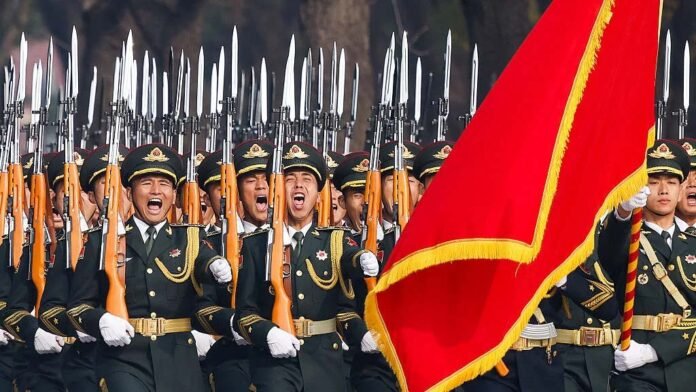
Atlanta: The recent push by China to build up and modernise its military means the American homeland is “increasingly vulnerable” to a myriad of threats that “directly threaten Americans’ security,” according to a new Pentagon report.
Over the course of 100 pages, the report, an annual assessment mandated by Congress states that while the Trump administration is pursuing friendlier relations with Beijing, the Asian giant has expanded its capabilities in several key strategic domains, including the cyber, space and nuclear disciplines.

The People’s Liberation Army is also well on its way to meeting leader Xi Jinping’s directive that it be in a position to achieve a “strategic decisive victory” over Taiwan by 2027 if so ordered. “In other words, China expects to be able to fight and win a war on Taiwan by the end of 2027,” the report states bluntly.
The assessment says that in 2024 China “tested essential components” of Taiwan invasion options, “including through exercises to strike sea and land targets, strike US forces in the Pacific, and block access to key ports.”
Among the key points in the report include buildup in space: it observes that by January 2024 China had already tripled its ISR satellite platforms on-orbit since 2018. Those satellites, along with others, and “coupled with PLA’s growing space-based ISR order of battle has dramatically increased its ability to monitor, track and target US and allied forces both terrestrially and on orbit.”
On nuclear weapons: China’s stockpile of nuclear weapons “remained in the low 600s through 2024,” the report says, which reflected a “slower rate of production” compared to previous years. However, it said a “massive” nuclear expansion has continued, and the PLA” remains on track to have over 1,000 warheads by 2030. For comparison, the US holds around 3,700 nuclear warheads and Russia has around 4,300, according to the Federation of American Scientists.

Missiles in silos: The report contends that the Chinese military has “likely loaded more than 100 solid-propellant ICBM missile silos at its three silo fields with DF-31 class ICBMs, which are very likely intended to support EWCS [early warning counterstrike capability].”
An ICMB into the Pacific: In September 2024 China launched an unarmed intercontinental ballistic missile “into the Pacific Ocean for the first time since 1980, probably to practice a wartime nuclear deterrence operation […].” (China warned the US about the test, but not some neighbours like Japan or the Philippines.)

In cyberspace: “In 2024, China’s cyber actors continued to conduct widespread cyberespionage and pre-position cyberattack capabilities against the United States, its allies, and partners, in line with Beijing’s goals to gain dominance in the information domain,” the report says, referencing the widespread Salt Typhoon and Volt Typhoon infections.
Relations with Russia: The report notes that in July 2024 China and Russia flew a “combined bomber patrol into the US Alaska Air Defence Identification Zone (ADIZ) for the first time,” which came months before the two nations “conducted their first combined coast guard patrol” in the Bering Sea. Overall, the report says Beijing and Moscow “deepened their strategic relationship, almost certainly driven by a shared interest in countering the United States” — but the two have stopped short of a defence alliance.
The report comes just weeks after the Trump administration published its National Security Strategy, which mostly shifted American focus to the Western Hemisphere and, when it discussed China, focused on economic relations.
“Under President Trump’s leadership, relations between the United States and China are stronger than they have been in many years, and the Department of War will support efforts to build on this progress,” the report says. “[…] At the same time, we will ensure that the Joint Force is always ready and able to defend our nation’s interests in the Indo-Pacific. As we do so, it bears emphasising that US interests in the Indo-Pacific are fundamental — but also scoped and reasonable.
“We do not seek to strangle, dominate, or humiliate China,” it says.






