


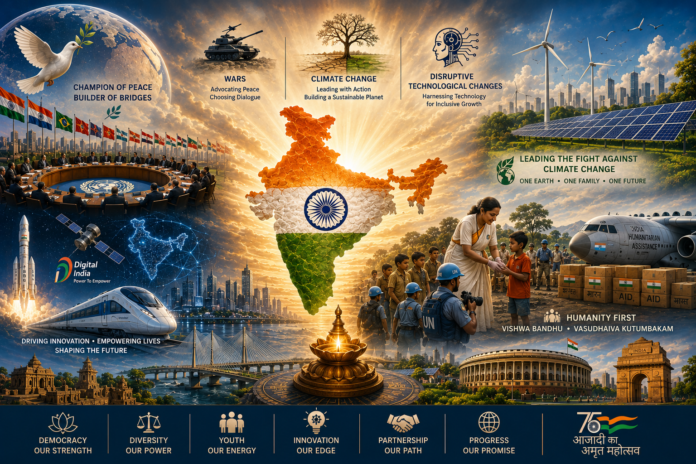
Aristotle, one of the foundational thinkers in Western political thought, believed that change is inevitable. For him, change was not a phenomenon that brought forth instability and chaos; rather, it signified the movement of human order towards a state of perfection. Change can be gradual or radical. When this concept of change is seen from the prism of the trajectory of a civilisational state like India, we find that a country which received its independence after a tumultuous period of British rule, full of omissions and commissions; it was time to grow and fulfil the country’s mission which its founding personalities had envisaged for it.
Fast-forward to the third decade of the 21st century, we are witnessing the rise of a country which is not only ambitious, but is also determined to claim its rightful place in the comity of nations. The last decade in this context has been a consequential one in regard to the transformation of the country from an emerging power to a real global power. The parameters of a nation’s strength in today’s day and age can be gauged from its progress in three areas — technological sophistication, economic development, and diplomatic clout. This assertion, therefore, necessitates a detailed analysis based on all these three parameters, which are interrelated.

A Rising Star in the Realm of Technology
In his book Homo Deus—A Brief History of Tomorrow, the Israeli historian Yuval Noah Harari argued that technological changes had, and still possess, the potential to rewrite the very history of human societies. This task of writing history seems to be apt when seen in the context of India’s remarkable journey. Over the years, India’s technological base and sophistication have evolved markedly. However, this acceleration has really picked up in the last decade. Today, India is one of the rising stars in the field of sophisticated technology.
In addition, initiatives like Digital India have been instrumental in developing a technologically sophisticated ecosystem in the country marked by the growth of a platformised society where technology has not only improved governance but has been a critical player in improving the lives of citizens. One of the key parts of the Digital India initiative is the growth of a state-of-the-art Digital Public Infrastructure (DPI).
India’s journey in the realm of technology has been remarkable. Over the years, India’s technological base and sophistication have evolved markedly. This acceleration picked up rapidly in the last decade. Today, India is one of the rising stars in technology
One of the key components of the DPI is UPI or United Payments Interface, a digital payments regime that has not only revolutionised the manner in which we pay, but has played a key role in formalising the economy. This system has expanded dramatically since its launch, growing from 2 crore transactions in FY 2016–17 to over 24,162 crore transactions in FY 2025–26, valuing the total cost of the transactions at Rs 314 lakh crore.
While Digital India is symptomatic of the utilitarian use of technology to improve governance, it becomes imperative to analyse how India is using technology to reshape the landscape of war. The ongoing wars in Ukraine and Iran have demonstrated the importance of drones as low-cost, high-damage-inflicting weapons. In this situation, the Indian Army is pioneering the philosophy of every soldier being a technologically savvy warrior. This is finding its expression in the integration of drones in the operationalisation of new formations like the Integrated Battle Groups, Bhairav Battalions, Shaktibaan Regiments, and Divyastra Batteries.

Dependence on other countries for critical military infrastructure may undermine national security at crucial moments in a conflict. Keeping that need in mind, the indigenisation of critical military infrastructure is moving ahead on a war footing. The Indian Navy recently inducted a spate of warships — ranging from stealth frigates and corvettes to guided missile destroyers, anti-submarine vessels, all with high indigenous content.
Effective use of technology in conflicts often requires a doctrinal push in order to develop a sense of coherence. This is something which the newly appointed Chief of Army Staff (COAS), General Dhiraj Seth has underlined via the VIJAY doctrine where — V stands for vigilance, underscoring the need for maintaining a sense of readiness in land, cyber, electromagnetic spectrum, and information; I for Information which articulates the need for faster doctrine, procurement, and technology absorption; J for Jointness, focusing on integrated theatre commands in the tri-services; A stands for Aatmanirbharta or promoting indigenisation in defence design and production; and, Y for Yoddha or Warrior, where the emphasis lies on the soldier and auxiliary personnel like the Agniveer.

India is among the top five economies in the world in terms of GDP, ranks third in Purchasing Power Parity (PPP), and the service sector dominates high-value exports in Information Technology, software development, and professional business services
Strong Economic Fundamentals
When we analyse hard power, we find that economics is an inextricable part of it. In the last decade, India’s economy has taken off rapidly. Today, the country is among the top five economies in the world in terms of GDP, ranks third globally in terms of Purchasing Power Parity (PPP), and has increasingly improved its per-capita income. Within the Indian economy, the service sector dominates in the form of high-value exports in Information Technology, software development, and professional business services.
What makes India an economic powerhouse is the presence of a vast domestic market, coupled with the sheer diversity of its export basket. India’s exports over the last decade have increased to reach US$ 825 billion in 2024–25, led by engineering goods, electronics, and pharmaceuticals, with the government of India targeting $1 trillion in exports by 2030.
Every major global player is seeking to invest in the India story, particularly aiming to leverage technology to expand their footprint across the Indian market. This is particularly evident in the announcement of several key collaborations for big-ticket data centre projects between Google and Reliance, Adani and Meta.
Growing Diplomatic Heft
To give practical effect to its strong macro and micro-economic fundamentals and the increasingly sophisticated nature of technology, diplomacy comes in handy. With an expansion of India’s power profile, its diplomatic heft has also expanded. This was felt acutely during the ongoing Iran-US-Israel war. Despite the closure of the Strait of Hormuz by Iran, a critically important waterway which functions as a key destination for India’s imports of hydrocarbon resources, New Delhi acted quickly. It expanded the portfolio of partners who can meet New Delhi’s oil and natural gas needs — increased purchases of non-Gulf crude grades from Russia & the United States of America; In West Africa, New Delhi sourced alternative supplies from countries like Angola; From South America, India imported new crude grades from Venezuela; and from, Fujairah (UAE), it utilised pipeline-connected ports located outside the Persian Gulf chokepoint.
Diplomacy comes in handy in giving practical effect to macro and micro-economic fundamentals and technology. With an expansion of India’s power profile, its diplomatic heft has expanded. This was felt acutely during the ongoing Iran war
In pursuance of its role as a country that pioneers HADR (Humanitarian Assistance and Disaster Response) form of diplomacy, Operation Amistad stands out. Venezuela, devastated in the wake of twin earthquakes, saw India sending medical, food, and other forms of emergency assistance. In addition, New Delhi sent emergency medical supplies and pharmaceutical aid to the Democratic Republic of Congo (DRC) in late May 2026 to help the country combat a severe Ebola outbreak; these include emergency diagnostics, therapeutics, and medical equipment. The gratitude expressed by the people of both countries serves as a testimony to India’s commitment to helping suffering humanity anywhere and everywhere.
In recent years, negotiations from a position of strength have become the norm. This assumes significance in India’s commercial relationships with its partners. A slew of bilateral trade deals which New Delhi recently signed with countries and actors like Australia, New Zealand, the European Union, and the United Kingdom and the refusal of New Delhi to compromise with its core interests while remaining true to the spirit of the multilateral trading order, underscores the increasing strength of India’s diplomacy.
Thus, it becomes clear that the last decade has been quite consequential for India. The need of the hour, however, is to keep the momentum going. There must be no complacency until we have reached the goal of Viksit Bharat by 2047.

The writer is a doctoral candidate in Political Science at Mahatma Gandhi Central University. The views expressed are personal and do not necessarily reflect the views of Raksha Anirveda





