


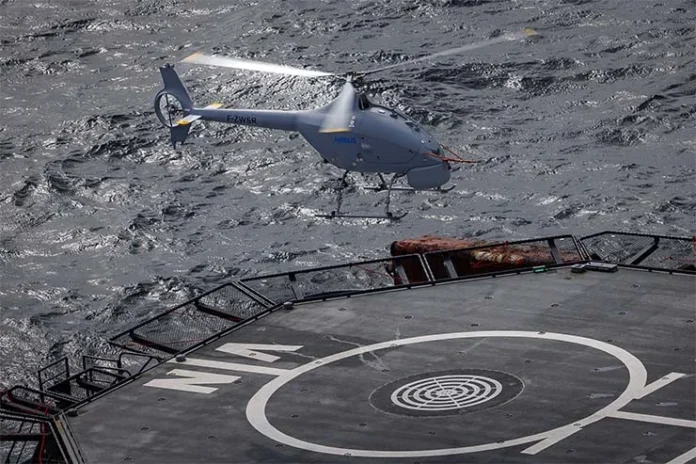
Marignane. Airbus Helicopters and the French Armament General Directorate (DGA) tested the unmanned aerial system (UAS) VSR700 for the first time in an operational configuration from a ship at sea. At the beginning of May, the VSR700 performed 80 fully autonomous take-offs and landings from a civil vessel equipped with a helicopter deck, cruising off the coast of Brittany in the west of France.

“This flight test campaign was an important step for the VSR700 programme as it allowed us to validate the excellent performance of the drone in operational conditions, which were representative of its future missions,” said Nicolas Delmas, Head of VSR700 programme at Airbus Helicopters. “The VSR700 prototype opened its flight envelope in winds above 40 knots, accumulated eight hours of testing in 14 flights, and made successful landings in several different sea states,” he added.
In 2022, the autonomous take-off and landing capabilities of the VSR700 were tested from the same vessel using an optionally piloted vehicle (OPV) based on a modified Guimbal Cabri G2 equipped with the autonomous take-off and landing (ATOL) system developed for the VSR700. This time the test campaign took place with the SDAM demonstrator and fully validated the capabilities of the system as part of the SDAM (Système de Drone Aérien pour la Marine) study that was awarded to Airbus Helicopters and Naval Group in 2017.
Autonomous take-off and landing capabilities are a key asset of the VSR700 and are made possible with the use of the Airbus DeckFinder system. This enables autonomous launch and recovery of unmanned air vehicles (UAVs) with an accuracy of 10-20cm during challenging operations in harsh environmental conditions, independently of GNSS/GPS and regardless of degraded visual conditions.
This new test campaign follows two series of trials that were conducted with the DGA in late 2022 and early 2023 from the Levant Island test center located in the south of France. During these trials, the SDAM prototype demonstrated its ability to operate in a maritime environment. The handling qualities of the aircraft were tested as well as the capabilities of the sensors (a maritime surveillance radar, an electro optical sensor, and an AIS receiver) alongside the mission system developed by Naval Group.

The next development steps will see the second VSR700 prototype perform its maiden flight ahead of flight testing onboard a French Navy FREMM during the second semester of this year.






