


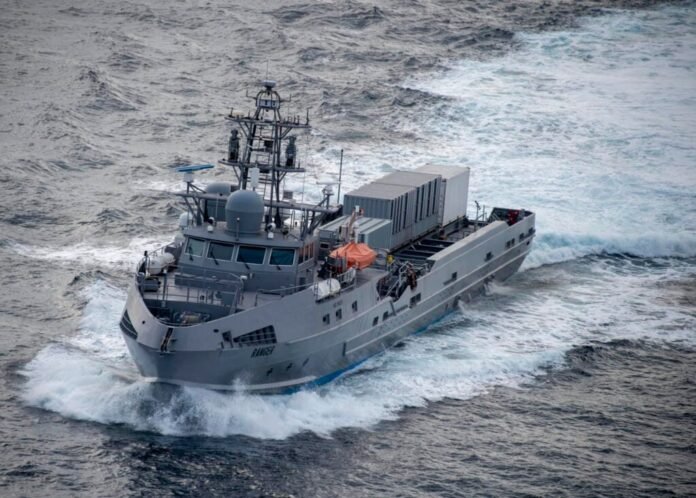
Washington: The US Navy unveiled its new Modular Attack Surface Craft programme, which would likely see unmanned surface vessels carrying missiles long distances at sea.
The programme calls for the development of a rugged, flexible and high-capacity unmanned surface vessel, or USV, capable of hauling a variety of “containerised payloads,” per a July 28 solicitation. Such payloads would include the maximum equivalent of more than four 40-foot containers — cargo that would roughly equal the size of the Navy’s anti-ballistic missile system, the Mark 70 Mod 1 Payload Delivery System.

“MASC seeks to leverage cutting-edge technologies and modular design principles to create adaptable and resilient solutions that can effectively counter evolving threats,” according to the solicitation.
As shipbuilding efforts have staggered over the years, the Navy has increasingly turned to containerised missile systems to add to the weapons capacity of existing warships, USNI News reported.
The new USVs are requested to be “non-exquisite,” and be easily built and repaired, according to Navy documents. The solicitation also asked that they be compatible with the needs of international allies.
The new solicitation comes on the heels of numerous attempts by the Navy to field new technology to solve cost, shipbuilding and modernisation issues over the last several months. Autonomous vessels have been put forward as a solution to a decades-long struggle within the Navy to obtain new ships.

Unmanned vessels featured largely in the Navy’s fiscal 2026 budget, with $203 million requested for surface vessels, $715 million for air systems and $668 million for underwater systems. Robotic vessels were also recently integrated into a major Baltic Sea warfighting exercise.
In addition to shipbuilding, the Navy has experienced problems repairing vessels, which a flexible, easily repaired surface attack USV could potentially alleviate.

In June, Naval Sea Systems Command streamlined a process for destroyer vessel components to be made using 3-D printing. Additionally, the service’s fiscal 2026 budget requested funding to modernise shipyards that, on average, are over 107 years old.






