


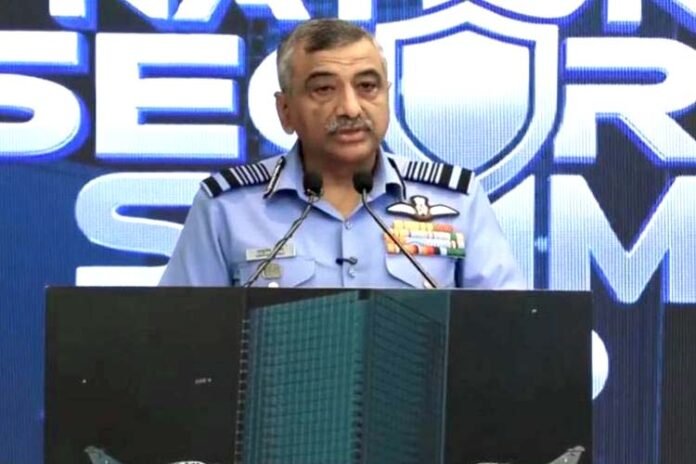
India is in a “no peace, no war” situation with China and must be ready to shift quickly towards either offensive or defensive action, Air Chief Marshal Ashutosh Dixit said on November 16. Speaking at the ANI National Security Summit 3.0 in New Delhi, the Chief of the Air Staff said the Indian Air Force was watching adversary activity closely and had plans in place to deter aggression.
Dixit described India’s position as “okay” but “not simple”, linking its ability to deter a threat to a combination of planning and the induction of new technology. He said assessments of an adversary’s air power must consider more than aircraft numbers: crew training, network-centric warfare capabilities and the altitude at which aircraft operate can all affect their effectiveness.

The remarks underline the IAF’s focus on preparedness amid continuing strategic competition with China. India and China have an unresolved border, and New Delhi has repeatedly said that peace and tranquility along it are essential to normalising bilateral relations. External Affairs Minister S Jaishankar said last month that disturbances along the border would have consequences for ties.
Dixit said monitoring adversary activity is part of the armed forces’ peacetime responsibility, alongside aligning procedures and capabilities. His comments suggest that deterrence is being framed as a combination of surveillance, readiness and the ability to use forces effectively, not simply the possession of advanced platforms. He did not provide operational details about the IAF’s plans or specify what new technologies are being inducted.
The air force also faces a numerical challenge. It currently operates 29 fighter squadrons, against a sanctioned strength of 42.5. Dixit stressed that indigenous aircraft production is important because it can help increase numbers and provide weapon-carrying capability at different locations.
He said the IAF expects a squadron of the indigenous Light Combat Aircraft (LCA) Mark 1A to join within the current financial year. Development work on the LCA Mark 2 and the Advanced Medium Combat Aircraft (AMCA) is also progressing, he said. The LCA programme draws on hundreds of work centres and laboratories across India, illustrating the scale of the industrial and technical effort involved in developing a fighter domestically.

Dixit’s comments place domestic production alongside upgrades to existing aircraft as part of the force’s response. He has said some legacy equipment has already been upgraded and that other upgrades are under way. The IAF is also pursuing the Multi-Role Fighter Aircraft (MRFA) process, which he said it wants to advance quickly, partly because procurement and production take time and squadron strength could fall further.
The broader challenge is to maintain readiness while future systems move through development and acquisition. Indigenous fighters may strengthen the force over time, but a programme’s announcement or development milestone does not immediately translate into operational squadrons. Training, weapons integration, maintenance and the pace of deliveries will all affect how quickly new aircraft can contribute.

For now, Dixit’s message is one of guarded confidence: India is tracking its adversaries and believes its plans and technology upgrades can help deter aggression, but he acknowledged that the circumstances are difficult. His use of “no peace, no war” captures the need to prepare for escalation without implying that conflict is inevitable.







