


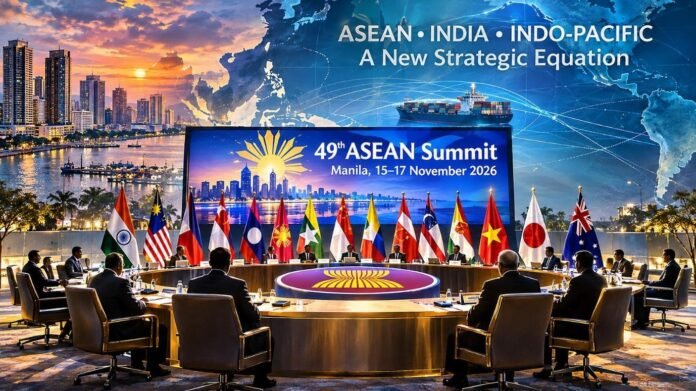
Geography has a peculiar way of turning prosperity into power and proximity into vulnerability. Few regions illustrate this better than Southeast Asia. Straddling some of the world’s busiest maritime arteries, adjoining the Indian and Pacific Oceans and sitting at the intersection of global supply chains, Southeast Asia has become the geographical centrepiece of an increasingly contested Indo-Pacific. The 49th ASEAN Summit in Manila, under the Philippines’ chairmanship, therefore convened at a defining moment in international politics.
Under the theme Navigating Our Future, Together, the summit brought 11 nations together to a conversation shaped by geopolitical rivalry, economic uncertainty, technological disruption and regional insecurity. Its deliberations produced more than 150 documents, reflecting an expansive agenda extending from maritime security to digital transformation and critical minerals. Yet its real significance lies not in the volume of declarations, but in the strategic choices they represent. ASEAN is attempting to preserve its centrality without becoming subordinate to competing power centres. That is an increasingly difficult balancing act.

The US-China Contest: ASEAN Between Two Giants
The defining strategic reality of the Indo-Pacific remains the competition between the United States and China. Beijing’s economic weight, expanding military capabilities and growing maritime assertiveness have altered regional calculations. Washington, meanwhile, continues to regard the Indo-Pacific as central to its global strategic position, strengthening partnerships and security arrangements across the region.
The summit brought 11 nations together for a conversation shaped by geopolitical rivalry, economic uncertainty, technological disruption and regional insecurity. Its deliberations produced more than 150 documents, reflecting an expansive agenda extending from maritime security to digital transformation and critical minerals
For ASEAN, this rivalry presents an uncomfortable contradiction. China is an indispensable trading partner, investor and geographical neighbour; the United States remains a significant security partner and an important guarantor of the regional balance. Neither relationship can be discarded without considerable economic or strategic consequences.
The danger is that economic interdependence may gradually become strategic dependence. Tariffs, technology restrictions, supply-chain controls and competing investment regimes are increasingly instruments of geopolitical influence. Smaller states risk being compelled to make choices that compromise their autonomy.
Manila’s emphasis on secure regional trade and strategic trade management is therefore significant. The declaration on Strategic Trade Management for Secure Regional Trade recognises that trade security, technology controls and economic resilience are no longer merely commercial concerns. They are instruments of national and regional security.

ASEAN’s challenge is to engage both powers without allowing either to dictate the region’s strategic direction. Neutrality, however, cannot become an excuse for indecision when sovereignty and international law are at stake.

South China Sea: The Test of Strategic Credibility
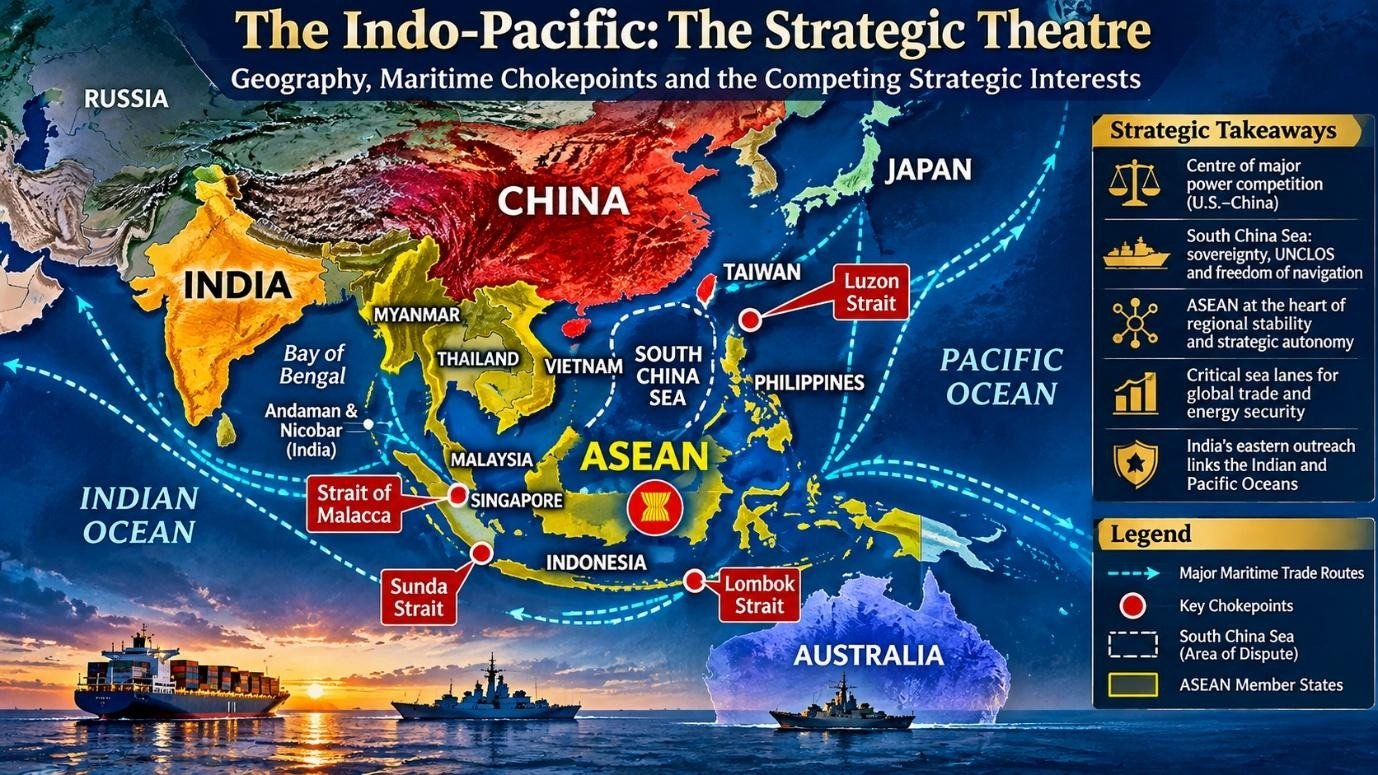
Nowhere is this dilemma more visible than in the South China Sea. The dispute involves territorial sovereignty, maritime entitlements, freedom of navigation and the interpretation of international law. For the Philippines and Vietnam, among others, it is an immediate security concern. For the wider world, it involves the uninterrupted movement of trade through one of the most important maritime corridors.
The defining strategic reality of the Indo-Pacific remains the competition between the United States and China. Beijing’s economic weight, expanding military capabilities and growing maritime assertiveness have altered regional calculations. Washington continues to regard the Indo-Pacific as central to its global strategic position
The Manila Summit produced a noteworthy development. Negotiations on the ASEAN-China Code of Conduct reached provisional agreement on approximately 80 per cent of its draft provisions, following an intensified negotiating process. The remaining questions include its legal character and other substantive issues. The negotiations have not concluded; the unfinished task passes to Singapore’s chairmanship.
This is progress, but it must not be mistaken for resolution. An effective Code must be consistent with the 1982 United Nations Convention on the Law of the Sea (UNCLOS), protect freedom of navigation and overflight, and provide credible mechanisms for managing incidents at sea. A document that merely records political assurances without constraining destabilising conduct would offer little strategic reassurance.
The larger issue is ASEAN’s credibility. International law cannot become selectively negotiable according to the relative power of the parties involved. Peaceful dispute resolution requires restraint from the powerful as much as patience from the vulnerable.
ASEAN Centrality: Unity Under Pressure
ASEAN’s greatest strategic asset is its collective voice. Its 11 members, with Timor-Leste now integrated into the grouping, represent considerable demographic, economic and geographical weight. Yet consensus-based diplomacy, while essential to ASEAN’s identity, can also limit action when national interests and threat perceptions diverge.
The Manila Summit produced a noteworthy development. Negotiations on the ASEAN-China Code of Conduct reached provisional agreement on approximately 80 per cent of its draft provisions, following an intensified negotiating process
The Myanmar crisis remains a particularly difficult test. At Manila, leaders reviewed implementation of the Five-Point Consensus and adopted a calibrated, progress-based approach to engagement. The continuing violence and humanitarian situation remain serious concerns. ASEAN’s decision to link the nature of its engagement to developments on the ground reflects a recognition that diplomatic patience cannot indefinitely substitute for political progress.
The summit also demonstrated that regional solidarity must extend beyond conventional security. Indonesia’s toxic forest-fire haze, affecting neighbouring countries, prompted an apology from President Prabowo and renewed calls for regional cooperation and accountability. Such issues may appear secondary to great-power rivalry, but they directly affect the lives and security of millions.
ASEAN must evolve from being an effective convening platform into a more capable institution for collective action. Centrality cannot rest on geography or diplomatic vocabulary alone; it must be earned through cohesion and performance.
Economic Security: The New Strategic Currency
One of Manila’s most consequential messages was the growing convergence of economic and national security. The declarations on critical minerals, strategic trade management, digital talent, artificial intelligence and micro, small and medium enterprises indicate that ASEAN is preparing for a more fragmented and technologically competitive global economy.
The larger issue is ASEAN’s credibility. International law cannot become selectively negotiable according to the relative power of the parties involved. Peaceful dispute resolution requires restraint from the powerful as much as patience from the vulnerable
The ASEAN Digital Economy Framework Agreement, signed during the Manila meetings, is particularly important. It offers a framework for deeper digital integration, facilitating cross-border commerce and cooperation in an economy increasingly shaped by data and technology. The declaration on ASEAN Critical Minerals similarly recognises the importance of securing resources essential to clean energy, advanced manufacturing and emerging technologies.
Energy security also featured prominently. The Middle East crisis and disruptions to critical supply routes reinforced the need to diversify energy sources, strengthen regional connectivity and accelerate renewable energy development. The ASEAN Power Grid is consequently more than an infrastructure initiative; it is an instrument of collective resilience.
The strategic lesson is unmistakable: countries that cannot secure their supply chains, energy systems, technological capabilities and critical resources will find their foreign-policy choices increasingly constrained.
India and Indo-Pacific: Opportunity Beyond Act East
For India, Manila should be viewed as a strategic opportunity rather than another diplomatic engagement. ASEAN occupies a central position in India’s Act East Policy and its wider MAHASAGAR vision. Rooted in centuries of civilisational exchange, the relationship has evolved into a Comprehensive Strategic Partnership encompassing trade, connectivity, maritime security and technology.
India’s participation in the 23rd ASEAN-India Summit and the 21st East Asia Summit on November 17 provides an important platform to reinforce this engagement. The year 2026, designated the ASEAN-India Year of Maritime Cooperation, offers an appropriate framework for translating strategic goodwill into practical outcomes.
India’s interests are substantial. The security of the Eastern Indian Ocean is inseparable from developments in the South China Sea and the wider Pacific. Maritime domain awareness, naval cooperation, humanitarian assistance, disaster relief and capacity-building with Southeast Asian partners must therefore receive sustained attention.
One of Manila’s most consequential messages was the growing convergence of economic and national security. The declarations on critical minerals, strategic trade management, digital talent, artificial intelligence and micro, small and medium enterprises indicate that ASEAN is preparing for a more fragmented and technologically competitive global economy
Connectivity remains equally important. The India-Myanmar-Thailand Trilateral Highway and the Kaladan Multimodal Transit Transport Project are intended to connect India’s Northeast with Southeast Asia. Their delayed implementation, however, underlines the gap between strategic ambition and execution. Infrastructure diplomacy must be supported by political continuity, security arrangements and timely delivery.
India should also deepen trade and investment, accelerate the review of the ASEAN-India Trade in Goods Agreement, strengthen technology partnerships and expand cooperation in digital public infrastructure and critical minerals.
Most importantly, India must position itself as a dependable partner that respects strategic autonomy. Its Indo-Pacific vision should not be reduced to an anti-China coalition. India’s comparative advantage lies in offering cooperation without demanding alignment, and security partnerships without strategic subordination.
The Quad and the Architecture of a Multipolar Asia
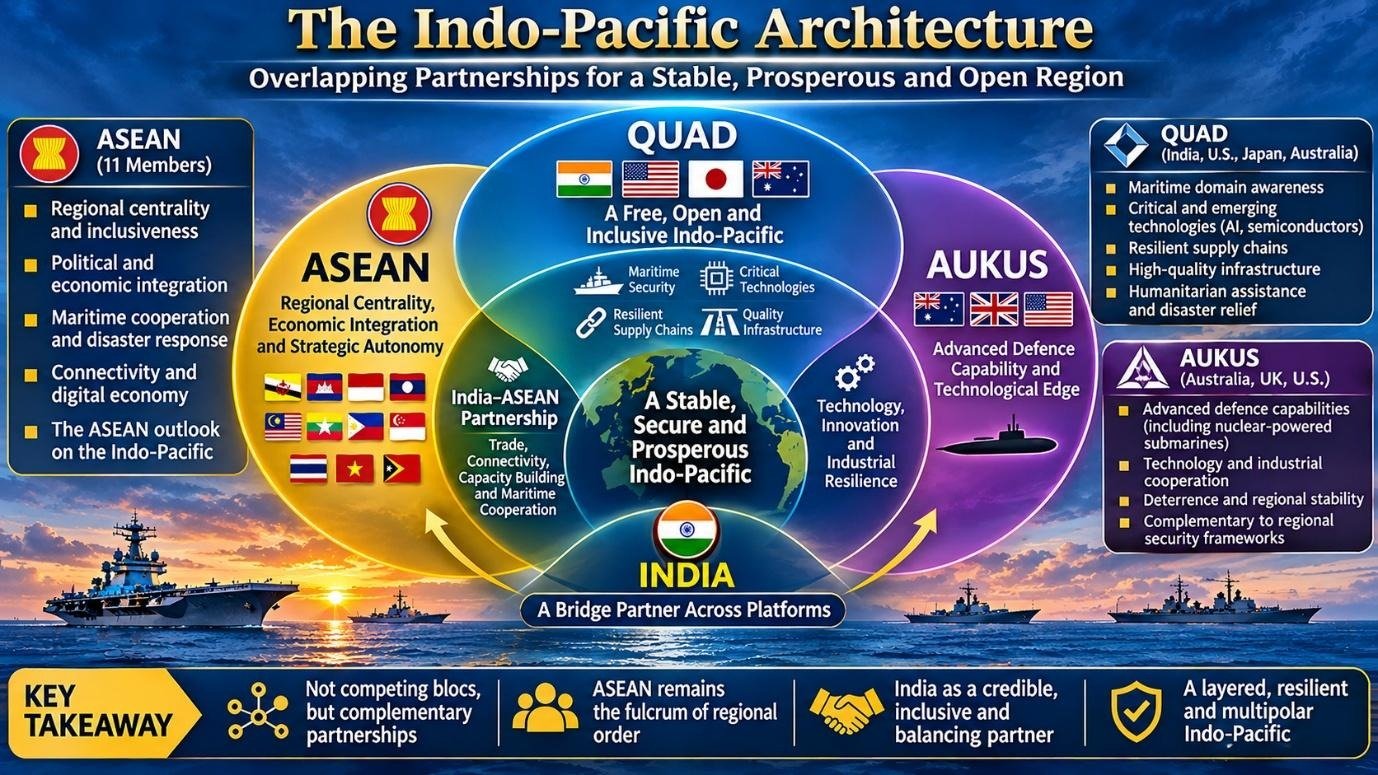
The Quad — India, the United States, Japan and Australia — adds another important dimension to the evolving regional architecture. Its contribution to maritime awareness, infrastructure, critical technologies, resilient supply chains and regional capacity-building is significant. However, its effectiveness will depend partly on its ability to complement, rather than compete with, ASEAN-led institutions.
India should also deepen trade and investment, accelerate the review of the ASEAN-India Trade in Goods Agreement, strengthen technology partnerships and expand cooperation in digital public infrastructure and critical minerals
The Manila engagements, including the scheduled Quad leaders’ meeting, bring this question into sharper focus. A region already crowded with strategic groupings does not need another rigid division between competing camps. It needs practical arrangements that strengthen deterrence while preserving diplomatic space.
Japan and Australia, alongside South Korea and other regional partners, have important roles in supporting this architecture. India, with its independent strategic outlook and relationships across multiple power centres, can help bridge institutional and geopolitical divides.
The objective should be a network of overlapping partnerships that reinforces regional stability rather than one that compels countries to choose sides. Multipolarity must mean a distribution of influence, not merely a proliferation of rivalries.
Beyond Manila: Declarations to Deliverables
The Manila Summit has produced an impressive body of commitments. The declarations on digital talent, creative industries, space cooperation, MSME development, critical minerals and the One Billion Trees initiative reflect an ASEAN seeking to broaden its definition of security and prosperity. The updated ASEAN emblem and flag, recognising Timor-Leste’s integration, also carry symbolic importance for a grouping now comprising 11 members.
Yet declarations are only the beginning of strategic action. The unfinished South China Sea Code of Conduct, the continuing Myanmar crisis, energy vulnerabilities and transboundary environmental challenges remain unresolved. The transition of the ASEAN chairmanship to Singapore offers an opportunity to convert Manila’s commitments into measurable progress.
The Manila Summit has produced an impressive body of commitments. The declarations on digital talent, creative industries, space cooperation, MSME development, critical minerals and the One Billion Trees initiative reflect an ASEAN seeking to broaden its definition of security and prosperity
The test of institutional credibility is implementation. ASEAN must demonstrate that its collective voice can influence conduct, its economic agreements can generate prosperity, and its diplomatic mechanisms can respond to crises. For India and other dialogue partners, the responsibility is to support this process through sustained engagement, resources and practical cooperation.
India’s Moment in the East
The Indo-Pacific is entering an era in which economic interdependence and strategic competition will coexist uneasily. No single power can guarantee regional stability, and no regional institution can preserve its relevance through declarations alone. ASEAN must protect its unity, defend international norms and retain the strategic autonomy that has underpinned its regional role.
For India, the implications are equally clear. Its eastern neighbourhood is not the periphery of its strategic imagination; it is central to its emergence as a consequential Indo-Pacific power. Act East must become an instrument of delivery, MAHASAGAR a framework for maritime cooperation, and India’s diplomacy a source of confidence for smaller nations navigating larger rivalries.
Manila may not have resolved the contradictions of the Indo-Pacific, but it has brought them into sharper focus. The future will belong neither to those who dominate the region nor to those who merely accommodate its powerful players. It will belong to those capable of building trust, protecting sovereignty and creating shared prosperity.
The Indo-Pacific must not become an ocean divided by competing ambitions; it must remain a region united by shared interests.

Lt Gen Rajeev Chaudhry (Retd) writes on contemporary national and international issues, strategic implications of infrastructure development towards national power, geo-moral dimension of international relations, and leadership nuances in a changing social construct. The views expressed are of the author and do not necessarily reflect the views of Raksha Anirveda






