


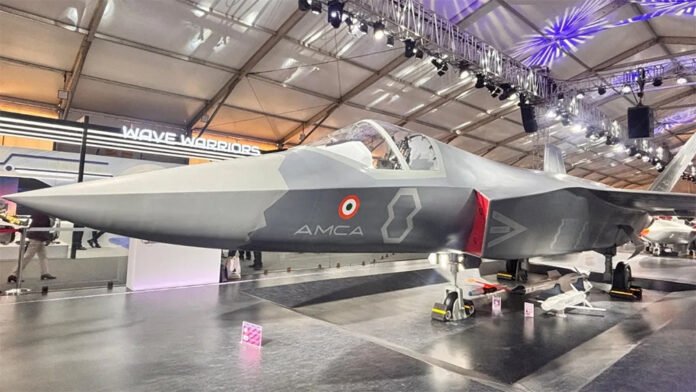
India is considering two routes to develop an engine for the Advanced Medium Combat Aircraft (AMCA): a public-sector proposal led by the Defence Research and Development Organisation’s Gas Turbine Research Establishment (GTRE), working with France’s Safran, and a proposal from private industry.
Defence Secretary Rajesh Kumar Singh said both options were under consideration at the ANI National Security Summit 3.0 in New Delhi on November 16. The government wants the organisations involved to work together rather than duplicate costly research, he said, describing the preferred approach as “whole-of-industry”. A stakeholder workshop in Bengaluru next month is expected to examine how the programme could bring DRDO laboratories, manufacturers and the Indian Air Force together.

The choice is strategically important because the engine is one of the most technically demanding parts of a fighter programme. Designing and manufacturing a modern jet engine requires expertise in high-temperature materials, turbine blades, compressors, cooling, control systems and precision production. A decision about how to develop it will shape not only the AMCA, but also India’s ability to build and sustain advanced aircraft engines in the future.
The Safran-GTRE proposal would combine the French company’s engine-development experience with India’s government research infrastructure. The private-sector proposal offers another possible route, though details about its partners, technical plan and proposed division of work were not disclosed in Singh’s remarks. He did not announce a preferred bidder or a final decision on the engine project.
Singh’s emphasis on cooperation reflects a challenge facing India’s defence industry: multiple organisations may bring valuable capabilities, but fragmented work can produce overlap and slow development. A shared effort could allocate research, design, testing and manufacturing responsibilities across public laboratories and private firms, while giving the Air Force a role in defining operational requirements. The workshop is intended to explore how such contributions might fit together.
The engine decision is separate from the competition to build AMCA prototypes. Three shortlisted industry groups have submitted bids for that aircraft-development contract, with Singh saying the government hopes to announce a winner within about a month. The selected firm or consortium would develop prototypes based on the Aeronautical Development Agency’s design; that selection does not determine who will develop the fighter’s future engine.

AMCA is planned as a fifth-generation stealth fighter. India’s public-sector engine proposal has been discussed as a collaboration between GTRE and Safran, while private industry has now entered the field with a competing option. The government will need to consider the technical approach, schedule, costs, industrial participation and how much lasting design and manufacturing expertise each proposal can establish in India.
India’s existing dependence on foreign engines illustrates why the question goes beyond supplying a powerplant for one aircraft. Domestic capability could help the country maintain, adapt and eventually upgrade engines without relying entirely on overseas suppliers. But developing a new fighter engine is a long-term undertaking; selecting an approach or partnership is only an initial step, not proof that the technology is ready for operational use.

The government’s push for a “whole-of-industry” model suggests it is looking to combine international expertise with domestic research and industrial capacity. Such a model could make private-sector investment and manufacturing skills complementary to GTRE’s research role, provided responsibilities and intellectual-property arrangements are clearly established.
The Bengaluru workshop, next month, will be an early test of whether the competing proposals can be shaped into a coordinated national programme. The outcome could clarify whether India pursues a single lead partnership, incorporates private firms into the GTRE-Safran effort, or advances parallel work before choosing a path. For now, the government says it is examining both public- and private-sector options, with collaboration, not a winner-takes-all contest, its stated preference.







