


The Pakistan Express Tribune published a column last week, mentioning that India and Pakistan had engaged in a Track 1.5 dialogue involving former diplomats, retired military officials and politicians. It was claimed that talks were held on the sidelines of the International Institute for Strategic Studies’ (IISS) annual South Asia Dialogue in Colombo. The IISS is a London-based think tank that hosts dialogues in Asia. The Indian government denied any such talks.
The Pakistani media report mentioned that RSS leader Ram Madhav, former army chief General MM Naravane and former diplomat Ruchi Ghanashyam participated in the dialogue. From Pakistan’s side, it claimed, were former senator Sherry Rehman, retired Major General Isfandiyar Ali Khan Pataudi and serving diplomat Sajjad Haider Khan. The report added that US Assistant Secretary of State for South and Central Asian Affairs, Paul Kapur, was also present.

The Pakistani media report says RSS leader Ram Madhav, former army chief General MM Naravane and former diplomat Ruchi Ghanashyam participated in the dialogue between India and Pakistan in Colombo. US Assistant Secretary of State for South and Central Asian Affairs, Paul Kapur, was also present
Ram Madhav subsequently tweeted, “Totally wrong portrayal. It was not any Track 2 dialogue. I did not attend the 2-day dialogue. I was invited to speak at one session, which I did, and left. Complete spin to a non-story.” There has been no comment of acceptance or denial from General Naravane or Ruchi Ghanashyam. This implies that while Ram Madhav may not have participated, the others could have.
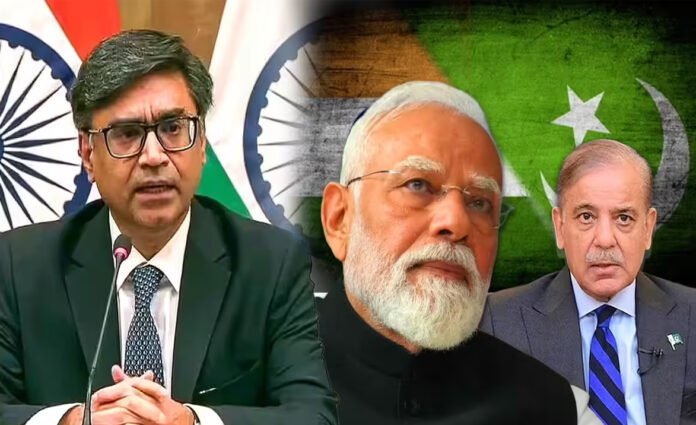
The Indian Foreign Secretary, Vikram Misri, mentioned, “Dozens of these kinds of events take place in dozens of places around the world on a whole variety of subjects. So, there is nothing new, nothing special, about these events. These are private events organised by private parties.” He added, “There is no official participation, no official support or involvement in these visits. We really take no cognisance of these events; they don’t hold much value as far as we are concerned.”
Track dialogues come at different levels. Track 1 diplomacy involves government officials, including heads of state, diplomats and international organisations. These are official dialogues between states. Track 1.5 is a hybrid process where official and unofficial members participate. Track 2 is unofficial and non-government dialogue. Track 3 is interaction by NGOs and citizens to foster long-term relations.
“Dozens of these kinds of events take place in dozens of places around the world on a whole variety of subjects. So, there is nothing new, nothing special, about these events. These are private events organised by private parties,” says India’s Foreign Secretary, Vikram Misri
It should be remembered that recently, there were comments by those stated to be involved in this dialogue on re-igniting Indo-Pakistan talks. RSS General Secretary, Dattatreya Hosabale, said in May, “If Pakistan is like a pinprick trying to create incidents like Pulwama etc, we have to answer appropriately according to the situation because security and self-respect of the country and nation have to be protected,” adding, “But at the same time, we should not close doors. We should always be ready to engage in dialogue.” His comments came soon after his return from a visit to the US, leading to the Congress accusing the RSS of toeing the US line.

The RSS Chief, Mohan Bhagwat, backed him by mentioning, “The doors of dialogue need to be kept open.” Naravane followed suit and added, “The common man has nothing to do with politics. When there is friendship between the two people, there will also be friendship between the two nations,” adding, “It is the right thing. People-to-people contact is important.” Defending Track II diplomacy, he added, “Even our people should know that those staying across the border are not sworn enemies.” His backing of dialogue with Pakistan, despite being a former army chief, was questioned.
Some Indian leaders’ comments supporting talks could be aimed at testing the waters at the national level for launching unofficial diplomacy. But the reaction on social media indicated that the country was unwilling to engage Pakistan in talks, especially as it continued to support terrorism in Jammu and Kashmir
It is possible that these comments were aimed at testing the waters at the national level for launching unofficial diplomacy. The reaction on social media indicated that the country was unwilling to engage Pakistan in talks, especially as it continued to support terrorism in Jammu and Kashmir. It could also be that since there was vehement opposition to suggestions by Hosabale and Naravane, the dialogue was not referred to as formal and backed by the government, though it may have been apprised of it.

There were also media reports emanating from Pakistan mentioning that discussions in this dialogue focused on India’s willingness to restore the Indus Water Treaty (IWT) in lieu of Pakistan lifting its airspace restrictions. This was also denied by the Indian government, which insists that the IWT will remain suspended and India has no plans to change this status, despite airspace being blocked. India continues to insist that ‘blood and water’ as well as ‘talks and terror’ cannot go simultaneously.
There are multiple events organised by different forums, which bring Indian and Pakistani participants on a common platform, the most prominent one being the Shangri La dialogue in Singapore. Communication and interaction at these events do not indicate any formal dialogue unless backed by the government. On the contrary, India-China Track 2 diplomacy is a regular feature involving retired military officials, diplomats and think tank analysts.
India is planning to display video and audio recordings at the forthcoming meeting of the FATF (Financial Action Task Force), highlighting Pakistan’s involvement in supporting terrorism in India. The intent is to place Pakistan back on the Grey List, from which it exited in 2022
While backchannel talks with China have proved helpful in restoring confidence along the LAC, despite China’s support for Pakistan, it is unlikely to be the same with Islamabad. The rhetoric and accusations flowing from Pakistan, increasing since Pakistan came on the global stage in attempting to resolve the US-Iran conflict, would make any dialogue, even at lower Track levels, meaningless. Nothing would emerge, nor would it reduce tensions.
India always engages with the government in power in Islamabad, while authority and decision-making rest with Rawalpindi. While the polity seeks peace with India, hoping to contain the rising power of their army, Rawalpindi will do anything to derail the process and keep enmity ongoing. For the Pakistani army, India as a declared enemy is essential for its survival. Now that it is in a bind, managing multiple uprisings amid a financial crisis, talking to it would only add to its confidence that India seeks peace. It would link the same to its narrative on Kashmir.
India is also planning to display video and audio recordings at the forthcoming meeting of the FATF (Financial Action Task Force), highlighting Pakistan’s involvement in supporting terrorism in India. The intent is to place Pakistan back on the Grey List, from which it exited in 2022. In such a scenario, India should not engage in any Track dialogue with Pakistan. If it does, then the advantage shifts to Pakistan. To convey firm messages on terrorist activities and India’s response to any misadventures, there are multiple channels, including DGMO Hot Lines, as well as nations friendly to both, including those in the Middle East and the US.
The writer is a strategic analyst and a motivator. He can be reached at @kakar_harsha. The views expressed are of the writer and do not necessarily reflect the views of Raksha Anirveda





