


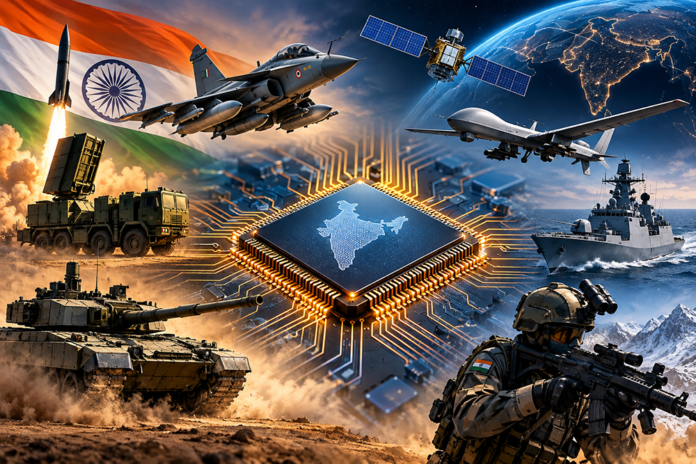
“The Silicon battlefields of future conflicts will be hallmarked by infinite tenacity, reverberate with lethality of defence technologies, evidenced with invincibility and resilience”
Semiconductors are the foundational building blocks of the modern technological world, and they have emerged as one of the most consequential strategic technologies of the twenty-first century. They power computers, communication systems, artificial intelligence, satellites, automobiles, medical equipment and virtually every advanced military platform.

Control over semiconductor technology is increasingly synonymous with technological sovereignty, economic competitiveness and national security.
The most important battlefield of the future may not always be visible. It may exist inside a microprocessor, an electronic warfare module, a radar processor, an artificial-intelligence accelerator, a satellite payload, a missile seeker or an autonomous drone.
Unmanned systems depend upon high-performance processors, sensors and secure communications, while artificial intelligence is beginning to transform targeting, surveillance, logistics and decision-support.
The modern military platform is increasingly a sophisticated computing system with kinetic capabilities attached to it. Aircraft are no longer simply flying machines; they are sensor, communication and computing platforms.

Ships are becoming floating data centres connected to distributed combat networks. Armoured vehicles are evolving into digitally connected nodes and satellites are becoming essential components of military intelligence and communication architecture.
The nation that controls its semiconductor ecosystem will possess a decisive cutting-edge advantage in the technologies of future warfare. For India, semiconductor self-reliance is not simply an economic ambition; it is a cornerstone of technological sovereignty, defence preparedness and strategic autonomy.

In future warfare, semiconductor capability will influence not only who can build the most advanced weapon system, but also who can sustain, secure and upgrade it throughout its operational life.
Semiconductors – Why Do They Matter
Once regarded primarily as a component of consumer electronics, the semiconductor now constitutes the digital nervous system of modern military power.
Fighter aircraft, unmanned systems, missiles, satellites, radars, electronic warfare platforms, secure communications, artificial intelligence, autonomous vehicles, precision-guided weapons, cyber systems and battlefield command networks all depend upon increasingly sophisticated semiconductor devices.
Consequently, access to trusted chips is becoming as important to national security as access to energy, critical minerals, advanced weapons and secure communications. India’s dependence on imported semiconductor components creates vulnerabilities in an era characterised by geopolitical competition, supply-chain disruption, technological sanctions, cyber warfare and rapidly changing military technology.
Semiconductors have evolved from consumer electronics into the digital nervous system of national defence, powering everything from autonomous drones to missile guidance systems
The global concentration of semiconductor manufacturing and the increasing weaponisation of technology supply chains demonstrate that a disruption of chip availability can directly affect military readiness.
India’s Semiconductor Opportunity
India has entered a decisive phase in its semiconductor journey. The Semiconductor Mission has evolved from an initial emphasis on establishing fabrication, assembly, testing and packaging capabilities towards a broader ecosystem encompassing design, equipment, materials, advanced packaging, research, talent and indigenous intellectual property.
In July 2026, the Government approved Semicon 2.0 with an outlay of ₹1,27,500 crore, explicitly expanding the national effort across these areas. By September 2026, five semiconductor manufacturing units had commenced commercial production, while approved projects across six states represented investment commitments exceeding ₹1.64 lakh crore.
Semiconductors are central to artificial intelligence and pivotal to machine learning. From a military perspective they are equally central to quantum computing, 5G/6G communications, autonomous vehicles and unmanned systems, spacecraft and satellites, radar and electronic warfare, cybersecurity systems, precision-guided weapons, and command, control, communications, computers, intelligence, surveillance and reconnaissance (C4ISR). Semiconductors are therefore not just components; they are strategic enablers of national power.
The future battlefield will increasingly be determined by the interaction between sensors, computing, communications, artificial intelligence, electronic warfare and autonomous systems, and at the centre of this ecosystem will be the semiconductor.
India’s ability to design, manufacture, integrate and protect advanced chips will influence not only its economic competitiveness but also the survivability, lethality, endurance and technological independence of its armed forces.
The strategic significance of semiconductors has thus undergone a fundamental transformation. The chip is no longer merely an industrial component; it is a strategic resource. A country may possess advanced aircraft, missiles, submarines and satellites, but if critical electronic components within those systems depend upon uncertain foreign supply chains, its technological sovereignty remains incomplete.
India is simultaneously pursuing military modernisation, indigenous defence production, artificial intelligence, space power, unmanned systems, quantum technologies, cyber capabilities and network-centric warfare, and every one of these pursuits rests on the same silicon foundation.
The future of semiconductor competition will not be determined solely by transistor size. Advanced packaging is rapidly becoming an equally important strategic technology. Instead of placing every function onto one enormous monolithic chip, different processing functions can be distributed across multiple chiplets and integrated within a single package. This architecture offers significant advantages, and it allows a country to leapfrog in areas where future value is shifting.
The NITI Aayog roadmap specifically identifies advanced packaging, chiplets, heterogeneous integration, compound semiconductors and wide-bandgap materials such as silicon carbide and gallium nitride as areas where India can build future capability.
In an era of weaponised supply chains, domestic chip capability is no longer just an economic ambition – it is a critical cornerstone of India’s defence preparedness and sovereignty
For defence sector this is particularly significant, as reiterated by the Chairman DRDO, the CDS and the Chiefs of the Armed Forces. A radar processor, electronic warfare module or autonomous drone computer could combine multiple specialised processing elements within a customised secure package, allowing Indian defence organisations to tailor semiconductor architecture to specific missions.
Visualised Challenges Before India
India possesses several advantages that can support a strong semiconductor ecosystem. However, it must move beyond design services towards ownership of complete semiconductor value chains. The semiconductor future also extends beyond traditional silicon. Compound semiconductors such as gallium nitride and silicon carbide are becoming increasingly important in high-frequency and high-power applications.
Gallium nitride is particularly relevant to radar and electronic warfare because of its advantages at high frequency and high power, while silicon carbide is highly relevant to power electronics because it operates efficiently under demanding thermal and electrical conditions.
These technologies could influence active electronically scanned array radars, electronic warfare systems, communication equipment, electric propulsion, directed-energy systems, high-power converters, unmanned platforms and advanced aerospace systems.
A future-oriented defence semiconductor programme must therefore include compound semiconductors and wide-bandgap technologies, and India should avoid defining self-reliance solely around conventional silicon fabs.
India already has the scientific and technical requirements, and the trained manpower, to support defence production and to crystallise as a force multiplier in defence-centric projects. Two strengths stand out:
- Skilled human resources. India has a large pool of engineers, scientists, software professionals and chip-design specialists. It is already an important global centre for semiconductor design, Electronic Design Automation (EDA), embedded systems, verification and validation, and firmware and software development.
With an approved outlay of ₹1,27,500 crore, India is rapidly expanding its ecosystem across design, equipment and advanced packaging to secure its technological future
The best-quality products will be produced only by skilled manpower in this domain, supervised by experts and supported by digitised, fully automated and technologically advanced software of world standard.
- Large domestic market. India’s expanding markets for smartphones, electric vehicles, telecommunications, consumer electronics, defence equipment and industrial automation create substantial demand for chips, and therefore strengthen the strategic significance of semiconductors.
However, calculated planning towards optimisation will have to incorporate a well-planned, sequential and multifaceted technological effort comprising five stages.
First: Strategic chip design. India already possesses major design capability. The challenge is to convert that talent into indigenous strategic semiconductor intellectual property. Indian designers should develop processors, microcontrollers, accelerators, signal processors and secure system-on-chip architectures specifically for defence applications.
Second: Trusted quality manufacturing. Critical military chips should be manufactured in controlled and auditable environments. The objective should be assured provenance: a military organisation must know where its critical chips originate, who designed them, who fabricated them, who packaged them and how they were tested.
Third: Secure packaging. Packaging is no longer a secondary manufacturing activity. Advanced packaging determines performance, power efficiency, thermal management and system integration. Future defence systems will increasingly depend upon chiplets and heterogeneous integration, so India must treat advanced packaging as a strategic capability.
Future warfare will rely heavily on compound semiconductors like Gallium Nitride and Silicon Carbide, which drive high-power radars, electronic warfare modules and directed-energy platforms
Fourth: Testing and certification. A chip may function correctly in a laboratory and fail in a battlefield environment. Military semiconductor testing must therefore include thermal stress, vibration, electromagnetic interference, radiation exposure where relevant, ageing, cyber-security and reliability testing.
Fifth: Lifecycle assurance. Defence semiconductor strategy must extend beyond procurement. India must ensure component availability throughout the operational life of major weapon systems. This requires lifecycle management, redesign capability, trusted alternatives and domestic knowledge of critical architectures.
Semiconductor manufacturing is among the most complex industrial activities in the world, and it can “crack the crucible” of even well-resourced nations. Prime Minister Narendra Modi has astutely picked up the gauntlet, deciding to open the semiconductor industry and reduce dependence, thereby obviating the resource constraints foreseen in critical times of war.
The major challenges nevertheless remain formidable. They include very high capital investment; a brilliant pool of specialist human resources and the need to make up the shortage of specialised fabrication professionals; access to advanced fabrication technology; a reliable supply of ultra-pure water with guaranteed, uninterrupted power; availability of semiconductor-grade chemicals and gases; dependence on advanced manufacturing equipment; and the need to cater for rapid technology obsolescence.
India also needs strategic inputs and deep insights into global competition from Taiwan, South Korea, the United States, China, Japan and Europe, along with sustained R&D funding, protection of intellectual property rights (IPR) and supply-chain security.
Building a resilient defence ecosystem requires a complete lifecycle strategy spanning strategic chip design, trusted manufacturing, secure advanced packaging, rigorous testing and long-term support
India does have an additional advantage in its Free Trade Agreements with the EU, the UK and others, and in trade partnerships with major developed nations. It has the capability to convert these challenges and imponderables into gainful opportunities and to become a potential leader in this complex industry.
Forthcoming Semiconductor Landscape in India
A phased, mission-oriented approach that focuses first on areas where India can achieve strategic advantage would be desirable. India’s semiconductor future is likely to develop across four layers.
Chip design leadership. Chip design is India’s natural strength and can provide the foundation for indigenous semiconductor intellectual property. India can become a global leader in designing AI accelerators, defence processors, secure microcontrollers, radar signal-processing chips, space-grade electronics, power-management ICs, automotive semiconductor systems and RISC-V-based processors. The central strategic challenge is to convert such designs into trusted physical hardware.
India’s semiconductor transformation must therefore move beyond design to answer one question: can India guarantee trusted semiconductor technology for its critical national-security systems under conditions of war, coercion, disruption and technological blockade? The answer will increasingly influence India’s strategic autonomy to a great extent.
Fabrication capability. For defence, the most advanced node is not always the most important node. Reliability, radiation tolerance, secure design, long-term availability and assured supply are often more significant than transistor density. Domestic fabrication will therefore be critical for strategic autonomy. India could prudently begin with mature-node semiconductor technologies, power semiconductors and sensors, microcontrollers, analogue and mixed-signal chips, radio-frequency devices and compound semiconductors.
By focusing on 2.5D/3D packaging and chiplet integration, India can engineer mission-customised, high-performance defence architectures even while scaling native fabrication
Compound semiconductors. This is where future critical technologies will carve out an arena for themselves. Materials such as gallium nitride (GaN), gallium arsenide (GaAs) and silicon carbide (SiC) are particularly important for defence and strategic applications. They enable:
- high-power radar transmitters and electronic warfare systems;
- high-frequency communications;
- high-efficiency power electronics;
- electric propulsion;
- high-temperature applications; and
- Directed-Energy Weapon (DEW) systems.
Advanced packaging. Advanced packaging is becoming as important as fabrication itself, because it allows India to develop high-performance systems even while progressively building advanced fabrication capabilities. The relevant areas include 2.5D and 3D packaging, chiplets, heterogeneous integration, System-in-Package (SiP) and high-bandwidth memory integration.
Indigenous semiconductor IP is equally essential to prevent dependence on foreign-controlled design ecosystems. India would need to create its own intellectual property in processor architectures, secure cryptographic modules, AI accelerators, sensor interfaces, high-speed data converters, radiation-hardened circuits, trusted hardware roots and hardware security modules.
Taken together, these four layers give India a realistic route from design strength to strategic capability, and they set the stage for the defence applications examined in the next part of the article.
To be continued….

Lt Gen S K Gadeock is a distinguished military leader, global strategist, and scholar who served as the Commandant of the Defence Services Staff College. A decorated veteran and former Logistics Advisor to the Botswana Defence Force, he has held numerous high-ranking appointments including Director General of the Amity Institute of Defence & Strategic Studies. Serving on the Advisory Board of Raksha Anirveda, he is a prolific writer and motivational speaker.





