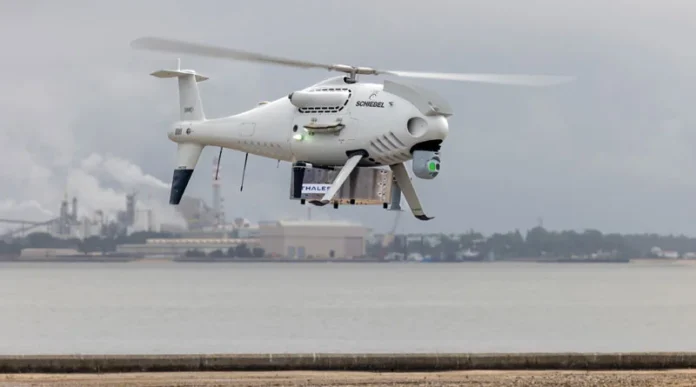
Vienna. Schiebel participated in REPMUS (Robotic Experimentation and Prototyping using Maritime Uncrewed Systems) and Dynamic Messenger 2023, in Portugal. Together with several partners, Schiebel conducted flights with the CAMCOPTER® S-100, showcasing its Anti-Submarine Warfare (ASW) sonobuoy deployment solution, bathymetric scanning for Rapid Environmental Assessment (REA) and Mine Counter Measures (MCM) as well as Autonomous Underwater Vehicle (AUV) and profiling float deployment.

Unmanned solutions for ASW, MCM, REA and Maritime Security Operations (MSO) are becoming increasingly relevant and applicable in today’s naval defence. At the month-long large-scale NATO exercise, Schiebel demonstrated its multi-mission capability with a selection of different sensors and payloads, reconfiguring the CAMCOPTER® S-100 between missions to conduct a variety of operations.
At last year’s REPMUS, Schiebel, together with Thales, demonstrated the relaying of data from sonobuoys. This year, the S-100 impressed with its sonobuoy dispenser, successfully deploying NATO-standard G-size sonobuoys. The combination of both these capabilities enables the Schiebel Unmanned Air System (UAS) to offer an end-to-end solution for ASW.
In the field of MCM, the CAMCOPTER® S-100 successfully demonstrated the VQ-840-G LiDAR from the Austrian company RIEGL working with Thales. Through the open architecture of the Thales MCM Mission Management System (M-CUBE), which enables rapid and flexible third-party sensor integration, the CAMCOPTER® S-100 was able to perform a complete airborne MCM mine hunting capability, achieving 100% detection of all mine targets.
Schiebel also showcased its role in supporting advanced REA missions, using the S-100’s proven cargo hook to deploy the Yuco AUV from the French company Seaber, as well as the APEX profiling float from Teledyne, producing a topobathymetric situational picture. The Fugro Rapid Airborne Multibeam Mapping System (RAMMS) from the U.S. company Areté contributed to the topobathymetric product, specifically closing the surf zone gap, which cannot be safely accessed by surface assets.

Unmanned-Unmanned Teaming (U-UT) was presented at the NATO exercise with the S-100 relaying data from ALSEAMAR’s SEAEXPLORER glider to a Combat Management System (CMS), validating the capability of the underwater vehicle to operate in a satellite-denied environment.
“Being NATO exercises, REPMUS and Dynamic Messenger are exceptional playgrounds to demonstrate our innovative capabilities. The S-100 once again proved to be a vital unmanned asset in supporting the latest maritime defence solutions, such as ASW and MCM – offering highly sought after capabilities”, said Hans Georg Schiebel, Chairman of the Schiebel Group.

Schiebel’s partners included Areté, Thales, Seaber (Yuco), Teledyne (APEX), ALSEAMAR (SEAEXPLORER), RIEGL and Fugro. The S-100’s involvement in the exercises was sponsored by both the UK Royal Navy and the U.S. Office of Naval Research. REPMUS and Dynamic Messenger were hosted by the Portuguese Navy.