


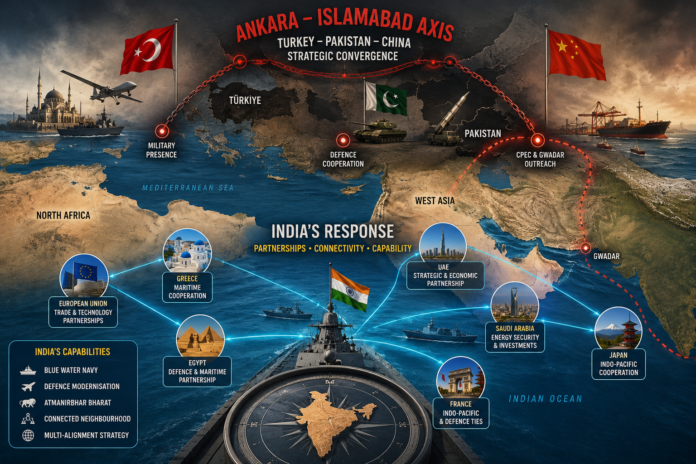
A structural revolution is underway in Indian foreign policy. For decades, New Delhi’s strategic horizons were comfortably bound by the geography of the Indian Ocean Region and the immediate threat vectors of the Malacca Strait and the Line of Actual Control. However, Turkey’s aggressive geopolitical manoeuvres have forced India to discard its historical reluctance towards extra-regional entanglements. By engineering a sophisticated ‘Indo-Mediterranean’ counter-encirclement strategy, India has built a powerful mini-lateral bloc with Israel, Greece, and Cyprus. This ‘Med Quad’ is a direct, asymmetric response designed to contain a revisionist Turkey and neutralise the rapidly hardening Ankara-Islamabad military axis.
The Catalyst: Erdogan’s South Asian Gambit
The shift in India’s posture is a direct response to Turkish President Recep Tayyip Erdoğan’s efforts to project power into South Asia. For years, Turkey’s support for Pakistan was confined to rhetorical grandstanding over Kashmir at the United Nations. Today, that alignment has evolved into a deep, systemic defence partnership that directly threatens Indian national security.

Turkey has become Pakistan’s primary source for cutting-edge asymmetric military hardware. The Pakistan Armed Forces have aggressively inducted Turkish-made Bayraktar TB2 and Akıncı armed drones, which have radically altered the dynamics of modern proxy warfare. Furthermore, the joint production of MILGEM-class naval corvettes has significantly boosted the Pakistan Navy’s surface combat capabilities.
The strategic landscape shifted dramatically with the signing of the Mecca Joint Defence Agreement. This mutual defence pact among Saudi Arabia, Turkey, and Pakistan introduced a collective defence clause. While Indian External Affairs Minister S Jaishankar publicly downplayed its immediate operational integration, the treaty formally institutionalised Turkish military influence on India’s western flank. Coupled with Ankara’s expanding military footprints and defence sales to Bangladesh and the Maldives, New Delhi’s military leadership now openly treats Turkey as an adversarial strategic actor.
The shift in India’s posture is a direct response to Ankara’s efforts to project power into South Asia. For years, Turkey’s support for Pakistan was confined to rhetorical grandstanding over Kashmir at the UN. Today, that alignment has evolved into a defence partnership that threatens Indian national security
Mechanics of the ‘Med Quad’: Weapons, Logistics, and Chokepoints
India’s counter-strategy relies on an asymmetric alignment with Turkey’s immediate regional rivals. By strengthening the defence capabilities of nations on Turkey’s borders, India is effectively tying down Ankara’s military resources in its own backyard.
The Greek Anchor

The relationship between New Delhi and Athens has rapidly evolved from diplomatic courtesy into a robust defence partnership. The signing of a Joint Declaration explicitly linked India’s Aatmanirbhar Bharat (self-reliant India) defence manufacturing initiative with Greece’s Agenda 2030 military reforms.
The Bilateral Military Cooperation Plan has institutionalised regular, cross-theater power projection:

- Air Domain: Indian Air Force Su-30MKI fighter jets are regular participants in Greece’s Iniochos exercises over the Mediterranean, while Greek F-16s deploy to India for the Tarang Shakti war games.
- Maritime Domain: Greece has stationed an International Liaison Officer at India’s Information Fusion Centre (IFC-IOR) in Gurugram, creating an unbroken line of maritime intelligence sharing from the Aegean Sea to the Western Indian Ocean.
The strategic landscape has shifted with the signing of the Mecca Joint Defence Agreement among Saudi Arabia, Turkey, and Pakistan. Coupled with Ankara’s expanding military footprints and defence sales to Bangladesh and the Maldives, India now treats Turkey as an adversarial strategic actor
The Cypriot Outpost
If Greece represents the naval anchor, Cyprus is emerging as India’s forward missile outpost in the Mediterranean. Under the India-Cyprus Defence Cooperation Roadmap, Nicosia has aggressively moved to procure Indian defence hardware to counter Turkish military superiority in Northern Cyprus.
Turkish media outlets, including TRHaber, have raised alarms over Nicosia’s efforts to acquire Indian-made combat UAVs and BrahMos supersonic cruise missiles. Turkish military analysts warn that deploying BrahMos batteries on Cypriot soil would fundamentally disrupt Turkish air and naval dominance in the Eastern Mediterranean. By backing the sovereignty and territorial integrity of Cyprus, Prime Minister Narendra Modi’s administration has delivered a clear message to Ankara: subversion in Kashmir will be met with direct countermeasures in the Levant.
The Israeli Core
Despite regional volatility, Israel remains the technological engine of this Mediterranean realignment. The long-standing Israel-Greece-Cyprus trilateral defence framework is quietly transitioning into a ‘3+1’ format with India.
This core focuses on developing solutions for asymmetric threats. By exchanging real-time tactical intelligence, cyber defence frameworks, and counter-UAV swarm technologies, the alliance aims to directly neutralise the operational advantages of Turkey’s drone fleet.
By exporting weapons, sharing intelligence, and conducting high-end military drills with Greece and Cyprus, India alters Turkey’s risk calculus. Ankara can no longer bankroll Pakistan’s military modernisation or deploy assets to South Asia without risking its own security stability closer to home
Incisive Analysis: The Indian Strategic Calculus
From an Indian perspective, this Mediterranean pivot represents a highly calculated, pragmatic shift in its geopolitical doctrine.
Strategic Autonomy via Mini-Lateral Deterrence
India is not looking to join a rigid, NATO-style collective defence pact. Instead, New Delhi is practicing “strategic autonomy through issue-based alignments.” By exporting weapons, sharing intelligence, and conducting high-end military drills with Greece and Cyprus, India alters Turkey’s risk calculus. Ankara can no longer bankroll Pakistan’s military modernisation or deploy assets to South Asia without risking its own security stability closer to home.
Guarding the Gateways of Economic Connectivity
The Eastern Mediterranean is the vital entry point for the India-Middle East-Europe Economic Corridor (IMEC). Turkey has actively attempted to disrupt and bypass IMEC because the corridor leaves Ankara out of the trade loop. By building deep defence ties with Greece (the corridor’s European gateway) and Cyprus (which leads the ‘Friends of IMEC’ bloc within the European Union), India ensures that its economic lifeline to Europe is protected by friendly, interoperable navies.
| Strategic Vector | Turkish/Pakistani Action | Indian Counter-Measure | Geopolitical Outcome |
| Asymmetric Tech | Turkey supplies Akıncı & TB2 drones to Pakistan | Joint Indo-Israeli counter-UAV and cyber frameworks | Neutralises drone superiority along the LoC |
| Maritime Dominance | Turkey builds MILGEM corvettes for Pakistan Navy | Intelligence sharing via IFC-IOR & Greek naval access | Secures Mediterranean shipping lanes and chokepoints |
| Levant Geopolitics | Turkey attempts to bypass and disrupt IMEC trade | Forms ‘3+1’ alignment with Israel, Greece, and Cyprus | Protects the European terminus of the trade corridor |
| Missile Deterrence | Ankara pursues South Asian encirclement | Explores BrahMos missile exports to Cyprus | Forces Turkey to refocus resources on its immediate borders |
The Maturity of Defence Exports
This realignment marks India’s evolution from a major weapons importer into a proactive security provider. Exporting sophisticated missile platforms and electronic warfare systems to EU-adjacent states elevates India’s status on the world stage. It proves that India’s domestic defence ecosystem can deliver reliable, combat-ready systems to nations facing immediate state-backed threats.
By treating Turkey’s provocations as a structural threat, New Delhi has successfully turned the tables on Ankara. The burgeoning partnerships with Greece, Cyprus, and Israel show that India is fully prepared to project power well beyond its traditional borders
Breaking the Encirclement
India’s decisive move into the Eastern Mediterranean signals the end of its traditionally passive foreign policy. By treating Turkey’s provocations as a structural threat, New Delhi has successfully turned the tables on Ankara. The burgeoning partnerships with Greece, Cyprus, and Israel show that India is fully prepared to project power well beyond its traditional borders. As the Ankara-Islamabad axis attempts to challenge India’s security interests in South Asia, New Delhi has made its answer clear: the defence of Kashmir begins in the waters of the Mediterranean.
India has transitioned from regional neutrality to a proactive counter-encirclement strategy by forging deep military and technological ties with Greece, Cyprus, and Israel to counter Turkish support for Pakistan. This emerging ‘Med Quad’ framework secures India’s economic connectivity through the IMEC corridor while forcing Ankara to absorb strategic costs in its own periphery.

–The writer is Assistant Professor, ICFAI School of Liberal Arts, ICFAI University, Jaipur. The views expressed are of the writer and do not necessarily reflect the views of Raksha Anirveda





