


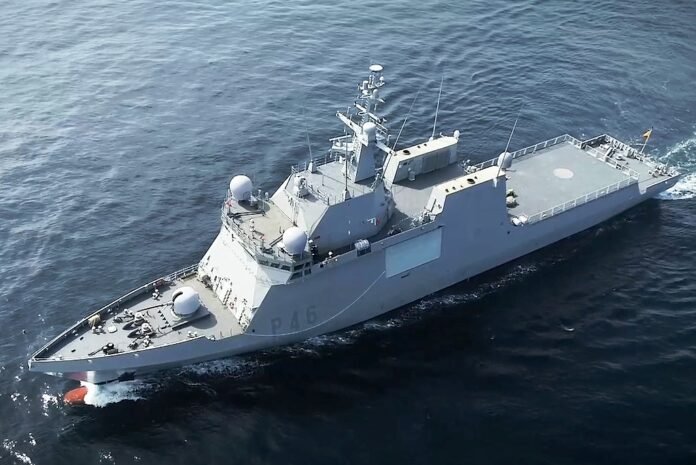
New Delhi / Madrid. The Government of Spain has authorised the commencement of the contracting process for Navantia to design and construct two new Offshore Patrol Vessels (BAM), which will be added to the six already in service (Meteoro, Rayo, Relámpago, Tornado, Audaz, and Furor). The aim is to reinforce maritime surveillance and security, as well as to maintain the operational capability of the Navy’s maritime action force.
The new BAMs, with a budget of Euro 716 million, will incorporate substantial improvements over their predecessors, both in operational capabilities and living conditions for the crew. Engineering work is set to begin once the contract is signed, with production expected to commence in the first half of 2027.

These new units will feature an updated combat system, a next-generation Integrated Platform Management System (IPMS), enhancements to communication and navigation systems, advanced cybersecurity measures, integration of unmanned vehicles, new workspaces and medical facilities, as well as increased accommodation capacity for crew members.
These improvements will enable the Navy to address current maritime security challenges more effectively, while also enhancing the quality of life for personnel on board.
The engineering for this second extension of the BAM programme will be developed entirely using the digital tools of the ELCANO programme, which is owned by Navantia and based on Siemens technologies. This environment enables the integration of design, modelling, simulation, and construction in a connected digital workflow, incorporating the latest advancements in Navantia’s digital transformation.
Construction will take place at Navantia’s Puerto Real facilities, which are equipped with a high level of automation and advanced technology. Part of the manufacturing process will be carried out in the flat block workshop, which features a state-of-the-art automated line currently in its final commissioning phase. This line will shortly begin operating at full capacity to build blocks for the UK’s Fleet Solid Support (FSS) programme.

This technological leap will revolutionise shipbuilding, thanks to a welding system that increases production speed, reduces heat input, and minimises deformation, resulting in higher quality products.






