


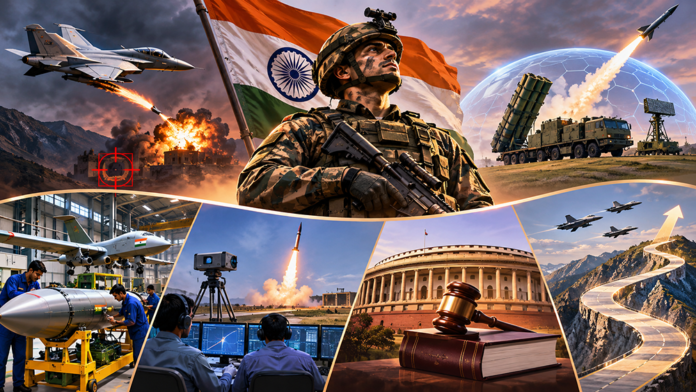
India stands at a defining crossroads in its military history. The thunderous success of Operation Sindoor in May 2025 — four days of precise, overwhelming and largely indigenous force that shattered terrorist infrastructure deep inside Pakistan and Pakistan-occupied Kashmir, neutralised enemy air defences, and swatted aside waves of drones and missiles — proved what focused reform can achieve. BRAHMOS missiles streaked in at nearly Mach 3 punched so many holes that Pakistani airspace began to look like Swiss cheese. Akash and Akashteer systems formed an invisible shield. Layered air defences, networked through the Integrated Air Command and Control System, turned Pakistani aerial assaults into debris. China-supplied systems on the other side failed to detect, deter or stop the Indian response. In the skies and on the ground, India demonstrated not just resolve but the physics of lethality at speed and scale.
Yet that victory is not a destination. It is a warning flare. Modern war moves at a velocity that renders yesterday’s excellence obsolete almost overnight. Technological leaps in drones, AI-enabled targeting, hypersonic weapons, electronic warfare, and swarm tactics compress decision cycles from months to minutes. Obsolescence arrives as fast as innovation. If India treats the reforms that delivered Op Sindoor as a completed chapter rather than a permanent campaign, the next confrontation — whether against a peer competitor or a proxy swarm — could expose gaps that no amount of bravery can close. Defence reform must become an unrelenting, institutionalised programme of continuous adaptation. Research and development, live testing under realistic conditions, and constant demonstration of new capabilities cannot pause. And the political commitment that has driven this progress under the current government must be locked in by law so that no future administration — liberal, secular, or nationalist — can dial back spending, slow reforms or starve R&D.

The Proof of What Reform Delivers: Operation Sindoor
Operation Sindoor was no ordinary retaliation. Triggered by the April 2025 Pahalgam terror attack that killed civilians, it marked a decisive shift from strategic restraint to calibrated, high-tempo conventional response. Indian forces struck nine terrorist camps and associated infrastructure on the night of May 6-7, then expanded the fight when Pakistan escalated with drone swarms, missiles, and attempts to target Indian bases and civilian areas. Within days the Indian Air Force and Army had achieved air superiority over key sectors, destroyed or degraded Pakistani radars, airfields, and command nodes, and forced a ceasefire.
Modern war moves at a velocity that renders yesterday’s excellence obsolete almost overnight. Technological leaps in drones, AI-enabled targeting, hypersonic weapons, electronic warfare, and swarm tactics compress decision cycles from months to minutes. Obsolescence arrives as fast as innovation
What made it transformative was the dominance of domestic systems. The BRAHMOS — co-developed with Russia but now produced largely in India — served as the primary offensive punch, delivering precision strikes at ranges and speeds that left Chinese-origin defences scrambling. Akash surface-to-air missiles and the AI-integrated Akashteer command-and-control network formed the backbone of a multi-layered shield that, alongside S-400 batteries and older platforms, intercepted hundreds of incoming drones, loitering munitions, and missiles. Indigenous counter-drone systems, including laser and electronic measures, added further layers. The Integrated Air Command and Control System stitched sensors and shooters into a real-time web that prevented collateral damage to civilian aircraft while neutralising threats. Reports from the Ministry of Defence’s subsequent assessments highlighted the longest surface-to-air kill of the engagement — an S-400 intercept at 314 km — and the near-total failure of Pakistani attempts to penetrate the Indian grid.
Make no mistake — this was not improvisation. It was the payoff of a decade of deliberate reform under the Make in India framework. Domestic sourcing in defence capital procurement climbed from roughly 30 percent to over 65 percent, with ambitions toward 90 percent. Capital outlays for indigenous production surged. FDI limits rose to 74 percent in defence, drawing partners while building local capacity. Positive indigenisation lists forced the services to look inward. Startups and MSMEs, empowered through iDEX and related programmes, flooded the ecosystem with agile solutions. Production values soared; exports followed. When the moment of truth arrived, India did not wait for foreign supply lines. It fought with systems designed, built and refined at home.
Ukraine’s wartime improvisation and Israel’s relentless cycle of fielding, learning and refining offer parallel lessons. Both nations treat the battlefield as the ultimate laboratory. India has the strategic depth and industrial base to do the same without the existential urgency of active invasion. The advantage of learning from Op Sindoor without absorbing equivalent losses must not be squandered
The contrast with the adversary was stark. Pakistan’s Chinese-supplied air defences — LY-80, HQ-9 variants and others — proved inadequate against the combination of speed, precision and networked Indian firepower. Drones and missiles that might have overwhelmed a slower, import-dependent force were largely defeated. Op Sindoor validated a national doctrine of self-reliance fused with operational tempo. It also sent a message far beyond the Indian Subcontinent: an India that masters rapid domestic iteration can impose costs that proxies and their backers cannot easily absorb.

Why Reform Cannot Be a One-Time Project
Success breeds complacency at deadly speed. The technologies that dominated Operation Sindoor are already evolving. Cheap, attritable drones have become the new artillery shells — expendable, swarmable and adaptable in software faster than hardware can be redesigned. AI-assisted target recognition, edge computing, and autonomous coordination are moving from experimental to operational. Directed-energy weapons, advanced electronic warfare and hypersonic glide vehicles are compressing reaction times still further. A system that performed brilliantly in May 2025 can be outmatched by incremental software updates or new production runs within months.
Therefore, defence reform must be perpetual. Research and development cannot cycle through multi-year budget freezes or bureaucratic reviews that treat innovation as a luxury. Live testing in realistic conditions — range exercises that replicate the clutter, electronic noise, and decision pressure of actual combat — must be continuous, not episodic. Demonstrations of new capabilities to the services, industry and political leadership must occur at a cadence that keeps pace with the threat. The private sector, startups and public-sector units must remain locked in competitive iteration rather than settling into comfortable long-term contracts.

Ukraine’s wartime improvisation and Israel’s relentless cycle of fielding, learning and refining offer parallel lessons. Both nations treat the battlefield as the ultimate laboratory. India has the strategic depth and industrial base to do the same without the existential urgency of active invasion. The advantage of learning from Op Sindoor without absorbing equivalent losses must not be squandered. Permanent forward-leaning learning teams — embedded with forces, industry test ranges, and even partner nations — should harvest lessons in real time and feed them directly into acquisition and doctrine. Surge capacity for munitions, drones and sensors must be designed in, not bolted on after a crisis. Modularity, volume and rapid upgrade paths must replace the pursuit of single exquisite platforms that take a decade to field and another decade to replace.
India’s relative success in fielding capable systems at fractions of Western sticker prices — Akashteer and related networks being clear examples — must be protected and expanded. Competition among suppliers, rather than cartelised dependence on a few primes, keeps prices honest and innovation alive
Cost structures matter as much as capability. High-performance systems that cannot be produced in the numbers modern war consumes become liabilities. India’s relative success in fielding capable systems at fractions of Western sticker prices — Akashteer and related networks being clear examples — must be protected and expanded. Competition among suppliers, rather than cartelised dependence on a few primes, keeps prices honest and innovation alive.
Locking in the Momentum: Legislation Against Political Drift
The current government has been unambiguously pro-defence. Capital budgets have risen, policy barriers have fallen, and political will has translated into operational results. That doesn’t mean such clarity is permanent. Future governments of different ideological complexion — liberal, secular or coalition-constrained — could face pressures to redirect resources toward social spending, reduce perceived “militarisation,” or slow the pace of structural change under the guise of fiscal prudence or diplomatic signaling. History offers enough examples of democracies that allowed defence readiness to atrophy between crises.

The remedy is legislation. Parliament should enact a binding framework that treats three pillars of the defence spectrum as non-negotiable national priorities:
- Sustained and growing defence spending as a percentage of GDP or absolute capability benchmarks.
- Continuous structural reforms in acquisition, production and force structure.
- Uninterrupted funding and institutional support for research, development, testing and demonstration.
Future governments of different ideological complexion — liberal, secular or coalition-constrained — could face pressures to redirect resources toward social spending, reduce perceived “militarisation,” or slow the pace of structural change under the guise of fiscal prudence or diplomatic signaling. History offers enough examples of democracies that allowed defence readiness to atrophy between crises
These elements should be protected from annual budgetary whim or easy political reversal. Independent review mechanisms, multi-year funding envelopes insulated from routine cuts, and mandatory progress reporting to Parliament can enforce accountability without removing democratic oversight. The goal is not to freeze any particular platform or vendor but to guarantee that the velocity of adaptation itself cannot be throttled.
Such legislation would not be unprecedented in spirit. Democracies have locked in strategic commitments — nuclear postures, alliance obligations, long-term infrastructure — when the stakes demand continuity across political cycles. India’s security environment, defined by a revisionist neighbour to the north and a persistently hostile and jehadi one to the west, both of which enjoy external backing, meets that threshold. The physics of modern lethality do not pause for election calendars.
Building the Ecosystem that Endures
Reform at this tempo requires more than budgets and laws. It demands cultural change inside the services, the bureaucracy and industry. Risk tolerance for iterative failure in testing must rise. Field commanders must have clearer channels to accelerate urgent operational needs without waiting for perfect paperwork. Public-private partnerships must move beyond rhetoric into shared risk and shared reward. Export success — already rising sharply — should be treated as both an economic opportunity and a strategic tool that expands production scale and funds further innovation.
Allies and partners can accelerate the process. Co-development and co-production arrangements that transfer real know-how, rather than mere assembly, strengthen the base. Learning from those who have already fought high-intensity drone and missile wars shortens India’s own learning curve. Yet the core competence must remain Indian. Dependence, even on friends, introduces friction that modern timelines cannot afford.
India’s defence reform must therefore match the speed of modern war not as a slogan but as a permanent operating system. Continuous R&D, relentless real-world testing and demonstration, and protected funding and reform authority are the minimum requirements. Legislating continuity across governments turns temporary excellence into enduring superiority
The industrial base itself must be designed for surge. Stockpiles of critical munitions, redundant production lines, and modular designs that allow rapid reconfiguration are no longer optional. The same principle applies to software: continuous update cycles, cyber-hardened architectures, and open interfaces that let new sensors and effectors plug in without redesigning the entire system.
The Clock is Already Ticking
Operation Sindoor proved India can think, build, and fight at the speed modern war demands—when the political will, industrial base and operational doctrine align. That alignment is fragile. Technological change does not respect victories. Adversaries study every successful engagement and adapt. A future crisis may arrive with less warning, against a more sophisticated mix of threats, or under conditions of greater strategic distraction.
India’s defence reform must therefore match the speed of modern war not as a slogan but as a permanent operating system. Continuous R&D, relentless real-world testing and demonstration, and protected funding and reform authority are the minimum requirements. Legislating continuity across governments turns temporary excellence into enduring superiority. The alternative is to rest on the laurels of Op Sindoor while the next generation of threats quietly overtakes the systems that delivered it.
The power that once allowed nations to surge in global conflict came from industrial agility and political resolve that outlasted any single administration. India has begun to reclaim that power in its own context. The task now is to institutionalise it so that every future Indian government, regardless of ideology, inherits a defence enterprise that is faster, leaner, more adaptive, and ready to win the wars of tomorrow on terms set by India itself. The time for incremental adjustment has passed. The time for permanent velocity is now.

The writer is a defence journalist specialising in military affairs, security policy and defence technology. He reports extensively on operation strategies, defence manufacturing initiatives and geopolitical developments across the Indo-Pacific region. The views expressed are personal and do not necessarily carry the views of Raksha Anirveda






