


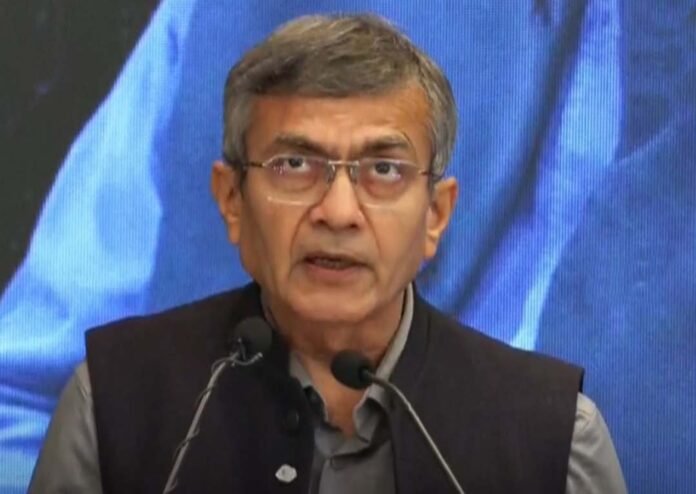
The government’s announcement will decide which of three shortlisted Indian industry groups will develop prototypes for the Advanced Medium Combat Aircraft (AMCA), the country’s planned stealth fighter. Speaking at the ANI National Security Summit 3.0 in New Delhi on November 16, Singh said bids had been received and the selection was expected within a month. He said the government hoped the decision would accelerate prototype development.
The contenders are Tata Advanced Systems; a consortium of Larsen & Toubro, Bharat Electronics and Dynamatic Technologies; and a group led by Bharat Forge with BEML and Data Patterns, according to reporting on the competition. The bids closed on October 30, 2026. The selected partner is expected to work with the Aeronautical Development Agency (ADA), which is responsible for the programme’s design.

The competition is a significant step in the government’s effort to bring Indian industry into the development of a domestically designed advanced combat aircraft. The Defence Ministry approved the AMCA execution model in May 2025, allowing eligible Indian companies to bid independently, as joint ventures or in consortia. The model offers public- and private-sector firms an opportunity to participate on a competitive basis.
The development phase is expected to include five flying prototypes and one structural test specimen, according to reporting on the programme. These aircraft would allow engineers to evaluate and refine the design before any decision on production or induction into the armed forces. The prototype contract is widely reported at around ₹15,000 crore, though the government’s May 2025 announcement focused on the execution model and industry partnership.
AMCA is planned as a twin-engine, fifth-generation fighter with stealth features. The project is intended to strengthen India’s domestic aerospace capabilities and reduce reliance on foreign suppliers for advanced combat aircraft. But selecting a development partner is an early milestone, not a guarantee of a quick delivery: prototype design, construction, testing and certification are complex processes that can take years.
Singh said the government had not yet decided whether to pursue another fifth-generation fighter programme beyond AMCA. “As of now, our fifth-generation programme is AMCA,” he said, according to ANI. The comment signals that the current programme remains the government’s stated focus, while leaving open whether a separate project could be considered later.

He also said India would have to manage with existing equipment and programmes while the AMCA is under development. That transition is relevant as the Air Force works to modernise its combat fleet and address delays affecting other aircraft programmes. Singh pointed to large Tejas Mk-1 contracts and said engine deliveries were beginning to gain visibility, offering a near-term element of progress as the longer-term stealth-fighter project advances.
Earlier at the summit, Chief of the Air Staff Air Chief Marshal Ashutosh Dixit said the Air Force expected to induct a squadron of indigenous Light Combat Aircraft Mark 1A within the current financial year. He also said the Tejas Mark 2 could roll out “maybe next year”, while describing work on AMCA as continuing. These programmes differ in role and maturity, but together form part of India’s effort to expand domestic combat-aircraft development.

The upcoming AMCA decision will therefore be closely watched by aerospace manufacturers and defence planners. The selected group will have to demonstrate the engineering capacity, industrial coordination and project management needed to turn ADA’s design into test aircraft. The government’s stated aim is to move faster once the partner is chosen; the schedule and performance of the prototype phase will show how quickly that ambition translates into an aircraft.







