


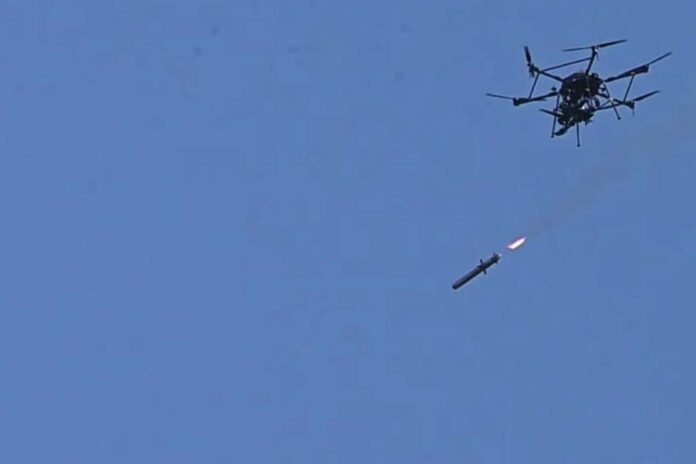
NEW DELHI / KURNOOL: In a momentous achievement for India’s indigenous defence manufacturing sector, the Defence Research and Development Organisation (DRDO) has successfully conducted the final deliverable configuration development trials of the Unmanned Aerial Vehicle Launched Precision Guided Missile (ULPGM)-V3. The extensive testing took place at the DRDO test range located near Kurnool in Andhra Pradesh. Evaluated across diverse combat roles, the weapon system proved its mettle in both Air-to-Ground and Air-to-Air engagement configurations.
The successful evaluation represents a monumental stride toward achieving Aatmanirbharta (self-reliance) in cutting-edge drone warfare technologies. Designed to expand the offensive envelope of unmanned aerial systems, the ULPGM-V3 demonstrated impeccable reliability, precision strike capabilities, and seamless operational effectiveness throughout the rigorous trial phase.

Twin-Mode Combat Capabilities
The newly developed ULPGM-V3 is a highly advanced precision-guided weapon specifically designed to be deployed from Unmanned Aerial Vehicles (UAVs), commonly referred to as drones. The latest series of tests demonstrated its capability to neutralise multiple types of threats in a multi-domain battlespace:
- Air-to-Ground Mode: Tailored primarily for anti-tank roles, this configuration allows UAVs to track and eliminate heavily armoured ground targets with pinpoint precision, offering a critical tactical edge to ground operations.
- Air-to-Air Mode: Engineered to counter aerial threats, this mode enables the system to intercept and destroy enemy drones, hostile helicopters, and various other moving airborne targets.
Amid global security transitions – where recent conflicts in Eastern Europe and West Asia have underscored the defining role of surveillance drones and remote precision strikes – the dual-capability of the ULPGM-V3 equips the Indian Armed Forces with a versatile, high-tech asymmetric asset.
State-of-the-Art Command & Control
A critical element of the successful testing was the performance of the integrated Ground Control System (GCS). The GCS was actively used to command, track, and control the entire ULPGM weapon system throughout the mission profile.
According to officials from the Ministry of Defence (MoD), the GCS incorporates state-of-the-art automated technologies. These advancements significantly streamline operational response times by automating pre-launch readiness checks and execution protocols. By removing manual delays, the system drastically increases the survivability and responsiveness of the launch platform in high-intensity combat scenarios.

Collaborative Development Matrix
The conceptualisation and birth of the ULPGM-V3 stem from an integrated network of DRDO laboratories working under a unified collaborative structure. The Research Centre Imarat (RCI) based in Hyderabad served as the nodal laboratory directing the project.
RCI worked in deep tandem with other specialised premier defence laboratories across India, including:

- Defence Research & Development Laboratory (DRDL), Hyderabad
- Terminal Ballistics Research Laboratory (TBRL), Chandigarh
- High Energy Materials Research Laboratory (HEMRL), Pune
To transition the technology from experimental prototypes to functional battlefield weapons, DRDO has forged partnerships with two high-profile production agencies: the public-sector undertaking (PSU) Bharat Dynamics Limited (BDL) based in Hyderabad, and the private defence major Adani Defence Systems & Technologies Limited, also operating out of Hyderabad. Furthermore, for the latest phase of development trials, the weapon system was integrated onto specialised UAV platforms designed and built by Bengaluru-based private aerospace company Newspace Research and Technologies.
A Mature Indigenous Supply Chain
One of the most remarkable highlights of the ULPGM-V3 programme is that the missile has been produced entirely within the boundaries of the domestic Indian defence ecosystem. The manufacturing framework integrated an extensive network of domestic industries, including a substantial number of Micro, Small, and Medium Enterprises (MSMEs).
Defence officials noted that the successful completion of these configuration trials effectively confirms that the domestic supply chain has fully matured. The industrial ecosystem is now completely equipped and optimised for immediate mass serial production, ensuring that future deployment phases will not suffer from foreign supply vulnerabilities.
High Praise from National Leadership
The landmark achievement drew widespread commendations from top political and defence leadership. Defence Minister Rajnath Singh extended his compliments to the DRDO, public sector undertakings, private industry partners, and contributing MSMEs involved in the successful development trials. He characterised the achievement as a “strategic milestone” in cementing the nation’s journey toward self-reliance in the high-stakes sector of defence manufacturing.
Echoing these remarks, Dr Samir V Kamat, Secretary of the Department of Defence R&D and Chairman of DRDO, congratulated all the core teams associated with the Kurnool trials. He lauded the collective effort for delivering a commendable milestone that elevates India’s stature in indigenous precision-guided technology.
With the development trials officially concluded and the domestic mass-production pipeline verified, the ULPGM-V3 is poised to transition into induction phases, promising to reshape India’s tactical unmanned combat doctrines in the years ahead.






