


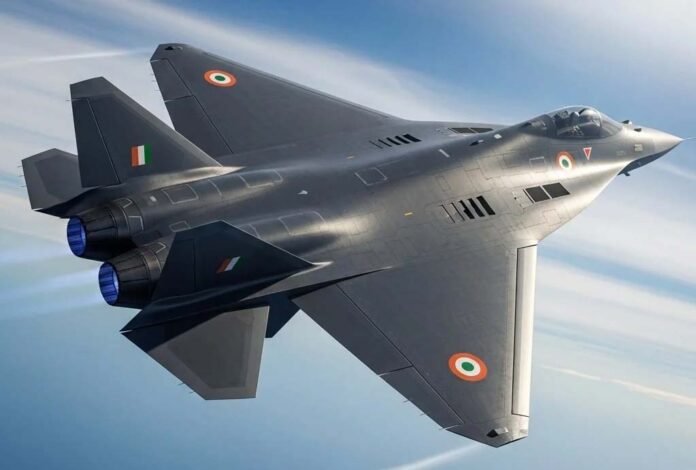
New Delhi: India’s next-generation combat aircraft research is moving into an era of unprecedented technological sophistication. Reports indicate that the Defence Research and Development Organisation (DRDO) is advancing two breakthrough technologies—“wing morphing” and “nano stealth coatings”—for its sixth-generation fighter programme, expected to leapfrog current fifth-generation designs such as the F‑35 or Su‑57.
Wing morphing represents a radical shift in aerodynamic design. Inspired by natural flyers such as birds and bats, it allows an aircraft’s wings to alter their shape dynamically during flight. This adaptive geometry can optimise lift, drag, and manoeuvrability across a wide range of speeds and altitudes, without relying on traditional control surfaces. Using smart materials, actuators, and flexible skin technologies, a wing-morphing system can reconfigure the wing sweep, camber, and surface area in real time. This provides better fuel efficiency, reduced radar cross-section, and enhanced agility in both subsonic and supersonic regimes. For a future air-dominance platform, these characteristics offer decisive operational advantages in stealth and mission adaptability.

Running parallel to morphing research is DRDO’s exploration of nano stealth coatings—radar-absorbing finishes made of atomically thin metamaterials. Unlike conventional radar-absorbent materials, which are thick, heavy, and degrade with thermal stress, nano coatings can self-heal, maintain structural integrity, and offer broadband stealth capabilities. These metamaterial-based layers manipulate electromagnetic, infrared, and even acoustic signatures. By bending and scattering incoming radar waves instead of merely absorbing them, such surfaces could render aircraft virtually undetectable to advanced sensors. Tunable nanostructures might allow modulable stealth characteristics via electric fields, giving pilots control over low observability in different operational environments.
Nano stealth coatings also address the growing threat of quantum‑enhanced detection systems. Their broadband absorption properties across X-band to millimetre-wave frequencies make them ideal for neutralising modern seekers and long‑range radars fielded by adversaries in China and other technologically advanced states.
An equally forward‑looking leap lies in the adoption of Fly‑By‑Light (FBL) avionics. This system replaces traditional electrical wiring used in fly‑by‑wire aircraft with fibre-optic communication links. Flight control inputs are transmitted using pulses of light rather than electrical signals, which greatly enhances data transmission speed and immunity to electromagnetic interference (EMI).
The resulting system improves response time, reduces signal latency, and enhances survivability in contested electromagnetic environments. For high‑energy combat theatres where jamming and cyber-attacks are common, FBL architectures provide a resilient infrastructure upon which next‑generation flight computers, sensors, and weapons can communicate securely.

The integration of adaptive aerodynamics, metamaterial stealth, and light‑based control systems signals India’s growing confidence in indigenous aerospace innovation. These technologies collectively aim to reduce dependence on imported platforms while positioning Indian defence research at the forefront of futuristic combat design.
As the United States and China race towards sixth‑generation air dominance with their NGAD and J‑XX programs, India’s own efforts could ensure parity in crucial technology domains. If realised, these initiatives could yield a stealthy, sensor‑fusion‑capable aircraft optimised for both manned and optionally unmanned operations by the mid‑2030s. The DRDO’s ongoing research underscores a broader strategic transition—from technology follower to pioneer—in the evolution of India’s air power and aerospace capabilities.







