



The Strait of Hormuz has once again reminded the world of an uncomfortable truth: geography can suddenly become strategy. A disruption thousands of kilometres away from India can ripple through crude prices, freight costs, inflation and the entire economic system. For a country that imports a large proportion of its petroleum requirements, energy security can never be taken for granted.
When Geography Becomes Strategy
But there is a less visible dimension to this vulnerability. We do not merely burn petroleum. We also build with it. Bitumen, the black binding material beneath much of the world’s road network, is predominantly petroleum-derived.

India’s roads carry its economy, connect its cities and increasingly reach its most remote borders. Yet, a significant part of the bitumen required for this enormous construction programme is imported. CSIR-CRRI estimates that nearly 49 per cent of India’s bitumen requirement is met through imports, with an annual foreign-exchange outgo of about ₹25,000 crore.
That makes bitumen more than a construction commodity. It is a strategic material. And that is why India’s emergence as the first country to commercially produce bio-bitumen deserves to be viewed not merely as a green innovation, but as a small yet potentially important step towards strategic autonomy.
The Bitumen Beneath Strategic Infrastructure
India is building roads at a scale and ambition unprecedented in its modern history. These roads are not merely arteries of commerce. Some are lifelines of national security.
A road through Ladakh is different from a road through the plains. A road approaching the Line of Actual Control is not simply a transportation project. It is an instrument of mobility, logistics, deterrence and national presence.

This gives the bitumen question a strategic dimension. India has rightly pursued diversification of its energy sources, strategic petroleum reserves, renewable energy and domestic production. But strategic resilience requires us to examine the entire supply chain of critical infrastructure – not merely the fuel that moves it.
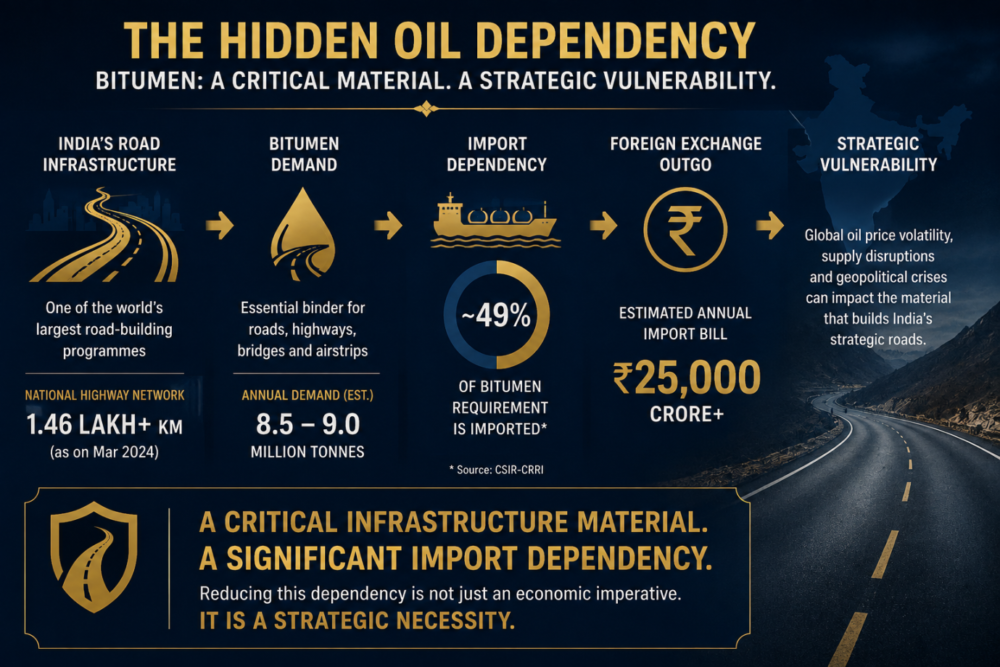

If a country depends on external sources for a critical material used in building its highways, bridges and strategic roads, that dependency deserves attention even when it represents only a fraction of the total infrastructure ecosystem.
The objective, therefore, should not be to eliminate petroleum-derived bitumen overnight. Nor is that realistic. The objective should be more intelligent:
Create an additional domestic source of a strategic material, reduce import vulnerability and build technological alternatives before a crisis forces us to do so.
That is where bio-bitumen enters the strategic conversation.
From Paddy Straw to Pavement
The Indian innovation is deceptively simple in concept but sophisticated in execution.
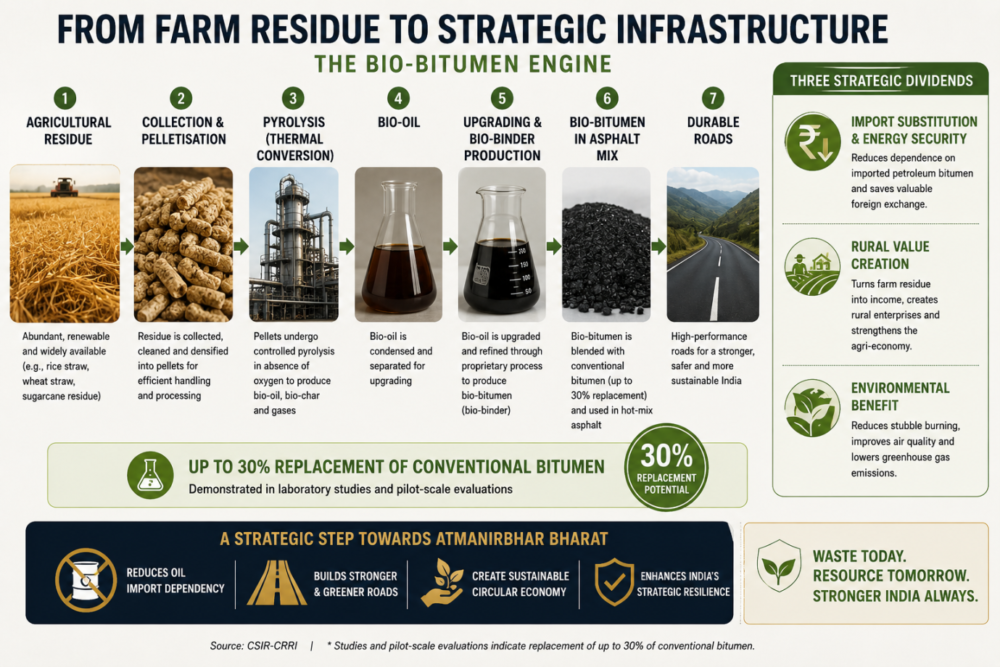
CSIR-CRRI and CSIR-Indian Institute of Petroleum have jointly developed an indigenous technology that converts agricultural residue, notably rice straw, into bio-bitumen.
The process uses controlled pyrolysis to convert the biomass into bio-oil, which is subsequently upgraded through chemical processing and converted into a bio-binder suitable for flexible pavements. The bio-binder can be used as a partial replacement or modifier for conventional bitumen.
Bitumen underpins national logistics and border defence. Substituting imported petroleum bitumen with domestic bio-bitumen safeguards critical infrastructure supply chains against global market volatility and supply chain shocks
In simple terms:
Rice straw → pyrolysis → bio-oil → upgraded bio-binder → asphalt mix → road.
But this is not a case of putting agricultural waste onto a road and hoping for the best. The material has undergone physical, chemical, rheological and mechanical evaluation, including tests for rutting, cracking, moisture damage and resilient modulus. A 100-metre trial stretch was laid on the Jorabat–Shillong Expressway, demonstrating field-level feasibility.
Studies and pilot-scale evaluations indicate that bio-bitumen can replace up to 30 per cent of conventional bitumen. At a more conservative 15 per cent blending level, the government estimates potential foreign-exchange savings of around ₹4,000 crore annually, although the actual figure would depend on blending ratios, feedstock availability and market prices.
The significance lies not in the number alone. It lies in the discovery that one of India’s most abundant agricultural residues could become an input into one of its most important strategic assets.
The Triple Dividend
Bio-bitumen offers India an unusual three-way dividend.
- Energy Security: Every percentage point of conventional bitumen that can be reliably replaced by a domestically produced alternative reduces exposure to imported petroleum and international price volatility.
- Agricultural Value Creation: India generates enormous quantities of agricultural residue. When residue has little economic value, burning it can become the easiest disposal mechanism. Turning it into an industrial feedstock changes that equation. The waste acquires a market.
Developed by CSIR-CRRI and CSIR-IIP, the technology converts crop residue (like rice straw) via controlled pyrolysis into a viable bio-binder. Pilot tests demonstrate it can replace up to 30% of conventional bitumen
- Environmental Benefit: Reduced stubble burning can improve air quality and reduce associated emissions, while the bio-based pathway potentially lowers the carbon intensity of road construction. CSIR-CRRI estimates significant greenhouse-gas reduction potential from the technology.
But the environmental argument, important though it is, should not dominate the conversation. The strategic opportunity is larger.
Bio-bitumen brings together energy security, rural economics and infrastructure resilience in a single technology.
That is precisely why it deserves attention from policymakers concerned not only with climate but with national power.
BRO: From Road Builder to Technology Pioneer
This is where India can take the idea one decisive step further. The Border Roads Organisation (BRO) should become an early strategic adopter of bio-bitumen.
BRO is uniquely positioned for such an experiment. It builds roads where conventional assumptions are constantly challenged – at high altitude, under severe temperature variations, through intense rainfall, in remote areas and across terrain where maintenance itself can become a logistical operation.
That makes BRO not merely a road-building agency, but potentially one of India’s most important real-world infrastructure laboratories.
Replacing standard bitumen yields three major benefits: lower foreign-exchange outgo (up to ₹4,000 crore annually), new income streams for farmers through crop residue monetisation and reduced air pollution from stubble burning
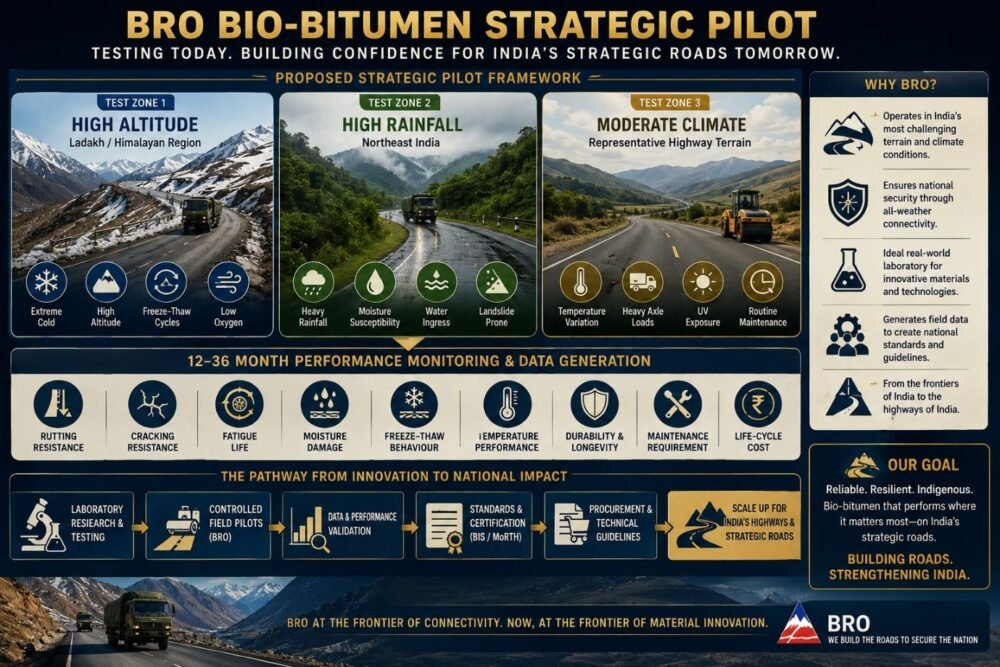
The objective should not be to announce that every strategic road will immediately use bio-bitumen. That would be premature. Instead, BRO could establish a Strategic Bio-Bitumen Pilot Programme, selecting carefully designed road stretches representing different climatic and operational conditions.
One could be in a high-altitude cold region. Another could be in the high-rainfall Northeast. A third could represent a relatively moderate climatic environment.
The roads should then be monitored over several seasons.
Rutting, cracking, moisture susceptibility, freeze-thaw behaviour, temperature performance, fatigue, surface deterioration, maintenance frequency, lifecycle cost – all should be monitored. The resulting database could be more valuable than any laboratory report.
BRO should not merely become a consumer of bio-bitumen. It should become an institution that helps determine where, when and how India can deploy it with confidence.
That would be a natural extension of BRO’s historic role: not simply building roads in difficult terrain, but pioneering technologies that make laying difficult roads possible.
Can it Survive the Border?
The ultimate test of any infrastructure technology is not whether it works in a laboratory. It is whether it survives reality.
A 100-metre demonstration stretch is encouraging. It is not yet proof of performance over thousands of kilometres and decades of service.’
The Border Roads Organisation (BRO) serves as an ideal adoption candidate. Deploying bio-bitumen across harsh, high-altitude and heavy-rainfall strategic corridors will rigorously test its real-world durability and freeze-thaw performance
Border roads present particularly demanding conditions. Extreme temperature swings can affect pavement behaviour. Freeze-thaw cycles can accelerate deterioration. Heavy military traffic can impose unusual loading patterns. Water ingress, snow, altitude and remoteness can magnify small material weaknesses.
This is why technological enthusiasm must be accompanied by engineering discipline. Bio-bitumen should initially be viewed as a graded substitution technology, not as an ideological replacement for petroleum bitumen. The right question is not, “How quickly can we eliminate conventional bitumen?” It is: Where can bio-bitumen perform reliably, at what blending ratio, under what climatic conditions and at what lifecycle cost?
The answer will probably vary across India. That is not a weakness. It is precisely how serious infrastructure technologies mature.
And if bio-bitumen can demonstrate long-term performance under the unforgiving conditions of India’s strategic roads, its credibility across the wider highway network will be considerably stronger.
From Pilot to Policy
The greatest danger now is not technological failure. It is institutional inertia.
India has no shortage of promising pilot projects. The challenge is converting innovation into standards, procurement practices and mass deployment. The pathway should be clear:
Research → testing → standards → certification → controlled pilots → performance database → procurement specifications → scale.
There is already movement in this direction. CSIR-CRRI is working with the Ministry of Road Transport and Highways on long-term performance evaluation and with the Bureau of Indian Standards on material specifications, testing protocols and usage guidelines.
Technology transfer to 14 industries began in January 2026, creating the beginnings of a commercial ecosystem.
The next phase must be performance-driven. Government procurement should reward certified performance rather than simply mandate a technology.
Commercialisation is actively underway, with technology transfers initiated across multiple industries. Building robust certification standards, performance databases and decentralised regional bio-refineries will be key to long-term adoption
Independent testing, transparent data and lifecycle assessment should determine where bio-bitumen is appropriate. The state must create the conditions for scale without compromising engineering standards.
Innovation may begin in a laboratory. Strategic capability begins when an innovation acquires an ecosystem.
Building a Domestic Bio-Bitumen Ecosystem
The larger opportunity extends far beyond road construction.
Imagine regional bio-refineries located close to agricultural belts. Crop residue is collected rather than burnt. Farmers and rural entrepreneurs participate in the supply chain.
Biomass is converted into bio-oil and then bio-binder. Road agencies procure a portion of their requirements domestically. Processing capacity grows around the availability of feedstock.
A new industrial loop emerges: Farm → biomass collection → bio-refinery → bio-binder → road → economic activity.
This is fundamentally different from a centralised petroleum supply chain. The feedstock is renewable, distributed and potentially available across multiple agricultural regions.
Production can therefore evolve into a geographically distributed network rather than another highly concentrated strategic dependency.
That creates resilience. It also creates rural value. And it demonstrates an important principle of modern strategic autonomy:
A country becomes more secure not when it produces everything itself, but when it possesses credible alternatives for what matters.
Bio-bitumen is one such alternative. It may never replace petroleum bitumen completely. It does not need to.
Complete replacement of petroleum bitumen isn’t the goal – optionality is. Establishing a distributed, renewable bio-bitumen network grants India strategic flexibility, proving the path to infrastructure autonomy can start in a field of rice straw
But if it could reliably replace a meaningful fraction, India gains something strategically valuable: optionality.
The Road Beyond Oil
The Hormuz crisis reminds us that strategic vulnerabilities often hide inside ordinary economic systems.
We usually think of energy security in terms of petrol, diesel, crude oil, LNG and electricity. But strategic autonomy is also about the materials that build the physical foundations of national power. Roads. Bridges. Tunnels. Airfields. Ports.
The future of infrastructure security will increasingly depend upon diversified supply chains, indigenous technology and the ability to convert domestic resources into strategic capability.
India’s bio-bitumen initiative is still young. Its long-term performance must be established. Its economics must be tested at scale. Feedstock logistics must be solved. Standards must mature. And its application to extreme environments must be demonstrated rather than assumed. But the direction is right.
India has shown that agricultural residue can be converted into a road-building material. It has moved the technology from laboratory research to field demonstration and now towards commercialisation.
The next opportunity is to make the idea strategically consequential. BRO could lead the way – not by replacing conventional bitumen overnight, but by becoming the test-bed for India’s roads beyond oil.
Hormuz tells us that dependence has a price. Bio-bitumen offers India a chance to reduce one small part of that dependence before the next crisis arrives.
And perhaps that is the most strategic way to look at this innovation: The road to strategic autonomy may not always begin in an oil field. Sometimes, it may begin in a field of rice straw.

Lt Gen Rajeev Chaudhry (Retd) writes on contemporary national and international issues, strategic implications of infrastructure development towards national power, geo-moral dimension of international relations, and leadership nuances in a changing social construct. The views expressed are of the author and do not necessarily reflect the views of Raksha Anirveda





