


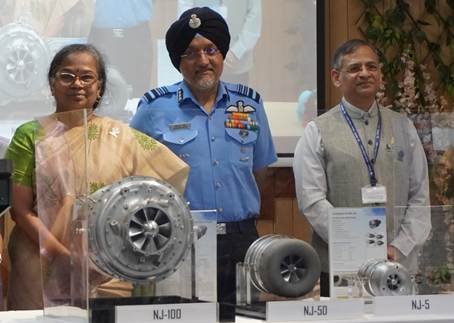
NEW DELHI. In a major breakthrough for indigenous defence manufacturing and aerospace engineering, the Council of Scientific and Industrial Research-National Aerospace Laboratories (CSIR-NAL) launched three miniaturised gas turbine engines designed specifically to power unmanned defence systems.
The unveiling ceremony, held at the CSIR headquarters in New Delhi, introduced three distinct variants: the NJ-05 generating 5 kilogrames of thrust, the NJ-50 providing 50 kilogrames of thrust, and the high-performance NJ-100 delivering 100 kilogrames of thrust. Developed to meet urgent tactical needs across the Indian armed forces, these lightweight propulsion systems are tailored for tactical unmanned aerial vehicles, high-speed drone interceptor platforms, target drones and compact cruise missile systems.

Air Marshal Tejinder Singh, Chief of Integrated Defence Staff to the Chairman Chiefs of Staff Committee, was the chief guest at the event and he officially unveiled the compact propulsion systems.
He emphasised that establishing complete domestic mastery over advanced turbine technologies is a strategic imperative that directly enhances national security, while reducing critical vulnerabilities associated with foreign supply chains. He noted that sovereign control over propulsion capabilities equips the military with greater operational flexibility and ensures long-term technological self-reliance.
Dr N Kalaiselvi, Director General of CSIR and Secretary of the Department of Scientific and Industrial Research, commended the scientific breakthroughs achieved during the project.
She described the indigenous creation of high-precision turbine sub-systems as a pivotal benchmark in advancing the broader goals of the national self-reliance mission in complex defence engineering.During the unveiling, lead scientists delivered detailed technical briefings highlighting breakthroughs in high-speed turbomachinery operating at extreme revolutions per minute, alongside innovations in high-temperature combustion systems that enabled such compact power-to-weight performance.

Addressing the strategic roadmap for commercialisation, Dr Abhay A Pashilkar, Director of CSIR-National Aerospace Laboratories, detailed the institute’s evolving mission as a multi-stage integrator within India’s rapidly growing unmanned ecosystem.
He urged domestic private enterprise, particularly the vibrant network of aerospace startups and defence manufacturers, to absorb these tech transfer frameworks and scale industrial production.Establishing local production pipelines for these miniaturised engines enables the domestic defence sector to mass-produce tactical drones and precision guided weapons at a fraction of the cost of imported alternatives.

The successful development of the NJ series resolves a long-standing technological bottleneck for the Indian defence sector.Miniaturised gas turbine engines require sophisticated material science, precision bearings, complex thermal management and advanced fuel delivery systems that are strictly controlled under global export regimes.By mastering these engineering complexities domestically, CSIR-NAL has established a robust design and manufacturing base that positions India as a competitive player in the global unmanned aerospace landscape while guaranteeing operational readiness for its defence forces.






