


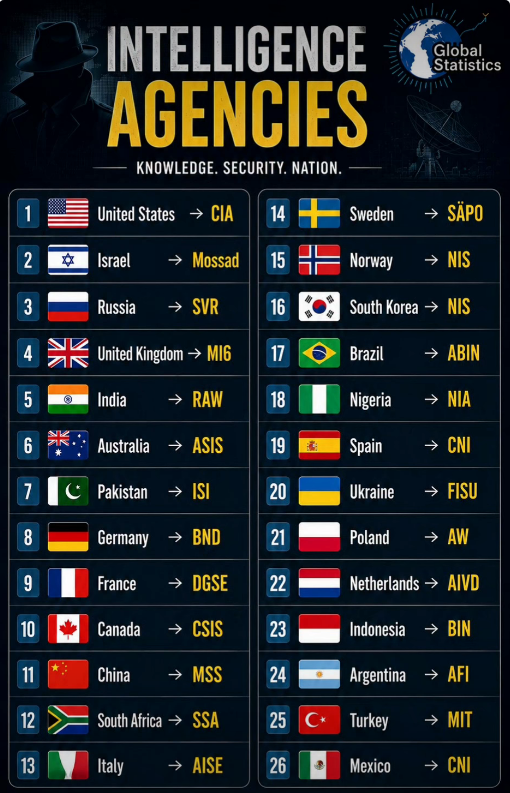
A slick infographic has been circulating across strategic-affairs feeds this month. Under a fedora-shadowed spy silhouette and the tagline “Knowledge. Security. Nation.”, it ranks the intelligence agencies of twenty-six countries from one to twenty-six. The CIA takes the top slot, Mossad second, Russia’s SVR third, Britain’s MI6 fourth, and, to the quiet satisfaction of many Indian readers, India’s R&AW fifth, ahead of Germany, France and China.
It is handsome, shareable, and almost entirely meaningless. Not because the agencies are fictional; most are real and consequential. It is meaningless because the exercise rests on a conceit no serious intelligence professional would defend: that the world’s secret services can be lined up like a batting order and assigned a number.

The ranking is entirely meaningless. Not because the agencies are fictional; most are real and consequential. It is meaningless because the exercise rests on a conceit no serious intelligence professional would defend: that the world’s secret services can be lined up like a batting order and assigned a number
The ranking begins with a promise it cannot keep. The graphic offers positions one through twenty-six but says nothing about what “best” is meant to signify. Is it human-intelligence reach? Signals interception? Satellite coverage? Cyber capability? Covert-action record? Analytical quality? Budget, or the depth of alliance access? Each of these produces a different table, and the world’s intelligence establishments are, by design, opaque about all of them. There is no audited ledger from which anyone could honestly declare the CIA first and the SVR third. The numbers project a false precision onto an arena built to resist measurement.
Look closer and the cracks widen. The list even gets some of its labels wrong. It places Argentina at twenty-four under “AFI”, an agency that no longer exists. Buenos Aires in July 2024 dissolved the Agencia Federal de Inteligencia, and then restored the older Secretaría de Inteligencia de Estado, the SIDE, which later has been restructured once more. But a chart that can’t keep up with a reorganisation from two years back shouldn’t be trusted to adjudicate global standing.
Then comes the deeper category error. The graphic treats one named agency as if it were the whole of a nation’s intelligence power. It lists Sweden’s SÄPO, a domestic security service, where the foreign-facing military intelligence, MUST, would be the fairer comparator. It names the Netherlands’ AIVD while ignoring the defence service, the MIVD, that sits beside it. It reduces the United States to the CIA, when the CIA is one node in a community of eighteen agencies. It reduces Russia to the SVR, setting aside the GRU and the FSB. To rank a single logo is to mistake a limb for the body.
The list even gets some of its labels wrong. It places Argentina at 24 under ‘AFI’, an agency that no longer exists. Buenos Aires dissolved the Agencia Federal de Inteligencia in July 2024, and restored the older Secretaría de Inteligencia de Estado, the SIDE
This is where the infographic stops being merely inaccurate and turns instructive, because its flaw is the flaw of an entire era’s thinking. For most of the twentieth century, intelligence power could plausibly be imagined as a single arrow, viz. the state commissions an agency, the agency runs its spies, the spies deliver secrets, and the secrets protect the nation. Rank the agencies and you rank the nations. That model is now obsolete.

In 2026, no single discipline truly decides things by itself. Human intelligence still matters, sure, but it’s just one input, among many. The states that actually hold a durable edge are the ones that can fuse multiple streams – human sources, intercepted signals, satellite and geospatial imagery, open-source scraping, even cyber intrusion and, more and more, financial intelligence – into one kind of coherent, real-time picture. Then layer over that the force now rewriting basically every profession: artificial intelligence that sifts oceans of data faster than any analyst cadre, and the cognitive plus behavioural tradecraft that turns raw collection into influence. The prize is no longer the best spy. It is decision advantage, the ability to see, understand and act before an adversary can.
Financial intelligence is the sharpest illustration of why the old scoreboard misleads. A terror plot, a proliferation network or a sanctions-evasion scheme now leaves its clearest signature not in a whispered tip but in the movement of money, the mispriced trade invoice, the shell company, the crypto wallet. A service that can read that flow and stitch it to human and cyber reporting will outperform a larger rival still organised around classical espionage. None of that appears in a numbered list of agency acronyms.

India has an intelligence system: R&AW for external collection, the Intelligence Bureau at home, the Defence Intelligence Agency for the military domain, and the National Technical Research Organisation for technical and geospatial work
Which returns us to India, and to that flattering fifth place. As a number, it is worthless; there is no methodology behind it, and India should be wary of applause built on sand. As a prompt for a better question, though, it is genuinely useful. The honest case for India’s rising intelligence weight has nothing to do with ranking R&AW against Mossad. It rests on architecture. India does not possess an intelligence agency so much as an intelligence system: R&AW for external collection, the Intelligence Bureau at home, the Defence Intelligence Agency for the military domain, and the National Technical Research Organisation for technical and geospatial work, layered over the collection capacities of the armed forces. The strategic question is not whether R&AW ranks fifth or fifteenth. It is whether these limbs are being fused into a single nervous system fast enough to keep pace with threats, cross-border terror finance, cyber intrusion, and cognitive manipulation, that no one of them can see alone.
That is the conversation the viral graphic accidentally invites. If we must build a scoreboard at all, let it measure the right things: not a country’s most famous acronym, but its capacity to integrate human, signals, geospatial, cyber, financial and machine-generated intelligence into decisions taken at speed. By that yardstick, the leaders are not the states with the most celebrated spies, but the ones quietly laying the plumbing that connects them.
So enjoy the infographic for what it is, a well-made piece of social-media theatre. Screenshot it, argue about India’s placing over chai, and then set it aside. The nations that will dominate the coming decade of statecraft are not counting their agencies. They are wiring them together. The real league table has no numbers on it yet, and the countries winning it are precisely the ones not bothering to make graphics about it.

The writer is an expert on geopolitics, national security, and counter-terrorism; and he regularly contributes his subject thought-leadership and academic commentary with several publications in newspapers, journals, and periodicals. He works with investigative agencies, regulatory bodies, financial institutions and enterprises, providing strategic and regulatory advisory. The views expressed are personal and do not necessarily carry the views of Raksha Anirveda





