


BENGALURU. Indian drone startup Airbound has secured $37 million in a Series A financing round led by investment firm Greenoaks, with participation from high-profile backers including DoorDash, Lightspeed, Lachy Groom, and Humba Ventures. The latest infusion comes less than a year after the company’s $8.65 million seed round, bringing its total raised capital to roughly $50 million.
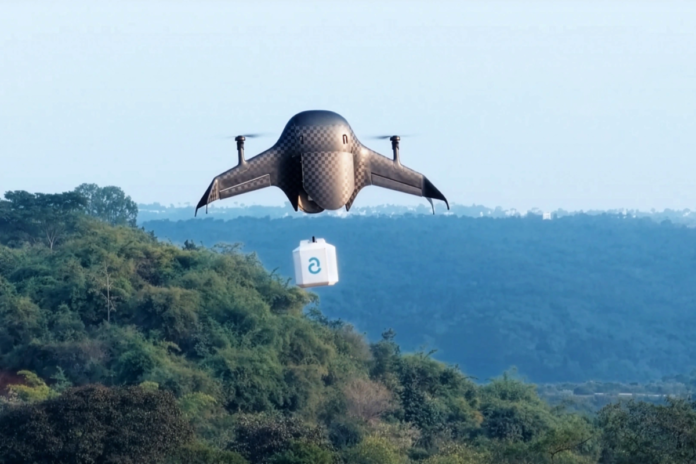
Airbound is taking an unconventional engineering approach to solving the expensive, slow nature of last-mile logistics. Rather than relying on standard quadcopters or runway-dependent fixed-wing aircraft, the startup builds lightweight, autonomous tail-sitter drones that launch vertically like rockets before transitioning into horizontal wing-borne flight.

This hybrid mechanism allows the craft to take off and land in virtually any location without needing dedicated runways, landing gear, or complex ground infrastructure. By eliminating heavy, unnecessary components, Airbound has achieved a rare design milestone with its flagship drone, the TRT. The craft itself weighs approximately 1.5 kilogrames (3.3 pounds), yet it is capable of carrying a payload of up to 1.0 kilogrames (2.2 pounds) – meaning the drone weighs less than the cargo it transports. Built for speed and efficiency, the aircraft cruises at 60 km/h, boasts a maximum range of 40 kilometres and operates at an ultra-quiet noise level of just 60 decibels.
By radically reducing the aircraft’s structural mass, the startup drastically lowers manufacturing and energy costs. Airbound’s stated goal is to drive the cost per kilometre of drone logistics down to parity with – or cheaper than – traditional delivery trucks, effectively replacing gas-chugging road freight for light goods like medical supplies, diagnostics and high-priority packages.
Airbound’s autonomous fleet has already logged over 13,000 successful commercial missions across India. In one early deployment with healthcare provider Narayana Health, the drones transported critical diagnostic samples between facilities in just seven minutes – a journey that previously took three to five hours by road due to urban traffic.
With the new capital, Airbound plans to expand its engineering team, scale its fleet manufacturing and expand operations into broader commercial logistics markets. By combining autonomous software with ultra-light hardware, the startup aims to render road logistics obsolete for time-sensitive cargo.







