


Icommanded 15 Punjab in Lebanon in 2006, immediately after the Israel-Hezbollah war, and saw at close quarters both the resilience of Lebanese society and the weakness of the state institutions around it.
Twenty years later, much has changed in Lebanon, but the central problem remains: the Lebanese state has struggled to establish a monopoly over force and to build institutions capable of delivering political and economic stability.

Lebanon’s resilience is remarkable, but resilience alone cannot substitute for a functioning state.
Lebanon was once a regional hub for banking, tourism and trade. Its location could again become an economic asset, particularly if reconstruction gathers pace in neighbouring Syria and Lebanese ports participate in regional trade and logistics.
Beirut is also exploring ways to strengthen its energy connectivity with the Gulf, including routes that could reduce dependence on the Strait of Hormuz. Yet these opportunities will remain difficult to realise unless Lebanon addresses its deeper political, security and economic weaknesses.
The end of the civil war in 1990 did not produce a durable political settlement. Mass anti-government protests in 2019 exposed the depth of public frustration, while the 2020 Beirut port explosion became a symbol of institutional failure.

The investigation into the blast was stalled for years, although it has now resumed and produced a report, underscoring both the persistence of accountability problems and the continuing demand for justice.
Lebanon finally emerged from a prolonged political vacuum in January 2025, when Parliament elected Joseph Aoun as President and Nawaf Salam became Prime Minister. Their backgrounds are markedly different.

Elected in early 2025, President Joseph Aoun and Prime Minister Nawaf Salam bring non-traditional backgrounds to a political system long dominated by legacy factions. Though committed to restoring state authority, their administration must navigate intense resistance while attempting to rebuild trust in government institutions
Aoun is a soldier; Salam is an academic and international jurist. Both came to office as relative outsiders in a political system long shaped by established political factions and former warlords. Both have pledged to strengthen state authority and address the issue of Hezbollah’s arms.
There has been some progress, including measures to advance economic reforms and negotiations with the International Monetary Fund. But the government’s record remains mixed.
The fundamental challenge is that Lebanon’s political, security and economic crises cannot be solved sequentially. Disarmament, institutional reform and reconstruction have to move together.
Hezbollah remains the central obstacle. Its military role has repeatedly drawn Lebanon into conflicts that the state has often been unable to control. In October 2023, Hezbollah opened fire on Israel in support of Hamas after the October 7 attack, triggering a new cycle of conflict.
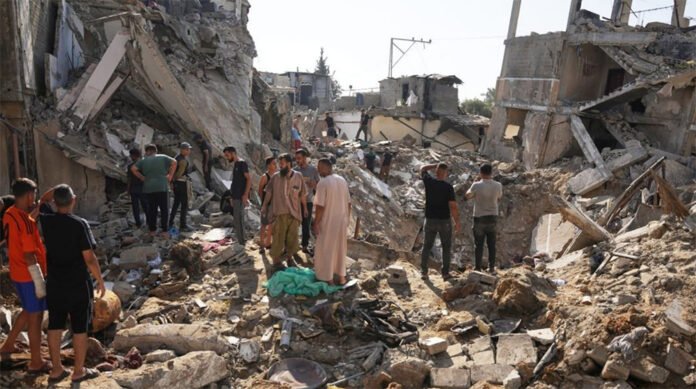
The subsequent fighting inflicted enormous economic damage. Lebanon has lost billions of dollars through successive rounds of conflict, adding to the devastation caused by the financial crisis and the port explosion.
Yet, Hezbollah cannot be understood simply as an armed organisation. Having observed its presence in Lebanon, I have seen how deeply it is embedded in parts of Shia society. It operates schools, hospitals and youth programmes and has built networks that provide services and financial support.
Lebanon cannot solve its security, political and economic crises sequentially. Achieving meaningful recovery demands that disarmament, institutional overhaul and post-conflict reconstruction move forward in tandem – a delicate balancing act that requires avoiding internal conflict while restoring public confidence
Its parallel financial mechanisms have helped some supporters withstand the country’s banking collapse. This helps explain the organisation’s enduring social base and why disarmament cannot be treated merely as a military operation.
The Lebanese government’s biggest challenge is therefore, how to establish state authority without triggering another internal conflict. Hezbollah has argued that surrendering its weapons would expose Lebanon to renewed Israeli aggression and could lead to a civil war.
The Lebanese Army, meanwhile, remains too weak to impose disarmament by force. Although its size has increased substantially since 2021, much of its limited budget goes towards salaries and pensions rather than modern weapons and capabilities.
Its institutional capacity, courts and political backing also remain insufficient for a confrontation with an organisation that has historically been better armed and more deeply embedded in parts of the country.
A second obstacle is southern Lebanon. The credibility of the Lebanese state and its army are weakened when Israeli forces remain on Lebanese territory or conduct continuing military operations.
Lebanon therefore, faces a difficult equation: it is being asked to establish a state monopoly over weapons while also seeking an end to foreign military presence on its territory. The two issues are closely connected and require parallel diplomacy.
The third challenge is money. Lebanon urgently needs reconstruction finance, but international donors are unlikely to commit substantial resources without credible reforms. An earlier donors’ conference in 2018 produced pledges of about $10 billion, but much of the promised support did not materialise.
The IMF has repeatedly stressed that banking-sector restructuring, fiscal sustainability, governance and transparency are prerequisites for recovery.
For global observers, Lebanon illustrates that political stability, economic growth and security are interconnected. To transform its strategic location from a vulnerability into an economic asset, Beirut must build functioning state institutions capable of outlasting crisis management
The economic numbers explain the urgency. Lebanon’s currency has lost almost all of its former value, while hyperinflation has devastated household savings and confidence. Inflation has nevertheless fallen sharply from its 2023 peak, showing that stabilisation is possible.
The country must now repair its banks, restore credit, broaden its sources of growth and reduce the heavy burden of wages and pensions on public finances. Its advantages remain considerable: relatively cheap labour, strong universities and an entrepreneurial culture.
Lebanon therefore faces a narrow window of opportunity. Its people have repeatedly demonstrated resilience, but the state has to convert that resilience into institutional strength.
The path forward lies in strengthening the Lebanese Army and state institutions, reducing the space for parallel centres of power, undertaking economic and banking reforms and securing credible international support for reconstruction.
None of these challenges can be addressed in isolation.
For India, Lebanon offers a broader lesson about state capacity in a fragmented security environment. Political stability, economic recovery and national security are mutually reinforcing, not separate policy compartments.
Lebanon’s experience also underlines the importance of institutions that can prevent non-state actors from becoming stronger than the state itself. If Beirut can restore state authority while rebuilding its economy, its strategic location could again become an asset rather than a vulnerability.
The choice before Lebanon is ultimately between remaining resilient in crisis and becoming resilient through functioning institutions. There may not be another opportunity to postpone that choice.
The writer commanded 15 Punjab in Lebanon under United Nations Flag, commanded 27 Sector as DIG in Churachandpur and was Brigadier Operational Logistics in HQ Western Command. He is currently an analyst on geopolitics, international and defence affairs. The views expressed are personal and do not necessarily carry the views of Raksha Anirveda





