


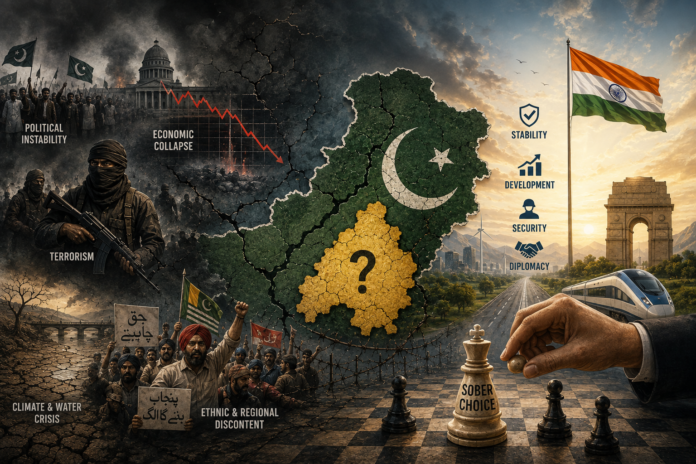
For most of its history, Pakistan has been a crisis state that fought its crises one at a time. What makes the present moment different is that every fault line seems to have cracked open at once.
A bankrupt economy, a radicalised society and a hollowed-out political order now coincide with unrest across almost every periphery. Balochistan has become this battlefield already.

Meanwhile, Khyber Pakhtunkhwa is still stuck inside that grinding cycle, insurgency and militancy, like it never really moves on. And then Pakistan-occupied Kashmir, or PoK, which was usually paraded as the pride, the showcase of Islamabad’s Kashmir policy has blown up with sustained protest.
For New Delhi, the temptation is to read these tremors as the opening chapters of Pakistan’s disintegration, a temptation worth resisting. The more useful question is not whether Pakistan will fragment, but why its crises keep converging, and what that means for India’s western frontier.
The protests in PoK should worry Islamabad far more than its official calm suggests. Every demonstration in the region erodes not only the administrative control, but the decades old claim that Pakistan alone speaks for Kashmiri aspirations as if it was certain.
Unrest in Balochistan and Khyber Pakhtunkhwa has evolved from long-simmering insurgencies into a broader breakdown of state authority. The economic contraction has eliminated the financial buffers that once kept peripheral discontent contained, forcing local populations to demand fundamental constitutional rights over dwindling resources
The Mirpuri diaspora in Britain once amplified this story through British politics and media; now protests in Muzaffarabad seem to reverberate in Bradford and Birmingham.

Yet, the meaning of this unrest must be read with care. The protesters have not just, overnight, become secular, liberal or pro-Bharat. Their grievance is more prosaic and for Islamabad really more corrosive: they increasingly see themselves as second class citizens in a Punjab-dominated state, treated no differently than Balochs or Pashtuns.
That anger built up over decades of political exclusion and economic neglect, and then it got detonated by Pakistan’s prolonged economic collapse. Where national resources have long been flowing disproportionately toward Punjab, the peripheries somehow survived on leftovers, and when the economy contracted, those leftovers too almost vanished.

Electricity tariffs climbed, subsidies were slashed and frustration spilled onto the streets. What started as protests about the price of wheat and power quickly turned into a push, for constitutional rights. People grasped what political economists have long known: economic condition and political condition are inseparable.
More significant is the quiet unravelling of Pakistan’s Kashmir narrative within PoK itself. Three uncomfortable realisations have set in. So, the story about “Azad Kashmir” looks transparent, like, not really the full story.
The real authority is in Islamabad, not in Muzaffarabad. Also, Pakistan really doesn’t have the military capability, or the diplomatic leverage, the kind needed to reshuffle the territorial status quo.
Mass protests in Pakistan-occupied Kashmir signal a profound erosion of Islamabad’s long-standing narrative. Demonstrations over wheat and power tariffs have laid bare deep grievances against a Punjab-dominated state structure, severely undercutting the historic premise that Islamabad speaks seamlessly for Kashmiri aspirations
And then there’s this visible economic transformation along the Line of Control in Jammu and Kashmir, it’s already starting to puncture those decades of propaganda, bit by bit. Slogans cannot indefinitely outrun reality.
All this unfolds, ironically, just as Pakistan enjoys a modest diplomatic revival, sensing renewed relevance after Donald Trump’s return to the White House and his conspicuous warmth toward the military establishment.
Here lies a familiar trap. Pakistan has repeatedly mistaken tactical geopolitical importance for strategic national strength. It was indispensable to the historic US-China opening of the early 1970s, the same years it suffered the loss of East Pakistan.
It was central to the anti-Soviet jihad under Zia ul Haq and to Washington’s calculations after 9/11, under Musharraf. Each episode ended not in national consolidation but in deeper extremism and instability. Borrowed relevance, bought by serving a superpower’s interests, manufactures the illusion of strength while masking structural rot at home.
Those structures are the heart of the matter. Scholars such as John R Schmidt and Babar Ayaz have argued, from within the Pakistani debate itself, that the state was captured early by Punjab’s landed and military elite and never evolved into a genuine federation.
After almost eight decades, Islamabad still acts like a colonial administrator, dealing with the outer borders, not like a federation. When one province keeps a grip on power, on the resources and even the wider national identity, the pushback from the edges becomes more or less unavoidable and that’s exactly why Balochistan and Khyber Pakhtunkhwa have kept simmering for decades now. In the same breath PoK now is lining up for the same arc, more or less.
Military dominance compounds the problem. Whether under direct rule or civilian governments on a short leash, Pakistan has consistently failed to resolve political conflict through accommodation. Armies are built to defeat enemies, not to reconcile identities; they read the world in binaries of loyal and rebellious.
Pakistan’s current diplomatic manoeuverings repeat a historic pattern of mistaking tactical international attention for structural internal strength. Reliance on external alignments – whether during the Cold War or post-9/11 – has repeatedly masked domestic institutional decay without resolving the underlying governance deficit
In such a system the general can rarely be publicly wrong, and the political rival becomes an enemy of the state. Imran Khan’s rise and fall, cordial with the establishment, then imprisoned once that bond broke, is only the latest illustration of a system in which legitimacy flows from the barracks, not the ballot.
Yet, intellectual honesty, needs caution toward the “Punjabistan” thesis itself. Punjab is not some single, monolith thing; in the south people there have long complained about neglect, and everyday Punjabis suffer under military dominated governance as much as anyone else.
The problem seems less like a Punjab conspiracy and more like an institutional order where a disproportionately Punjabi establishment governs a multi ethnic state without any real consent.
And no, persistent instability doesn’t automatically mean an imminent collapse. States possess enormous coercive capacity and usually outlast their obituaries. A cohesive army, nuclear deterrence and an international system that instinctively defends Pakistan’s territorial integrity make near-term fragmentation the least likely outcome. Far more probable is protracted internal contestation, a slow test of the federal compact rather than its sudden rupture.
Despite severe federal strain, predicting an imminent collapse underestimates the structural endurance of the state. A cohesive military apparatus, robust nuclear deterrence and international systemic support ensure that long-term internal contestation – rather than sudden territorial rupture – remains the most likely trajectory
This is where India’s strategy must be clear-eyed. The lesson of PoK is not that its people are turning toward New Delhi. The evidence points to demands for cheaper electricity, wheat subsidies and constitutional rights, not a yearning for accession.
To read local protest as pro-India sentiment is to invite a costly blind spot. A Pakistan absorbed by internal security may divert resources away from conventional competition, but an establishment that treats external tension as an instrument of domestic cohesion may just as easily reach for asymmetric tools across the frontier. Instability, in other words, cuts both ways.
India’s advantage doesn’t really show up in wagering on an adversary’s decline, it’s more about quietly adding up its own strength, like one small nudge after another. You can see it in steady economic growth, in governance that’s visible in Jammu and Kashmir, and in a measured diplomacy that gives Pakistan time to let its own contradictions do the talking.
Maybe Islamabad is actually drifting toward becoming, more or less what it kept insisting it could become, a nation made of Punjabis not so much a homeland of Muslims. But India’s security cannot be built on that prophecy. It must be built on capability and resilience, so that whatever Pakistan ultimately becomes, the outcome on our western frontier is decided on India’s terms, and not by the arithmetic of Islamabad’s decay.

The writer is an expert on geopolitics, national security, and counter-terrorism; and he regularly contributes his subject thought-leadership and academic commentary with several publications in newspapers, journals, and periodicals. He works with investigative agencies, regulatory bodies, financial institutions and enterprises, providing strategic and regulatory advisory. The views expressed are personal and do not necessarily carry the views of Raksha Anirveda





