


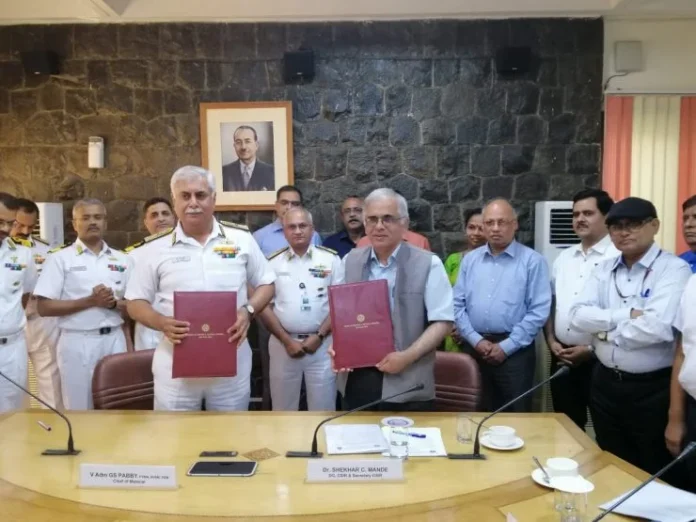
New Delhi. Indian Navy and Council of Scientific and Industrial Research (CSIR) on April 5 inked a Memorandum of Understanding (MoU) to undertake joint research and development of advanced technologies for the Indian Navy.

This will be a collaborative arrangement between labs of CSIR, Indian Navy and Indian industry.
The MoU was signed by Vice Admiral GS Pabby PVSM, AVSM, VSM Chief of Materiel of Indian Navy and Shekhar C Mande, Secretary DSIR and Director General, CSIR.
The event was attended by Directors of Seven CSIR Labs, Flag Officers and Heads of Directorates of Indian Navy and eminent scientists from distinguished CSIR Labs.
The MoU provides a formal framework for interaction between Indian Navy and CSIR. It would facilitate joint R&D activities in diverse fields of Mechanical, Electronics, Communication, Computer Science, Propulsion systems, Metallurgy and Nanotechnology.

Speaking on the occasion, Vice Admiral GS Pabby congratulated CSIR for its yeoman service to the nation in the field of Scientific Research and Development and noted some of the futuristic technology being developed, which could be used for enhancing operational availability and combat capabilities of Naval platforms.
He emphasised on the necessity of such partnerships between the armed forces and world class national institutions like CSIR which would allow Indian Navy to leapfrog towards latest technologies as well as jointly engage under ‘Make in India’, and other innovative programmes of our Government.

Signing of this MoU would form the foundation for exchange of ideas and development of new technologies in the future, he added.
Mande complimented the joint efforts and emphasised that defence remain a priority area for CSIR with an aim towards indigenisation and self-reliance in advanced technologies.
Some of the immediate projects to be progressed under this MoU include development of alternative desalination technologies, installation of wireless MEMS based sensors for remote operation, Residual Life Assessment studies of Gas Turbine Generator blades to improve reliability.






