


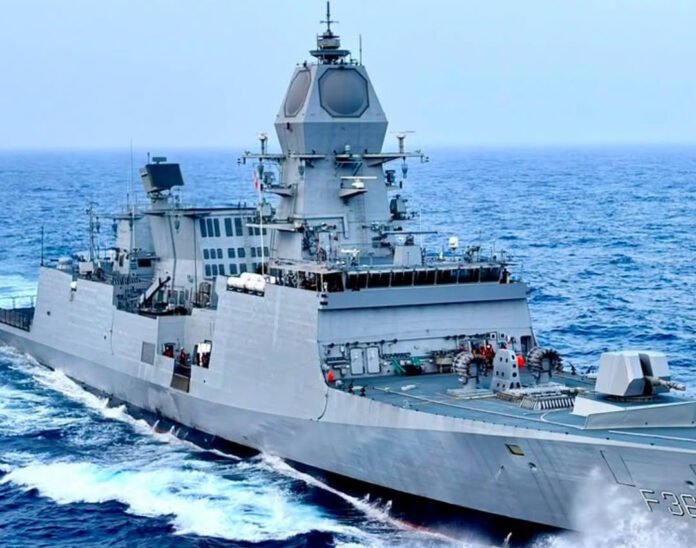
New Delhi. Prime Minister Narendra Modi on Sunday, June 21, 2026 commissioned three indigenously designed and built naval ships at Kolkata’s Syama Prasad Mookerjee Port – INS Dunagiri, an advanced stealth frigate; INS Sanshodhak, a survey vessel (large); and INS Agray, an anti-submarine warfare shallow water craft – at a ceremony that coincided with both International Day of Yoga and World Hydrography Day.
The vessels were designed by the Indian Navy’s Warship Design Bureau alongside Garden Reach Shipbuilders & Engineers (GRSE), Kolkata, and constructed by GRSE, representing key operational capabilities across maritime combat, hydrographic surveying and anti-submarine warfare.

West Bengal Governor R N Ravi, Chief Minister Suvendu Adhikari, and Indian Navy Chief Admiral Krishna Swaminathan were among the dignitaries present at the commissioning event. The platforms carry indigenous content exceeding 75 per cent, with contributions from more than 200 MSMEs, underscoring India’s growing defence manufacturing ecosystem and its push toward self-reliance.
India “Cannot Become Just a Market for the World”: PM Modi
Addressing the ceremony, PM Modi said that strong maritime capabilities are the deciding factor for a country’s economic and strategic influence, declaring that India does not want to remain only a buyer country in the defence sector and that the nation’s armed forces cannot become just a market for the world.
“The recognition of our capabilities lies in our self-reliance and not in becoming a market for the world,” he said. Reflecting on the journey since the commissioning of India’s indigenous aircraft carrier, PM Modi said, “The journey from INS Vikrant to this day is not just a journey of new warships; it is also a journey of India’s growing self-reliance. Today, INS Agray, INS Dunagiri, and INS Sanshodhak are giving new impetus to that journey.”

PM Modi added that India has always regarded the ocean as a medium of cooperation, but that the country also knows strength is essential to safeguard peace, noting that “security is necessary for prosperity and self-reliance is needed for building the future.”
He further said over 40 warships and submarines have been commissioned in the last few years, with 45 large naval platforms currently under construction.

“New Speed in Modern Technology, Self-Reliance and Self-Confidence”: Navy Chief
Chief of the Naval Staff Admiral Krishna Swaminathan said the commissioning shows that India’s warship-building capability is gaining new speed in modern technology, self-reliance, and self-confidence.
In his opening remarks, the CNS stated that the three ships will greatly boost the Indian Navy’s capabilities and make its efforts to protect the nation’s maritime interests much more powerful and effective.
He noted that the Kolkata tri-commissioning comes just 17 months after independent India’s first tri-commissioning in Mumbai, and further observed that critical minerals, deep-sea resources and future sources of energy will increasingly be connected to the maritime domain, making a nation’s economic and strategic influence directly linked to the strength of its maritime sector.
The Three Platforms: Distinct Roles at Sea
INS Dunagiri is the fifth of the seven-ship Project 17A Nilgiri-class series, the first class of Indian warships built using the faster “integrated construction” technique, and is fitted with the latest weapons, sensors and attack missiles including BrahMos and air-defence missiles, giving it extended blue-water endurance.
The frigate is equipped with radar-absorbing materials, a low-signature hull and advanced systems that reduce its radar, heat and acoustic visibility, with a weapon package including BrahMos supersonic surface-to-surface missiles, the Medium Range Surface-to-Air Missile (MRSAM) system and a 76 mm naval gun, powered by a Combined Diesel or Gas (CODOG) propulsion system for long-duration, multi-domain missions.
INS Sanshodhak is the last of four ships in the ‘survey vessel large’ category, generating hydrographic data that is a strategic necessity not just for naval operations such as submarines but also for commercial application, with sister ships INS Ikshak, INS Sandhayak and INS Nirdeshak.
It has a displacement of about 3,400 tonnes, is 110 metres long, and carries over 80 per cent indigenous content. Beyond surveying, the ship can also support humanitarian assistance and disaster relief operations, search-and-rescue missions, and can be adapted for specialised roles during emergencies.
INS Agray is the fourth ship of the INS Arnala class, classified as an anti-submarine warfare shallow water craft (ASW-SWC), built by GRSE Kolkata in a public-private partnership with L&T’s shipyard at Kattupalli, Tamil Nadu. It is equipped with shallow-water sonar systems, lightweight anti-submarine torpedoes and indigenous rocket launchers, with a waterjet propulsion system that allows it to operate effectively in shallow regions while reducing noise levels and improving its ability to track enemy submarines.
India Accelerating Shipbuilding Drive
This marks the second time this year that the Navy has commissioned three frontline platforms in a single day – earlier on January 15, 2026 the Navy had commissioned warships INS Surat and INS Nilgiri besides the submarine INS Vagsheer.
The Indian Navy has set itself on course to commission 19 warships in 2026, which would make it the biggest force accretion achieved in a single year, following 14 vessels commissioned in 2025, including a submarine – together totalling 33 ships commissioned across the 24 months between January 2025 and December 2026.
Indian shipyards now produce a warship in around six years, down from the earlier eight-to-nine-year timeline, with the Naval Warship Design Bureau introducing new design software, artificial intelligence and modern construction techniques that can predict a ship’s turning radius, sailing ability, infrared signature, and power requirements before construction begins.
The Kolkata ceremony adds further momentum to India’s broader naval expansion strategy, reinforcing the message – echoed by both the Prime Minister and the Navy Chief – that India’s shipbuilding ambitions are now firmly oriented toward self-sufficiency rather than dependence on imported platforms.






