


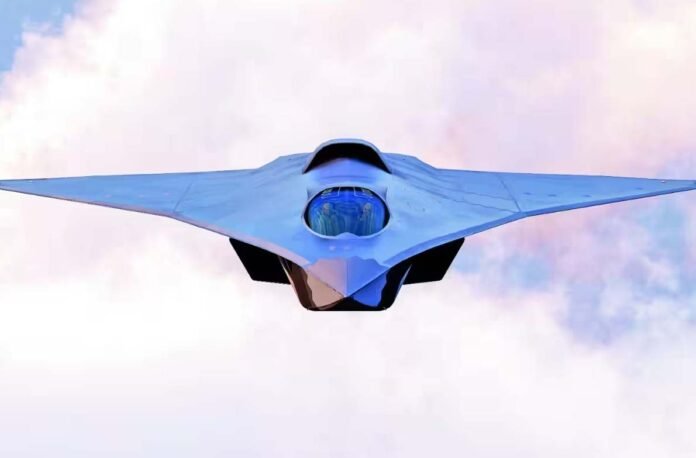
NEW DELHI. India has formally initiated efforts to join France’s Future Combat Air System, selecting the French-led programme over a rival British-led effort to secure a vital foothold in next-generation fighter aviation.
The Ministry of Defence confirmed in an Action Taken submission to the Parliamentary Standing Committee on Defence (SCoD) that it has “initiated efforts in a concerted manner to co-join” the Future Combat Air System (FCAS). Tabled in the Lok Sabha as part of the committee’s Twenty-Fifth Report for 2025–26, the disclosure brings clarity to a strategic choice left open earlier this year, when the Indian Air Force (IAF) was weighing FCAS against the UK-Italy-Japan Global Combat Air Programme (GCAP).

India’s push to enter sixth-generation combat aviation comes as major global powers accelerate the development of air combat platforms integrated with stealth, artificial intelligence, hyper-connected sensor networks and autonomous systems. Unlike traditional aircraft, sixth-generation aviation operates as a “system of systems,” where a crewed platform commands swarms of unmanned aerial vehicles (UAVs) and “remote carriers” linked through high-speed combat data clouds.
The strategic imperative behind India’s decision is heavily influenced by rapid developments in its neighbourhood. China’s People’s Liberation Army Air Force (PLAAF) has already deployed fifth-generation J-20 and J-35 stealth fighters and has reportedly flown two sixth-generation aircraft prototypes. China is concurrently building an ecosystem of autonomous wingmen, long-range precision weaponry and airborne electronic warfare capabilities. In contrast, the IAF’s squadron strength remains well below its sanctioned 42-squadron requirement, while India’s indigenous fifth-generation platform – the Advanced Medium Combat Aircraft (AMCA) – targets a first flight around 2029.
By opting for FCAS, New Delhi deepens its long-standing strategic defence partnership with Paris. India is currently working to finalise a ₹3.25 lakh crore deal for 114 additional Rafale fighters for the IAF, featuring substantial domestic manufacturing under “Make in India.” Furthermore, French aerospace giant Safran is finalising an agreement with DRDO’s Gas Turbine Research Establishment (GTRE) to co-develop a 120kN high-thrust jet engine designed to power the AMCA Mk2.
Originally launched as a joint venture between France, Germany and Spain, the FCAS enterprise recently underwent structural shifts following workshare and intellectual property disagreements between Dassault Aviation and Airbus. Consequently, France is taking the lead on the crewed fighter component under Dassault, while Germany and Spain focus on broader combat ecosystem technologies. This restructuring presents India with a unique window to negotiate targeted participation, whether through technology transfer, joint development or manufacturing workshares.

Recognising the urgent need to bridge capability gaps, the parliamentary panel has asked the Ministry of Defence to furnish a comprehensive status report, clear roadmap, and implementation timeline for India’s sixth-generation fighter endeavours in its next submission.






