


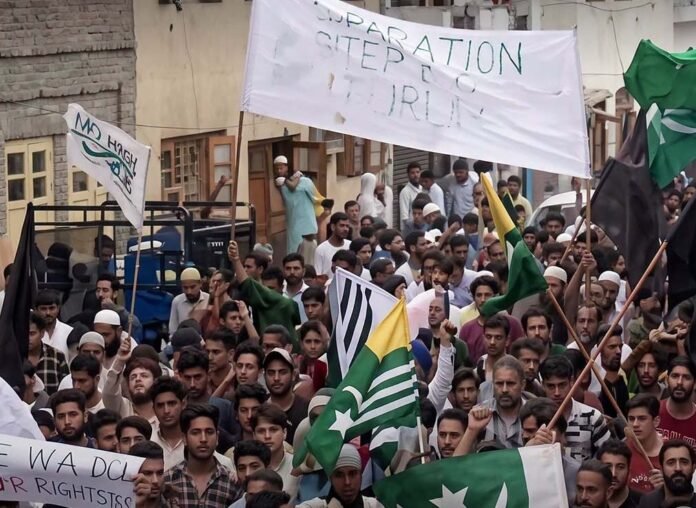
The latest protests in Pakistan-occupied Kashmir (PoK) are more than another episode of regional unrest. They expose a deeper structural problem confronting Pakistan: while Islamabad seeks greater diplomatic influence abroad, it continues to struggle with political representation, governance and internal security within territories under its own control. From PoK to Balochistan and Khyber Pakhtunkhwa, domestic fault lines increasingly pose a greater challenge to Pakistan’s long-term stability than any external rivalry.
Fresh protests in PoK have coincided with the three-phase Assembly elections being held between July 27 and August 11. What began as public anger over inflation, rising electricity tariffs and shortages of subsidised wheat has evolved into a broader movement demanding greater political representation and electoral reforms. The Jammu Kashmir Joint Awami Action Committee (JKJAAC), which has emerged as the principal voice of the protests, has alleged electoral manipulation and argues that the existing political system remains heavily influenced by Pakistan’s establishment rather than reflecting the aspirations of the local population.

The controversy centres on the composition of the 53-member PoK Legislative Assembly. Local groups argue that these seats dilute the political representation of PoK residents because legislators elected from outside the territory influence decisions affecting people who did not elect them. Once reserved and nominated seats are accounted for, local voters directly elect only 33 representatives, reinforcing perceptions of democratic deficit
The controversy centres on the composition of the 53-member PoK Legislative Assembly. While 45 members are elected and eight nominated, 12 of the elected seats are reserved for refugees from the former princely State of Jammu and Kashmir who migrated to different parts of Pakistan after 1947. Elections for these seats are conducted outside PoK, with refugee voters residing in Punjab, Sindh and elsewhere casting their ballots. Local groups argue that these seats dilute the political representation of PoK residents because legislators elected from outside the territory influence decisions affecting people who did not elect them. Once reserved and nominated seats are accounted for, local voters directly elect only 33 representatives, reinforcing perceptions of democratic deficit.
Economic grievances have further intensified the unrest. Despite generating substantial hydropower through the Mangla Dam, many residents complain of high electricity tariffs and inadequate local benefits. The dam displaced thousands of people, yet many believe PoK has not received a proportionate share of its economic returns. JKJAAC has therefore demanded subsidised wheat, fair electricity pricing and abolition of the 12 reserved seats. The organisation has now been banned by Pakistan, while reports of a security crackdown and casualties have further deepened public resentment.
The protests also reflect a broader pattern of uneven political and economic development in territories administered by Pakistan. Similar grievances have periodically surfaced in Gilgit-Baltistan, where demands for greater constitutional rights, political representation and equitable development have remained unresolved. Together, these developments raise larger questions about governance and political inclusion in Pakistan’s peripheral regions.
The timing of the unrest is particularly significant. It comes at a time when Pakistan is attempting to project itself internationally as a responsible regional stakeholder while simultaneously grappling with economic pressures, fiscal constraints and persistent political polarisation at home
The timing of the unrest is particularly significant. It comes at a time when Pakistan is attempting to project itself internationally as a responsible regional stakeholder while simultaneously grappling with economic pressures, fiscal constraints and persistent political polarisation at home. Continued instability in PoK risks diverting administrative attention and security resources at a time when Islamabad is already confronting multiple internal challenges. More importantly, it reinforces the perception that governance deficits, rather than purely external pressures, remain central to Pakistan’s long-term stability.

The unrest in PoK is unfolding against the backdrop of Pakistan’s wider internal security challenges. The Tehrik-e-Taliban Pakistan continues to mount attacks against security forces in the country’s north-west, while the Balochistan Liberation Army has sustained its insurgency by targeting security personnel, infrastructure and projects linked to the China-Pakistan Economic Corridor. Relations with Afghanistan also remain strained over Islamabad’s allegations that the Afghan Taliban continue to provide sanctuary to TTP fighters. These multiple security pressures have stretched Pakistan’s internal security apparatus and complicated efforts to restore stability.
The persistence of these challenges demonstrates that military measures alone cannot resolve movements rooted in political and economic grievances. While security operations may temporarily suppress violence, durable stability requires political accommodation, responsive governance and inclusive economic development. The experiences of Balochistan, the former tribal areas and now PoK illustrate the limits of an exclusively security-centric approach.

For Pakistan, lasting regional influence will ultimately depend less on diplomatic activism abroad than on its ability to build political legitimacy, economic inclusion and internal stability at home. Durable peace cannot rest solely on security measures; it also requires institutions that command public confidence and address long-standing political grievances
For India, developments in Pakistan-occupied Kashmir warrant close attention. Instability across the Line of Control has direct implications for regional security, cross-border terrorism and the broader trajectory of India-Pakistan relations. Continued unrest could also affect border management and the overall security environment in Jammu and Kashmir.
At the same time, the protests underline that many of Pakistan’s most pressing challenges are domestic rather than external. India should therefore continue to monitor developments with strategic restraint while maintaining its consistent position on Jammu and Kashmir, while avoiding actions that could allow domestic unrest within Pakistan to be externalised.
For Pakistan, lasting regional influence will ultimately depend less on diplomatic activism abroad than on its ability to build political legitimacy, economic inclusion and internal stability at home. Durable peace cannot rest solely on security measures; it also requires institutions that command public confidence and address long-standing political grievances. Until those structural challenges are addressed, Pakistan’s domestic fault lines will continue to constrain its strategic ambitions and shape its regional role.
The writer commanded 15 Punjab in Lebanon under United Nations Flag, commanded 27 Sector as DIG in Churachandpur and was Brigadier Operational Logistics in HQ Western Command. He is currently an analyst on geopolitics, international and defence affairs. The views expressed are personal and do not necessarily carry the views of Raksha Anirveda





