


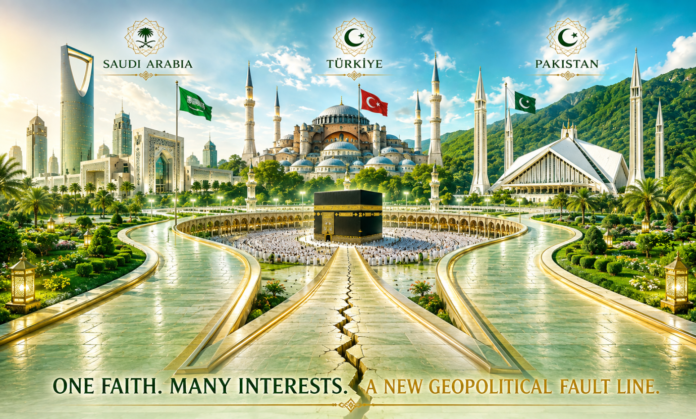
On August 7, Saudi Arabia, Türkiye and Pakistan signed what has been described as the Mecca Joint Defence Agreement, committing themselves to the principle that aggression against one would be treated as aggression against all. The agreement comes at a moment of extraordinary regional turbulence, following the wider US-Israel-Iran conflict and Iranian attacks affecting the Gulf. The three governments have nevertheless been careful to describe the pact as defensive and not directed against any particular country.
On the face of it, its logic is compelling. Saudi Arabia possesses extraordinary financial and energy power but has long depended heavily on external security guarantees. Türkiye possesses one of the region’s most capable conventional militaries and an increasingly formidable indigenous defence industry. Pakistan brings military experience, manpower and, uniquely among the three, a nuclear deterrent.

Their strengths are complementary.
But there is something almost poetic about the venue. Mecca is the spiritual centre of Islam; the pact may become a marker of the growing importance of national power over the idea of a single Muslim strategic community.
The treaty may be defensive in its language, but its geopolitical consequences could be offensive to the old assumptions about Muslim unity.
Why This Pact Had to Happen
The pact is not difficult to understand because each of its three architects has discovered that security cannot be outsourced indefinitely.

Saudi Arabia’s strategic vulnerability has become starkly visible. The kingdom sits astride the world’s most consequential energy arteries, yet remains exposed to missiles, drones and proxy warfare. Indeed, Saudi officials had warned immediately before the pact of possible attacks by Iran-linked forces from both Iraq and Yemen.
Pakistan, meanwhile, has already demonstrated that its relationship with Saudi Arabia is more than ceremonial. In May, Islamabad deployed thousands of troops, fighter aircraft and air-defence capability to Saudi Arabia during the regional crisis. The Saudi-Pakistani Strategic Mutual Defence Agreement signed in September 2025 had already established a formal foundation for this relationship.

Türkiye brings another dimension: military-industrial capability, a large conventional force, NATO experience and ambitions for greater strategic autonomy.
Put simply: Saudi Arabia brings the purse. Türkiye brings the military-industrial muscle. Pakistan brings the soldier and the nuclear shadow.
But this is not an alliance born from ideological unity. It is an alliance born from converging insecurity. When three countries discover that their vulnerabilities complement each other’s strengths, a defence pact becomes almost inevitable.
From Gulf to Arabian Sea: A New Security Geometry
The most consequential feature of the pact may be that it connects three strategic theatres that were previously treated largely as separate problems.
Saudi Arabia anchors the arrangement in the Gulf. Türkiye stretches it towards Anatolia and the Eastern Mediterranean. Pakistan carries it across the Arabian Sea into South Asia.
It is, in effect, a security bridge from Anatolia to the Arabian Sea.
This matters because West Asian geopolitics has traditionally revolved around the Gulf, Israel, Iran and the American security presence. The new arrangement introduces a regional layer between great-power competition and local security.
It does not replace the United States. It potentially regionalises security.
Mecca is the spiritual centre of Islam; the pact may become a marker of the growing importance of national power over the idea of a single Muslim strategic community. The treaty may be defensive in its language, but its geopolitical consequences could be offensive to the old assumptions about Muslim unity
And Iran sits geographically and strategically at the centre of this new geometry. The pact does not name Iran as an adversary. Nor should we prematurely describe it as an anti-Iran alliance. Yet Tehran will inevitably have to calculate what it means if a confrontation with one of these states can potentially activate the strategic interests of the other two.
The map has changed before a single soldier has moved.
Hidden Question: What it does to Muslim Solidarity?
The most important consequence of the Mecca pact may not be military at all—it may be psychological.
The Organisation of Islamic Cooperation has 57 member states and represents the world’s second-largest intergovernmental organisation after the United Nations. Its very existence embodies the political idea of a shared Muslim identity.
But shared identity has never meant shared strategic interest.
The Muslim world contains Arabs and non-Arabs, Sunnis and Shias, monarchies and republics, democracies and authoritarian systems, states aligned with Washington and states opposed to it, countries dependent on China and countries wary of Beijing.
Iran itself has long projected its regional role through the language of resistance and solidarity with Palestine.
The Mecca pact introduces a potentially uncomfortable question: What happens when the Muslim world’s most powerful states begin organising their security interests around national and regional calculations rather than around a common political identity?
Saudi Arabia has its interests. Türkiye has its interests. Pakistan has its interests. Iran has its interests. And eventually every one of the 57 will have to reconcile Muslim solidarity with national survival.
The danger to Muslim solidarity is not that 57 countries will split neatly into two camps; it is that they may discover they were never one strategic camp to begin with.
From One Muslim World to Several Muslim Centres
The Mecca pact could mark the beginning of a shift from one imagined Muslim geopolitical community to several competing centres of Muslim power.
For decades, the Islamic world has lacked a single political or strategic centre. Egypt once possessed enormous Arab influence; Saudi Arabia commands religious legitimacy; Iran has projected revolutionary resistance; Türkiye invokes its Ottoman heritage and increasingly autonomous foreign policy; Pakistan possesses something no other Muslim state possesses—nuclear weapons.
The Mecca pact brings three of these power centres together without including the fourth major regional power, Iran. That distinction is important. It does not create a Sunni NATO. But it potentially creates a Sunni strategic pole with enough military and economic weight to alter the calculations of other Muslim states.
Put simply: Saudi Arabia brings the purse. Türkiye brings the military-industrial muscle. Pakistan brings the soldier and the nuclear shadow. But this is not an alliance born from ideological unity. It is an alliance born from converging insecurity. When three countries discover that their vulnerabilities complement each other’s strengths, a defence pact becomes almost inevitable
Countries such as Egypt, Indonesia, Malaysia, Qatar, the UAE and others are unlikely simply to choose sides. They will hedge, balance and preserve autonomy.
And that is precisely the point. The future may not be about choosing between two blocs; it may be about the disappearance of the idea that one bloc exists.
The Muslim world may not be splitting in two; it may be discovering that it has many centres.
Iran: Isolation of Champion of Resistance
The pact could challenge Iran’s most valuable strategic asset—not its missiles, but its claim to represent the wider Muslim resistance.
Iran has successfully constructed a regional identity around resistance to Israel and opposition to American dominance. That narrative has given Tehran influence far beyond its conventional economic strength.
But the emergence of a powerful Saudi-Turkish-Pakistani security framework complicates that narrative.
The question becomes uncomfortable: If Saudi Arabia—the custodian of Islam’s holiest cities—stands outside Iran’s strategic orbit; if Türkiye, historically one of the great centres of Sunni power, chooses its own security architecture; and if Pakistan, the world’s only nuclear-armed Muslim state, participates in it—can Tehran still plausibly speak for the Muslim world as a whole?
Probably not. But Iran will remain too powerful to ignore. That means the region could move from an ideological contest to a competition among multiple Muslim power centres.
Iran may not become weaker because of the pact; what may weaken is its monopoly over the narrative of Muslim resistance.
USA: Losing Monopoly, Gaining Leverage
The great irony is that Washington may benefit from an arrangement that simultaneously reduces America’s monopoly over regional security.
The United States has spent decades underwriting Gulf security, maintaining military infrastructure and carrying an enormous share of the deterrence burden. Saudi Arabia even signed a Strategic Defence Agreement with Washington in November 2025, reinforcing the long-standing American-Saudi security relationship.
The Mecca pact therefore does not mean Saudi Arabia has abandoned America. Rather, Riyadh appears to be pursuing security diversification. For Washington, that could be useful.
If Saudi Arabia can rely increasingly on regional partners for manpower and conventional deterrence, if Türkiye contributes military technology and Pakistan contributes military capability, America can potentially concentrate on what only it can provide at scale—intelligence, advanced technology, strategic logistics, missile defence and high-end deterrence.
West Asian geopolitics has traditionally revolved around the Gulf, Israel, Iran and the American security presence. The new arrangement introduces a regional layer between great-power competition and local security. It does not replace the United States. It potentially regionalises security. The map has changed before a single soldier has moved
And most importantly, Iran faces a more complicated regional balance. But there is a paradox. America may surrender some control over the regional security architecture while gaining a stronger regional balance of power against its principal adversaries.
That is not necessarily American decline. It may be American burden-sharing by another name.
Washington may not have built the new architecture, but it may discover that it fits rather neatly into America’s strategic furniture.
China: The Dragon Between Two Muslim Worlds
China may be the great external power with the most complicated balancing act ahead.
Beijing has cultivated deep relations with Iran while simultaneously building substantial economic and strategic relationships with Saudi Arabia and Pakistan. Türkiye too matters to China as a bridge between Asia and Europe.
China therefore has little incentive to choose. Its preferred strategy will almost certainly be balance, hedge and prevent rupture.
Beijing needs Iranian energy and strategic access. It needs Saudi energy, investment and markets. It values Pakistan’s geography and connectivity. And Türkiye offers access to Eurasian trade routes and a major regional defence industry.
The Mecca pact therefore presents China with an exquisite dilemma. If it moves too close to Iran, it risks alienating Saudi Arabia, Pakistan and Türkiye. If it embraces the new bloc, it risks weakening its relationship with Tehran.
China’s likely answer is neither. It will try to remain indispensable to both sides. That is classic Chinese statecraft: avoid choosing sides where balancing can produce greater influence.
China does not need to win the Muslim world; it only needs to ensure that neither side can afford to lose China.
India: The Pact Arrives at India’s Western Doorstep
For India, the Mecca pact should be neither dismissed as an anti-India arrangement nor viewed through the narrow prism of Pakistan.
There are obvious concerns. Pakistan now potentially enjoys a deeper strategic relationship with Saudi Arabia and Türkiye. Turkish defence technology could strengthen Pakistani capabilities. And a more confident Pakistan could acquire greater diplomatic room for manoeuvre.
Yet the Indian picture is more nuanced. Saudi Arabia is also an increasingly important Indian partner. India has invested heavily in its relationship with Riyadh, while its engagement with Iran remains important for connectivity and access to Central Asia. Türkiye, despite political differences, remains an important regional power with which India must engage.
The Indian response, therefore, cannot be to join one side of an emerging West Asian divide. It should be to deepen relationships across the divide. India needs Saudi Arabia without surrendering Iran; Türkiye without abandoning its strategic autonomy; America without becoming an American ally in every theatre.
The Mecca pact introduces a potentially uncomfortable question: What happens when the Muslim world’s most powerful states begin organising their security interests around national and regional calculations rather than around a common political identity? The danger to Muslim
That is not fence-sitting. It is precisely what strategic autonomy is supposed to mean.
India’s answer to a world of blocs should not be another bloc; it should be more India.
Final Paradox: What Does Mecca Really Signify?
The greatest irony of the Mecca pact is that an agreement signed at Islam’s holiest site may ultimately demonstrate the limits of religious solidarity in an age of hard national interest.
Three Muslim powers have come together because their strategic interests converge. Iran remains outside because its interests do not. The remaining Muslim states will watch, calculate and hedge. America may quietly welcome a stronger regional balance against Iran while simultaneously losing some of its old monopoly.
China will seek to balance both sides. India will have to navigate between them. And Israel will inevitably watch the emergence of a more complex Muslim security landscape with great attention. None of this makes the Mecca pact an Islamic NATO.
Indeed, that may be the wrong question. The more interesting question is whether it represents the beginning of a new era in which Muslim states increasingly organise around power, geography and national interest rather than the assumption of collective political solidarity.
The pact may therefore be remembered not for creating a unified Islamic military bloc, but for revealing how difficult such unity actually is.
Because the deepest geopolitical truth is also the simplest: Countries may share a faith, a history and a civilisation—but when survival is at stake, nations ultimately choose their interests.
And perhaps that is the most non-obvious meaning of the Mecca pact.
It may not be the beginning of an Islamic NATO. It may be the beginning of the end of the assumption that there can ever be one.

Lt Gen Rajeev Chaudhry (Retd) writes on contemporary national and international issues, strategic implications of infrastructure development towards national power, geo-moral dimension of international relations, and leadership nuances in a changing social construct. The views expressed are of the author and do not necessarily reflect the views of Raksha Anirveda





