

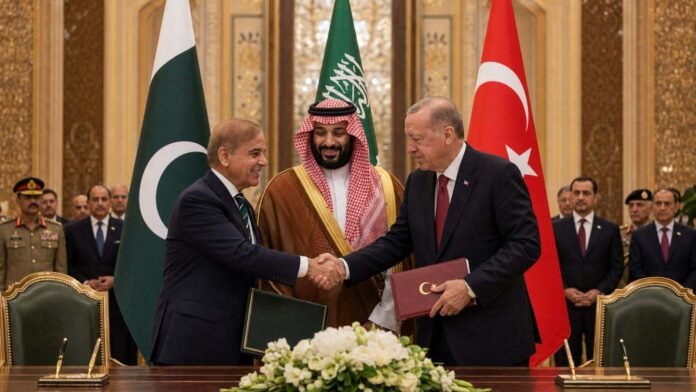
On August 7, 2026, inside the Al-Safa Palace overlooking Islam’s holiest city, Crown Prince Mohammed bin Salman, President Recep Tayyip Erdogan and Prime Minister Shehbaz Sharif signed the Mecca Joint Defence Agreement, a pact declaring that an armed attack on any one of Saudi Arabia, Turkey or Pakistan would be treated as an attack on all three. The choice of venue was deliberate. Mecca lends a pact built on hard security calculation the vocabulary of Islamic brotherhood, a framing no purely transactional treaty could claim on its own.
The agreement did not appear out of nowhere. It extends the Strategic Mutual Defence Agreement that Riyadh and Islamabad signed in September 2025, itself a formalisation of nearly eight decades of Saudi-Pakistani military cooperation. Turkey’s accession, long anticipated, was confirmed against the backdrop of a regional war that has kept Gulf capitals under repeated missile and drone fire since February. For Riyadh in particular, the calculation is straightforward. The pact is additional insurance against Iran, layered on top of, and not a substitute for, its continuing reliance on Washington.

Sunni identity gives the pact a legitimising vocabulary, allowing it to be framed as the defence of a shared community rather than a narrow transaction. Complementary capability gives it practical logic
Four threads bind the trio together, and none of them strictly required a formal treaty to function on their own. Sunni identity gives the pact a legitimising vocabulary, allowing it to be framed as the defence of a shared community rather than a narrow transaction. Complementary capability gives it practical logic: Saudi Arabia supplies financial weight and the custodianship of Mecca and Medina, Turkey supplies NATO-standard forces and a fast-growing drone and missile industry, and Pakistan supplies nuclear weapons, a large trained army and decades of experience training Gulf militaries.
A shared anxiety about being drawn into someone else’s war gives it urgency, since Riyadh has taken direct Iranian fire, Ankara worries about instability spilling across its southern border, and Islamabad has long used Gulf patronage to offset dependence on any single external power. And a long transactional history, running from Pakistani troops guarding Saudi installations since the 1960s to Turkish frigates and drones sold to both partners, gives it depth.
None of this makes the pact a Middle Eastern NATO, however often that comparison is reached for in early commentary. NATO’s Article 5 rests on integrated command structures, standing forces and decades of interoperability built under a single alliance architecture. The Mecca agreement rests on none of these. What is realistically deliverable in the near term is narrower: joint training, technical assistance, limited deployment of manpower and equipment during periods of tension, intelligence sharing, and technology transfer focused initially on drones, missiles and communications, an area where onward transfer of NATO-origin technology without prior clearance would itself invite friction with Washington.
NATO’s Article 5 rests on integrated command structures, standing forces and decades of interoperability built under a single alliance architecture. The Mecca agreement rests on none of these. What is realistically deliverable in the near term is narrower
The aggregate numbers already circulating in commentary, roughly 170 nuclear warheads, a combined economy nearing three trillion dollars, close to two million men under arms and thousands of tanks and armoured vehicles, describe a bloc’s theoretical weight, not its usable reach. Geography still separates the three capitals by thousands of kilometres, and it is expeditionary capability, not aggregate inventory, that decides how much of that weight can actually be moved and applied when it matters.

The pact also contains internal contradictions that will limit its reach. Turkey’s neo-Ottoman, Muslim Brotherhood-adjacent brand of political Islam has long been viewed by Riyadh and Abu Dhabi as a threat to monarchical legitimacy. This rivalry was laid bare during the 2017–2021 Qatar blockade, when Ankara backed Doha against Riyadh, and again after the killing of Jamal Khashoggi, when Turkish disclosures badly embarrassed the Saudi crown. Saudi religious authority rests on custodianship of the holy sites and a state-sanctioned religious establishment. Turkish religious authority rests on Ottoman historical prestige and a more populist, movement-based Islamism.
Two competing claims to Muslim leadership now sit within the same compact. Pakistan’s position is awkward for a different reason: any material assistance to Saudi Arabia against Iran would risk strategic encirclement for Islamabad, given Tehran’s proximity and Pakistan’s restive western border.

For India, the correct response is neither alarm nor dismissal, but differentiation. New Delhi’s relationships with the three signatories are not remotely equivalent, and treating the pact as a monolithic bloc would obscure more than it reveals.
Two competing claims to Muslim leadership now sit within the same compact. Pakistan’s position is awkward for a different reason: any material assistance to Saudi Arabia against Iran would risk strategic encirclement for Islamabad, given Tehran’s proximity and Pakistan’s restive western border
The Saudi relationship remains one of India’s most substantive Gulf partnerships. A Strategic Partnership Council, co-chaired by the Prime Minister and the Crown Prince, runs four ministerial tracks covering political and security cooperation, defence, economy and energy, and tourism and culture. Riyadh is among India’s largest Gulf trading partners and a leading oil supplier, and high-level contact has continued without interruption, including a visit by National Security Advisor Ajit Doval to Riyadh as recently as July 2026.
Following the pact’s signing, the Ministry of External Affairs said only that it was closely following the development, a studied restraint that reflects both how much New Delhi has invested in this tie and how carefully it intends to protect it. Riyadh, for its part, has kept Kashmir off its public agenda and stayed neutral through recent India-Pakistan tensions, treating the relationship as economic and strategic rather than civilisational.
The Turkish relationship is a different story altogether. Ties have deteriorated sharply since Operation Sindoor in May 2025, when Ankara backed Islamabad diplomatically, and Turkish-origin drones were used against Indian targets. India responded by revoking the security clearance of a Turkish ground-handling firm operating at nine Indian airports and by deepening outreach to states wary of Turkey’s regional ambitions, including Greece, Cyprus and Armenia. President Erdogan’s repeated invocation of Kashmir at multilateral forums, and pro-government Turkish media’s amplification of Pakistani narratives during crises, have hardened Indian assessments of Ankara’s role as part of a wider project directed against Indian interests rather than routine defence commerce.
The Mecca pact is neither a NATO for the Islamic world nor primarily aimed at India. It is, however, one more thread in an increasingly complex regional fabric, and New Delhi’s task is to read each thread on its own terms rather than through the shorthand of a single new alliance
Pakistan’s position within the pact requires little elaboration for an Indian readership beyond one observation. Islamabad’s principal gain is diplomatic and financial cushioning, not any credible expectation of Gulf military intervention in a bilateral conflict with India. A full-scale India-Pakistan war remains a contingency neither side has reason to deliberately court, and in any lesser skirmish, the practical value of external backing for Pakistan would be marginal at best.
What should Indian policy actually track? First, resist the temptation to read the pact as a unified anti-India axis. The internal Saudi-Turkish rivalry for religious and political leadership is real and will constrain collective action far more effectively than any Indian countermeasure could. Second, deliberately protect the Riyadh channel, since it is the pact’s most India-friendly node and the one most worth insulating from spillover. Third, continue the hedge already underway with Greece, Cyprus and Armenia, since Turkey’s regional ambitions will keep intersecting with Indian interests well beyond South Asia. Fourth, watch the technology-transfer and nuclear know-how provisions closely, since even indirect proliferation assistance to Pakistan through a wealthier partner would cross a line India has consistently flagged at multilateral fora. Fifth, keep the public response calibrated and unhurried, exactly as the Ministry of External Affairs has done so far, since overreaction would give the pact a significance its actual military content does not yet warrant.
The Mecca pact is a genuine data point in a region rebalancing away from unquestioned American security guarantees. On the evidence available today, it is neither a NATO for the Islamic world nor primarily aimed at India. It is, however, one more thread in an increasingly complex regional fabric, and New Delhi’s task is to read each thread on its own terms rather than through the shorthand of a single new alliance.

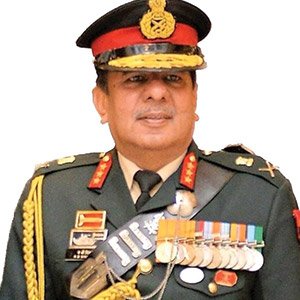
The writer, a PVSM, AVSM, VSM has had an illustrious career spanning nearly four decades. A distinguished Armoured Corps officer, he has served in various prestigious staff and command appointments including Commander Independent Armoured Brigade, ADG PP, GOC Armoured Division and GOC Strike 1. The officer retired as DG Mechanised Forces in December 2017 during which he was the architect to initiate process for reintroduction of Light Tank and Chairman on the study on C5ISR for Indian Army. Subsequently he was Consultant MoD/OFB from 2018 to 2020. He is also a reputed defence analyst, a motivational speaker and prolific writer on matters of military, defence technology and national security. The views expressed are personal and do not necessarily carry the views of Raksha Anirveda





