


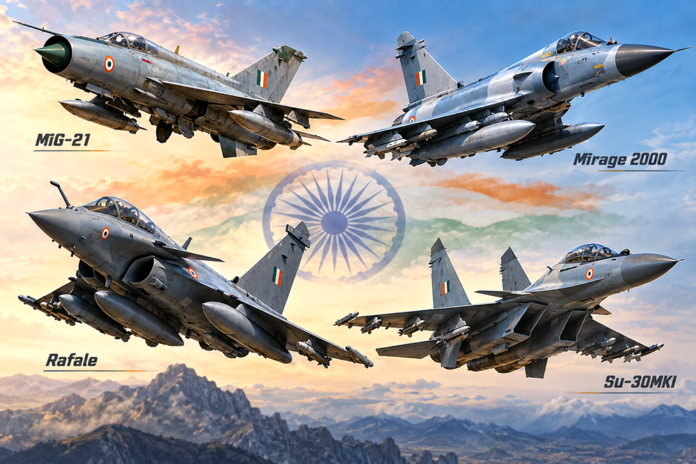
The Indian Air Force enters its 94th anniversary year confronting a paradox. Its operational responsibilities are expanding across the Himalayas, the Indian Ocean, cyberspace and the near-space domain, even as its combat fleet remains below the strength required for a credible two-front contingency.
The IAF’s authorised strength is 42 fighter squadrons, but open-source assessments place its current combat strength at roughly 29 to 31 squadrons. The gap has widened as ageing MiG-21s have retired and Jaguar, Mirage 2000 and early MiG-29 fleets approach the later stages of their service lives. The Su-30MKI remains the backbone of the force, supported by Rafale, upgraded MiG-29s, Mirage 2000s and Tejas Mk1 aircraft. Yet numbers, availability, weapons stocks, pilots, maintenance capacity and force multipliers remain as important as the headline squadron figure.

Entering its 94th anniversary year, the Indian Air Force faces expanding responsibilities across the Himalayas, Indian Ocean, and cyberspace-even as its combat strength sits at roughly 30 squadrons against an authorised 42. Bridging this critical gap requires managing fleet retirements while accelerating force multipliers and next-generation acquisitions
The operational theatre has also changed. The IAF is no longer required merely to defend national airspace or provide battlefield support to the Army. It must maintain continuous surveillance along the northern and western frontiers, support maritime security from the Arabian Sea to the eastern Indian Ocean, deter Pakistan, monitor China’s military infrastructure and contribute to expeditionary and humanitarian missions.
Future operations are likely to combine crewed aircraft with unmanned combat aerial vehicles, loitering munitions, satellites, cyber effects, electronic warfare and long-range precision weapons. That requires a networked force capable of finding targets, making decisions and striking across great distances while surviving increasingly dense air-defence systems.
The immediate weakness is aircraft availability. The Tejas Mk1A programme, intended to provide the IAF with 180 new fighters, has been delayed by shortages of General Electric F404 engines and by the time required to integrate radar, electronic-warfare equipment and weapons software. Reports in 2026 said HAL had built several airframes but could not deliver many of them because production engines were arriving late.
The problem illustrates a wider vulnerability: a modern air force cannot be created by assembling airframes alone. Engines, AESA radars, electronic-warfare suites, infrared search-and-track systems, beyond-visual-range missiles, data links, flight-control computers, simulators and maintenance infrastructure must mature together.

To avoid past developmental delays, opening flagship programmes like the fifth-generation AMCA to private industry marks a critical turning point. Building a permanent defence-industrial base with companies like Tata and L&T enables scalable, multi-vendor production for fighters, drones and avionics
The Tejas Mk2 is expected to address the gap between the light Tejas and heavier fighters such as the Su-30MKI and Rafale. It is intended to replace several ageing strike-fighter types, but its development and first-flight schedules have slipped. Current projections place the first flight in 2026, with operational service still several years away.
The Advanced Medium Combat Aircraft presents an even greater challenge. The twin-engine, fifth-generation stealth fighter is intended to provide India with an indigenous platform featuring low observability, advanced sensors, super-cruise potential, internal weapons carriage and extensive network connectivity. The official roadmap points towards prototype development and first flight around 2028-29, followed by production from about 2035.

Those dates are ambitious. India’s experience with the Tejas shows that aircraft development can stretch across decades when design changes, certification, engine supply, testing and production capacity are not synchronised. AMCA will require mastery of stealth composites, digital engineering, mission systems, thermal management, advanced propulsion and secure software. A delay of even three or four years would deepen the fighter deficit because several existing fleets will be retiring during the same period.
Modern air campaigns demand linking tactical aviation directly with space assets for real-time targeting, resilient navigation and secure communications. Strengthening ties between the IAF, ISRO and the Defence Space Agency converts India’s national space prowess into actionable military power
The decision to open AMCA development to private industry could become a turning point. Rather than leaving HAL to manage every major aviation programme, the government is seeking a lead private-sector integrator supported by a broad network of public and private suppliers. Companies such as Tata Advanced Systems and Larsen & Toubro have developed capabilities in aerospace structures, composites, precision manufacturing and systems integration. Their participation could improve schedule discipline, competition and production scalability.
HAL will remain indispensable, especially in design support, flight testing, certification and serial production. But India needs an ecosystem rather than a single institution. The target should be a permanent industrial base capable of producing fighters, engines, radars, missiles, drones, simulators and spares in parallel. Small and medium enterprises, start-ups, universities and private laboratories must be integrated into long-term programmes instead of being engaged only as emergency suppliers.
That ecosystem is already taking stronger roots. Indian companies are expanding into unmanned aircraft, high-altitude platforms, propulsion, avionics, electronic warfare, artificial intelligence, secure communications, satellite buses and launch vehicles. The private space sector’s emergence, including domestic launch and satellite firms, offers technologies that can spill over into defence aviation.
The next requirement is institutional: India must link its air and space capabilities. Navigation, timing, satellite communications, intelligence, surveillance and reconnaissance, meteorological data and space-based targeting already influence air operations. The Defence Space Agency, created as a tri-service organisation, provides a foundation, while the IAF has previously argued for a stronger air-and-space construct.
Future operations will combine crewed fighters with unmanned combat drones, loitering munitions, space surveillance and electronic warfare. Building a resilient, networked force capable of sensing and striking across vast distances is vital to survive increasingly dense air-defense systems
India possesses significant space strengths. It has demonstrated independent launch capability, operates remote-sensing and communications satellites, fields NavIC navigation services, has conducted lunar and interplanetary missions and demonstrated an anti-satellite capability. The country is also developing a larger private space industry and new satellite constellations.
The challenge is to convert these national achievements into operational military power. Satellites must provide timely information to commanders and aircraft, not merely generate imagery for later analysis. Fighter pilots need resilient communications, assured navigation, target-quality data and rapid access to space-based surveillance. The IAF should be closely integrated with the Defence Space Agency, ISRO, the Defence Research and Development Organisation and private space companies.
A future air campaign may begin with a satellite detecting movement, an unmanned aircraft confirming the target, an airborne early-warning platform coordinating the picture, a fighter launching a long-range weapon and cyber or electronic effects disrupting the adversary’s response. Such a chain will fail if data standards, command structures and communications networks remain fragmented.
India, therefore needs resilient satellite constellations, protected ground stations, rapid replacement launch capacity, space-domain awareness and counter-space capabilities. It must also develop high-altitude pseudo-satellites and near-space systems that can remain over areas of interest for long periods. The objective should not be the militarisation of space for its own sake, but the ability to protect national assets and ensure that air operations continue when satellites are jammed, attacked or disabled.
A secure, developed India requires an air force that is technologically sovereign, industrially backed and seamlessly connected to space. Achieving true strategic autonomy by 2047 demands strict milestone-based programme oversight, secure engine technology and expanded production capacity
The transformation must support the larger Viksit Bharat @2047 objective. A developed India will require secure trade routes, protected infrastructure, uninterrupted communications and the ability to deter coercion. Air power will be central to that ambition because it connects the country’s land borders, island territories, economic centres and wider maritime interests.
The answer is not simply to buy more fighters, although urgent stopgap acquisitions may be necessary while indigenous programmes mature. India must simultaneously accelerate Tejas Mk1A deliveries, protect Tejas Mk2 funding, place AMCA under strict milestone-based oversight, secure engine technology, expand production lines and procure force multipliers such as airborne early-warning aircraft, tankers, transport aircraft and unmanned systems.
Air Force Day should therefore be more than a ceremonial celebration of past victories. It should mark a national commitment to delivery, accountability and integration. A truly “Saksham Bharat” will need an IAF that is sufficiently large, technologically sovereign, industrially supported and seamlessly connected to space.
By 2047, India’s air force must not merely possess advanced aircraft. It must operate as an integrated aerospace power – able to sense, decide, strike, sustain and recover across every theatre. That is the capability the country’s strategic ambitions now demand.

-The writer is a New Delhi-based senior commentator on international and strategic affairs, environmental issues, an interfaith practitioner, and a media consultant. The views expressed are personal and do not necessarily carry the views of Raksha Anirveda





