

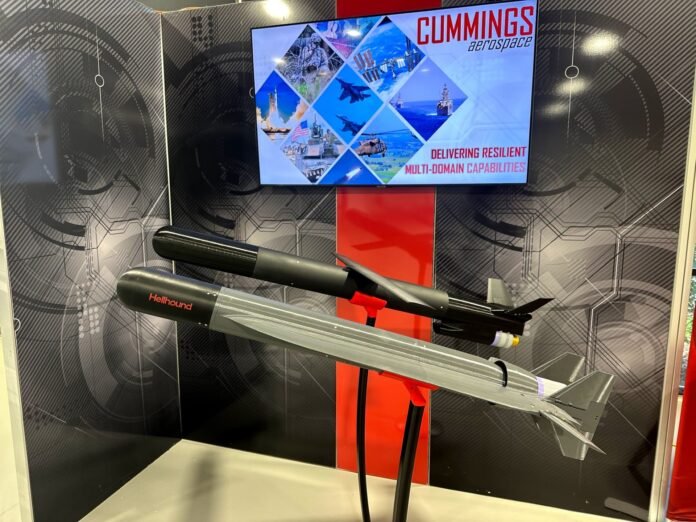
Washington: Cummings Aerospace unveiled a variant of its Hellhound drone designed to meet homeland defence missions at the Space and Missile Defence Symposium in Huntsville, Alabama, this week.
The company is taking its S3 variant and beefing it up into a new S4 variant to take on air defence missions, particularly countering drone threats, that could fit within the framework of President Donald Trump’s homeland missile defence shield dubbed Golden Dome.

The turbojet-powered, 3D-printed Hellhound S3 drone can carry a variety of payloads, and the company is putting that version forward as a loitering munition option for a competition that the US Army is planning to kick off this year.
The S4 variant, designed to take on Golden Dome mission sets, is a scaled-up version of the S3 that adopts its modular architecture such as the removable nose that allows the unmanned aerial system to shift from countering drones to intelligence, surveillance and reconnaissance or serving as a weapon itself like a low-cost cruise missile, according to Sheila Cummings, the company’s CEO.
The S4 is “really a multimission capability as well as a multilaunch platform capability,” she added, “so ground-based is kind of the primary, but then the airframe and launch canister can support both an air- and sea-based launch.”
“Mobility and multimission capability are obviously paramount to any sort of layered approach for Golden Dome,” she said.

While the S3 variant is roughly 12 to 14 pounds, depending on the payload, the S4 falls in the 45-pound range. But the majority of the capability uses the same software, additive manufacturing techniques, 3D-printed materials and other commercial-off-the-shelf parts.
The S4 is in the engineering development phase and the company is building prototypes. The plan is to go into flight tests with the capability from as early as this fall through next spring, Cummings said.

Like the S3 manufacturing strategy, the S4 design also takes into account the reality that it will need to be manufactured at a large scale.
The military is changing the way it acquires weapon systems and, in many cases, requires companies to prove they can build systems at scale as part of competitive acquisitions. Historically, a weapon system might be chosen for its performance on the battlefield without much attention paid to the amount of work it would take to build a system or even how stable the supplier base was.
The Huntsville-based company chose a space next door to Redstone Arsenal, Alabama, home to the programme office and testing and development for Army aviation, in 2021 and designed and built a facility intended to produce large numbers of the drones.
A large portion of the Hellhound air vehicle is made using commercially available 3D printers in-house and buying commercially available standard parts that are not unique to just a few suppliers, Cummings said.
“If you think about low-cost solutions — that’s part of the strategy — is we have to design something that we can get screws from multiple vendors, we can get 3D print material from multiple vendors,” she said. “We talk about exquisite payloads, that’s a different challenge, but electronics, we have to make sure we can source them from multiple vendors.”
For the Huntsville facility, Cummings said her goal is to produce at least 100 S3 air vehicles a month.
“The same distributed manufacturing approach that we have considered for the Hellhound S3 through our supplier partners is the same approach that we’re looking to take with S4 again,” Cummings said, such as, “the combination of US and international partners [and] licensing agreements for the vehicle design, whether it be with the government or with industry partners, in order to meet the production demand.”
The company is “well suited to bring forward the solution set for Golden Dome as part of that layered defensive strategy,” she said. “Cummings Aerospace was built on missile defence programmes. That’s how we first got started, and so we have, over the last 16 years, contributed to almost every interceptor, sensor or [command-and-control] programme within the missile defence portfolio.”






