


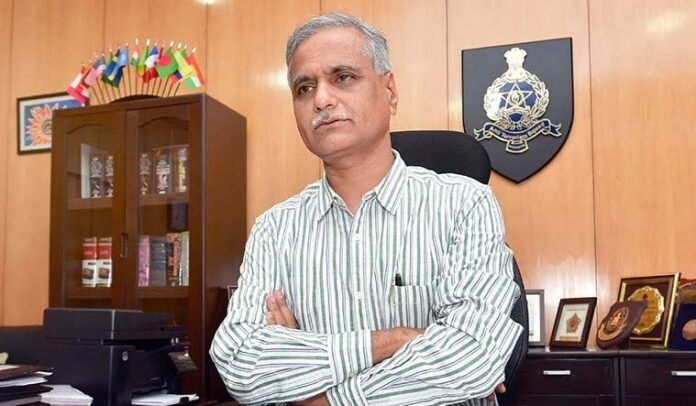
When a former Intelligence Bureau officer with eleven years in the service sits down for a long, unguarded conversation, the result should be treated as primary-source material. Atul Chandra Kulkarni’s appearance on Jayesh Gangan’s Awara Musafir podcast is exactly that, an on-the-record walk through 26/11, David Headley, Ajmal Kasab, radicalisation, de-radicalisation and terror financing by an officer who interrogated and litigated many of these cases himself.
The frustration of the episode is that the format could not carry its cargo, meaning the interviewer, for all his youthful enthusiasm, time limit and public appeal for informal storytelling, yet rightfully for public’s need-to-know expanse, touch surfaced only a limited version of what the senior officer knows.

What follows is an attempt to mine the deeper seams, the operating lessons for police and intelligence that lie between the lines. Kulkarni’s factual assertions are his own recollection and should be read as a testimony rather than a settled record; the value here is in the tradecraft, not the anecdotes.
The Jigsaw, Not the “Failure”
Kulkarni’s most portable idea is his reframing of intelligence work as a jigsaw assembled from too few pieces. You are handed five of ten pieces, he says, and must extrapolate the picture; the clean cinematic input, date, time, place, is a “jackpot” that almost never arrives.
Systemic failures stem from poor internal collation rather than bad collection, making a transition from “need to know” to “need to share” vital since foreign intelligence is rarely reliably shared
This is not a folksy analogy but a precise correction to the public and political vocabulary of “intelligence failure”. The system is built to operate on incomplete data; the breakdown, when it comes, is usually not of collection but of collation, the joining of scattered fragments into a picture in time to act.
26/11 is his exhibit: rehearsals of deep-water swimming, a sea-borne threat, Leopold and the Taj as targets, all sitting as disconnected shards. The Ram Pradhan Committee said as much. The corrective India adopted, the present Home Ministry’s insistence on replacing “need to know” with “need to share”, is the single most important institutional lesson in the conversation.

But practitioners should note how the officer extends the logic outward: liaison between countries, he warns, is a game in which “two plus two seldom equals four.” Public diplomacy and private intelligence cooperation are decoupled, the Austrian-grenade analysis withheld until after 26/11, and Pakistani help that turned “prompt” only once the cameras rolled, are his evidence.
The takeaway is uncomfortable but clarifying, i.e. fusion must be engineered internally, because it will never be reliably donated from outside.

The War Machine and the Manufacture of a Weapon
The most human moment in the interview is also its most analytically loaded. Kasab, Kulkarni recalls, showed no remorse, not because he was exceptionally evil but because he had been converted into a “war machine”, drilled to fire and to feel pride in firing.
Operatives like Kasab are systematically manufactured into emotionless “war machines”, proving agencies must disrupt the upstream radicalisation process rather than simply reacting to finished bombers
Keeping him alive, and granting him the due process that so offended public sentiment, was not sentimentality; it was an evidentiary and diplomatic imperative, the only way to prove on the record that the attack was manufactured in Pakistan.
Here the account deserves an addition the officer does not quite made explicit. If Kasab was a machine that was built, then radicalisation is the assembly line, and dehumanisation is its product as much as its method, the recruit is stripped of self before he is asked to strip others of life.
That link, between the psychological hollowing-out of the operative and the ideology that hollows him, is rarely examined in Indian counter-terrorism, which tends to treat the finished bomber as the problem, rather than the process that produced him. The lesson for agencies is to move the point of intervention upstream, to the manufacture, not merely the manufactured.
The Tanzeem Paradox
Kulkarni is impatient with organisational labels, and rightly so. Jaish, Lashkar, Hizbul, Al-Badr, Tehreek-ul-Mujahideen, in his telling, these are fewer rival ideologies than franchises under a corporate umbrella, the United Jihad Council, coordinated for deniability and assigned territory by capability: Jaish for the north, Lashkar for the wider country.
Ban a tanzeem (organisation) and another is spawned overnight; “the name does not matter”. This is the single most useful insight for attribution work, and it maps directly onto what India’s courts are now testing in the Pahalgam prosecution, where the state must show that The Resistance Front is not a home-grown novelty but Lashkar wearing a local mask.
Operatives increasingly originate from educated, white-collar backgrounds via digital funnels, requiring state agencies to counter-radicalisation as an ongoing national-security campaign rather than an isolated criminal file
The corollary for the practitioner is that proscription which chases names is a treadmill; what must be targeted is the durable infrastructure beneath the labels, the handlers, the training pipelines and, above all, the money. A front is not a firewall, and a new acronym is not a new enemy.
Radicalisation as a Full-Spectrum Operation
The officer’s account of radicalisation should be a required reading, precisely because it dismantles the madrassa stereotype. The radicalised, in his experience, are as often engineers from Pune or doctors in a “white-collar” module as the stereotyped seminary student; the Red Fort episode, which he reads as a far larger plot disrupted at the cost of one blast, featured a doctor as a suicide operative.
The method has migrated from the offline model into physical spotting, profiling, travel to PoK for training, to an online and then dark-net funnel, complete with narratives of a global war on Islam, the Dar-ul-Kufr and Dar-ul-Islam binary, bot-driven grooming, and a distinct track for recruiting women.
This is a full-spectrum operation that exploits every surface of modern connectivity. The inference practitioners should draw is jurisprudential as much as tactical: radicalisation handled purely as a discrete crime, a file to be charged and closed, will always lag an adversary who treats it as a phased campaign.
The Popular Front’s proscribed 2047 blueprint, with its staged progression toward a claimed Islamic order, is exactly the kind of long-horizon political-military design to which a close-the-file mindset is structurally blind.
Beyond tracing attack-specific funds, security apparatus must target ambient, community-embedded financial flows – such as fake charities or repurposed payment rails – that continuously fund radicalisation and grooming
It is more honestly met as a national-security matter, the conspiracy and unlawful-association provisions of the penal code reach here, with lone-wolf self-radicalisation, whose plot lives only inside one head, as the outer limit of the problem.
The Seam Nobody Funds: Financing
If the interview has a genuinely under-served subject, it is terror financing, and this is where the officer’s catalogue is richest and where India’s analytical attention is thinnest.
He sketches a web: hawala and cryptocurrency; crowdfunding whose danger is anonymity (fifty rupees from each of two hundred thousand donors, or five hundred a head to stone-pelters, none of it traceable); over-invoicing concealed inside cross-LoC barter; even medical-college seats in Pakistan awarded to the children of dead militants as a laundered form of reward, and dating-site subscriptions repurposed as payment rails.
Against this he ranges the countermeasures, the FCRA’s single-window discipline through one designated bank branch, the No Money for Terror ministerial India hosted, the FATF review process, the digitisation of banking after 2001.
The sharper point, which deserves to be pressed harder than the podcast allowed, is that Indian counter-financing remains fixated on the financing of attacks while neglecting the financing of radicalisation, the slow, ambient, often community-embedded money that sustains preachers, networks and grooming long before any device is assembled.
Effective de-radicalisation hinges on community-centered models incorporating psychologists, family, clergy and economic rehabilitation, backed by academic-practitioner integration to institutionalise field tradecraft
Obligatory-giving streams that present themselves as charity demand study as radicalisation infrastructure, not merely as suspicious transactions. That this line of research has struggled for years to find institutional sponsorship is itself a finding: the state is resourced to trace the rupee that buys the detonator, far less the one that builds the mindset.
De-radicalisation, Capability and the Missing Academy
The most encouraging portion of the conversation is also the least publicised in the Indian discourse: de-radicalisation as restoration rather than mere prevention.
Kulkarni describes a four-element model, police in the background, psychologist, clergy and family, layered over economic rehabilitation through existing self-employment schemes, with hundreds of youths trained and a majority running ventures by the time he left the posting.
He is candid that results are mixed and relapse real, and that prison, chronically overcrowded, is itself a radicalisation multiplier best mitigated by isolating hardened elements and by video-linked court appearances that cut physical mingling.
The unglamorous truth is that the most effective counter-terrorism is neither kinetic nor purely legal but community-centred, fitting, since the community is also where grooming and its financing incubate.
The same sobriety governs his answer to the populist demand for American-style strikes on terror leadership: India is not the United States, lacks the global operational footprint and the strategic depth to reach Karachi and return, and is better served by calibrated responses that place responsibility squarely on the adversary.
That is realism, not timidity, and it is the honest complement to the legal and financial pressure India is now building against the same leadership.
Which returns us to the interview’s real, unstated lesson. India’s counter-terrorism knowledge sits in the heads of a handful of veterans like Kulkarni and a smaller number of specialised academics, and it is transmitted, if at all, through podcasts and passed files rather than through institutions.
The officer’s own aside, that adversary states treat their universities as intelligence nurseries, is a rebuke India should feel.
Treating radicalisation as a national-security campaign, funding the study of its financing, and fusing practitioner tradecraft with academic rigour are not soft accompaniments to the hard work. They are the hard work. The masterclass was there in the conversation. The task for police and intelligence is to stop letting it disappear between the lines.

The writer is an expert on geopolitics, national security, and counter-terrorism; and he regularly contributes his subject thought-leadership and academic commentary with several publications in newspapers, journals, and periodicals. He works with investigative agencies, regulatory bodies, financial institutions and enterprises, providing strategic and regulatory advisory. The views expressed are personal and do not necessarily carry the views of Raksha Anirveda





